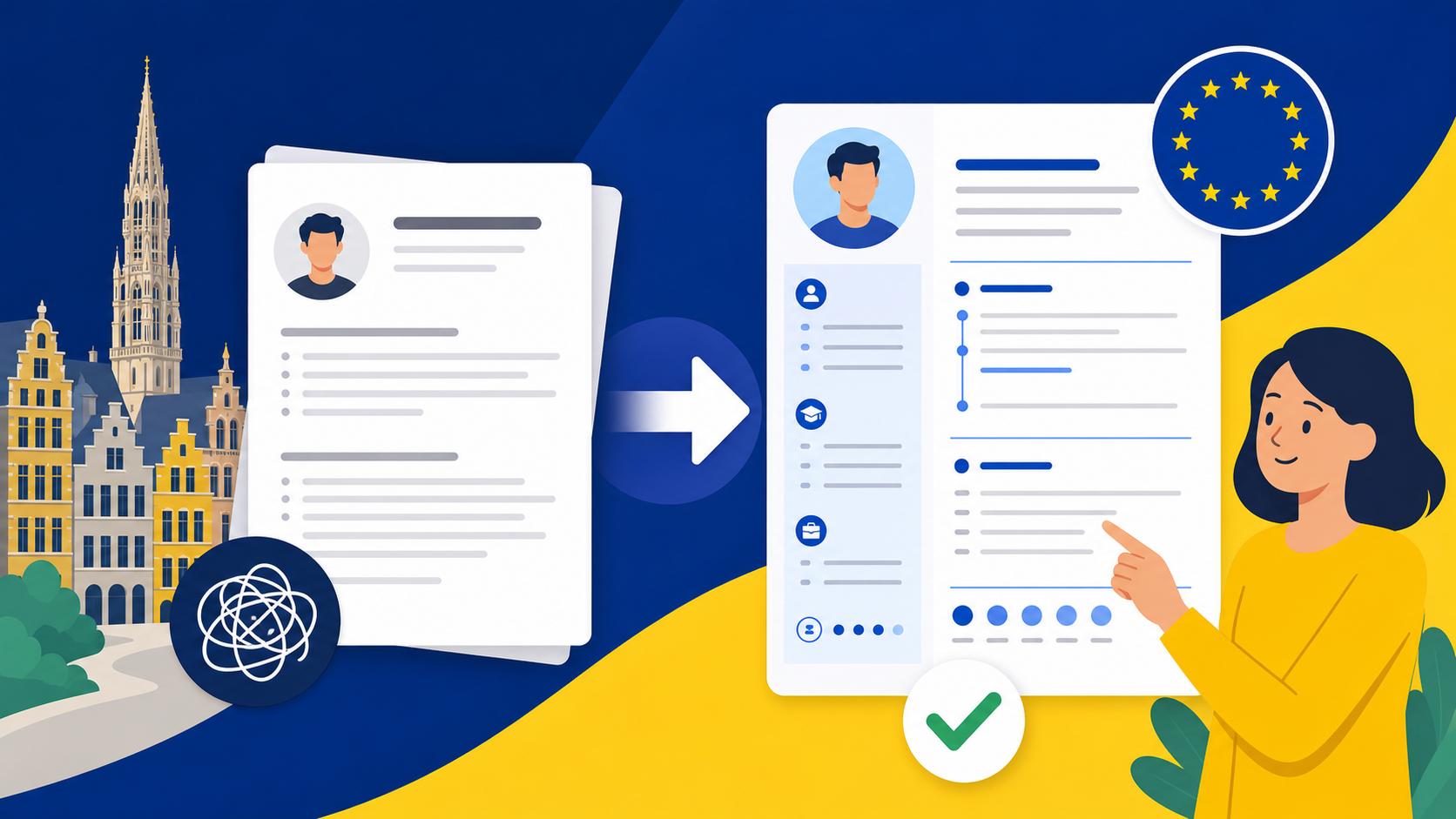
How to Translate Your Resume into a Belgian Europass Format
You have been sending out dozens of applications through LinkedIn and local job boards, but the silence from Belgian recruiters is deafening. I remember sitting in a rainy cafe in Brussels five years ago, staring at my perfectly polished American resume, wondering why nobody would even give me an introductory phone call. This guide solves the mystery of the Belgian recruitment filter by teaching you exactly how to rebuild your professional identity using the Europass format.
Why Your International Resume is Getting Filtered Out
The Belgian job market is unique because it sits at the crossroads of several European administrative traditions. Unlike the "one-page" rule often found in the United States or the narrative-heavy styles seen in the UK, Belgian recruiters, particularly in the public sector and large multinational corporations, have a deep-seated affinity for the Europass structure. If your resume looks like a creative design project rather than a standardized document, it might not even make it past the initial automated screening tools.
When I first arrived, I didn't realize that Working in Belgium as an Expat: Jobs, Culture, and Hiring (2027) requires a specific level of transparency. A Belgian CV isn't just a list of what you did; it’s a standardized map of your competencies. Recruiters here are looking for specific data points—your language levels, your specific technical certifications, and even your mobility status. If these aren't in the "standard" places where a recruiter expects to see them, they will move on to the next candidate in less than six seconds.
Furthermore, Belgium is a country of strict standards. Whether you are applying for Tech and Engineering Jobs in Flanders (Antwerp, Ghent, Leuven) or an administrative role in Wallonia, the Europass format provides a "neutral" ground. It levels the playing field for foreigners by using the Common European Framework of Reference for Languages (CEFR), which tells a recruiter exactly what "Intermediate" means without any ambiguity.
The Step-by-Step Anatomy of a Belgian Europass CV
The Europass is more than just a template; it is a logical flow of information. You shouldn't just copy-paste your old resume into the online builder. You need to translate the intent of your experience into the Belgian context.
The Personal Information and the Photo Question
In the header of your Belgian Europass, you need the basics: name, address, phone number, and email. However, there are two local nuances. First, if you already have a Belgian national number, it can be helpful to indicate that you are already a resident, as this simplifies the Single Permit (Gecombineerde Vergunning) Overview for 2027 process for the employer.
Second is the photo. In many countries, putting a photo on a CV is a major faux pas. In Belgium, it is quite common, though not strictly mandatory. If you choose to include one, it must be a professional headshot—no "vacation crops." I’ve seen many expats struggle with this decision, so I highly recommend reading up on Should You Put a Photo on a Belgian CV? Pros and Cons to decide what fits your specific industry best. Generally, for client-facing roles in Brussels, a photo is often expected.
Work Experience: Focus on Achievements and Context
In the work experience section, Belgians prefer a reverse-chronological order. However, they are very interested in the type of company you worked for. Was it an ASBL (non-profit) or an NV/SA (corporation)? If your previous employers were outside of Europe, briefly describe the company’s size and industry.
Don't just list tasks. Use bullet points to describe outcomes. If you managed a budget, mention the amount in Euros. If you increased efficiency, give a percentage. Recruiters here are practical; they want to see how your previous experience will directly impact their bottom line or their organizational goals. This is especially true if you are aiming for roles that offer high-level benefits like Meal Vouchers (Cheques Repas): How This Employee Benefit Works.
Education and the Recognition of Degrees
This is where many expats get stuck. You cannot simply list "Bachelor of Arts." You should ideally mention the equivalent European Qualification Framework (EQF) level. If you are in a regulated profession (like nursing, engineering, or teaching), you may need to go through the process of Getting Your Foreign Degree Recognized by NARIC Flanders/Wallonia. In your Europass, clearly state if your degree recognition is "in progress" or "completed." This shows the recruiter you understand the Belgian legal requirements.
Proving Your Language Proficiency the European Way
Belgium is a trilingual country, and your resume must reflect your ability to navigate this. Simply saying you are "fluent" in English or "good" at French is not enough. The Europass format uses the CEFR grid (A1, A2, B1, B2, C1, C2).
If you are currently at an A2 level in Dutch but aiming for a job in Antwerp, show that you are actively improving. I found that mentioning specific tools I used, such as DutchPod101, helped prove my commitment to integration. For those looking for work in Brussels or Wallonia, using resources like FrenchPod101 to reach a B2 level can be the difference between getting an interview and being ignored.
If you find that your language skills are holding you back during the screening process, consider platforms like Lingoda to get a formal certificate of your level. This certificate can be uploaded as an annex to your Europass, providing concrete proof of your skills. Remember to consult our guide on Do I Need to Speak French or Dutch to Work in Belgium? to see the specific requirements for your sector.
| Feature | International/US Style | Belgian Europass Style |
|---|---|---|
| Length | Strictly 1 page | 2 to 3 pages is acceptable |
| Photo | Strongly discouraged | Very common and often expected |
| Languages | Narrative (e.g., "Fluent") | CEFR Levels (e.g., "B2") |
| Date of Birth | Never included | Frequently included |
| Structure | Flexible/Creative | Standardized Blocks |
| Personal Interests | Minimal | Highly valued (shows cultural fit) |
Highlighting Digital and Soft Skills for the Market
The Belgian market is increasingly focusing on digital transformation. The Europass format has a dedicated section for "Digital Skills." Do not leave this empty. List the specific software you are proficient in, but also mention any modern project management methodologies like Agile or Scrum.
If you have taken online courses to pivot your career, ensure they are listed under the "Certifications" or "Education" section. Belgian employers highly respect continuous learning. If you have completed specialized tracks on Coursera or Udemy, list them clearly with the date of completion. This is particularly relevant if you are moving into a new field and need to show that you have the theoretical knowledge to back up your lack of local experience.
When describing your "Soft Skills," avoid clichés. Instead of saying you are a "team player," describe a situation where you collaborated across departments. In Belgium, where "polder model" consensus-seeking is common in Flanders and a more hierarchical but communicative style exists in Wallonia, showing you can adapt to different work cultures is vital. You can learn more about these nuances in our article on French vs Dutch: Which Language is Better for Your Belgian Career?.
Final Polish: Tailoring Your Resume for the "Itsme" Era
By 2026, the Belgian recruitment process has become highly digitized. Many companies will ask you to upload your Europass XML file directly into their systems. This allows them to parse your data instantly. Always keep both a PDF version for human eyes and the XML version for the machines.
Before you hit send, check the following:
- The Language of the CV: If the job ad is in Dutch, your CV should be in Dutch. If it's in English, English is fine, but a bilingual French/English or Dutch/English CV is a power move in Brussels.
- The Formatting: Ensure there are no broken lines or weird font changes. The Europass online editor can be finicky; always download the preview.
- The Contact Details: Make sure your Belgian phone number is correct. If you don't have one yet, get a local SIM as soon as possible.
Once your resume is ready, you'll need to prepare for the next step. Belgians love a multi-stage interview process, often involving a technical test and a cultural fit interview. To get ahead, start practicing with Common Interview Questions at Belgian Tech Companies. Understanding the local mindset will help you explain why you are the best fit, not just on paper, but in the office.
Finally, remember that the resume is just the foot in the door. Once you land that job, the administrative fun really begins—from signing your contract to How to Read Your First Belgian Payslip (Fiche de Paie). But for now, focus on that Europass. It is your passport to a professional life in the heart of Europe.
Disclaimer
This guide is for informational purposes only and reflects the personal experiences and research of the author regarding the Belgian job market in 2026. Recruitment practices can vary significantly between industries and regions (Flanders, Wallonia, and Brussels). Always verify specific employer requirements and consult with a legal professional or immigration expert regarding work permits and residency status.