Registering at the Crossroads Bank for Enterprises (CBE/BCE)
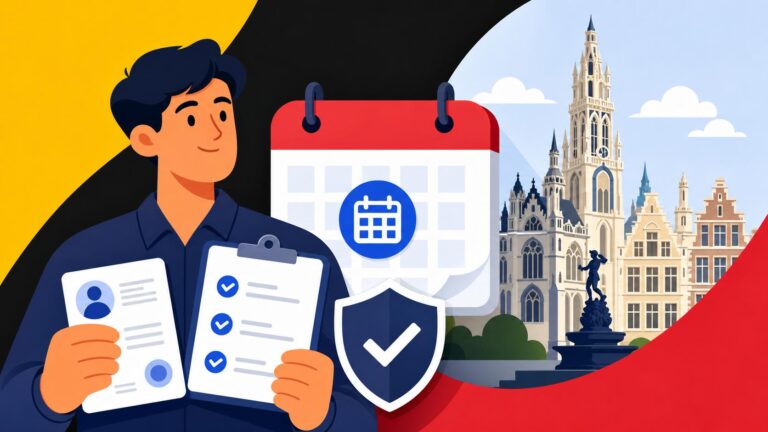
Walking into a social security office or an enterprise counter in Brussels or Antwerp for the first time feels like entering a labyrinth where the minotaur is made of paperwork. I remember sweating over my laptop, wondering why a "bank" was asking for my degree instead of my money. This guide simplifies the CBE/BCE registration so you can launch.
What Exactly is the Crossroads Bank for Enterprises
One of the most common points of confusion for new arrivals is the name itself. In English, we call it the Crossroads Bank for Enterprises (CBE). In French, it is the Banque-Carrefour des Entreprises (BCE), and in Dutch, it is the Kruispuntbank van Ondernemingen (KBO). Despite the word "bank" being in the title, let me be very clear: this is not a place where you store money, apply for a mortgage, or get a credit card.
The CBE is a massive, centralized database managed by the Federal Public Service Economy. It serves as the single point of truth for every business entity operating in Belgium. When you register, you receive a unique enterprise number. This ten-digit code is essentially your business's identity card. From the moment you have it, every government department—from the tax office to the social security portal—will use this number to track your activities.
I remember the relief of finally getting my number, thinking the hard part was over. In reality, the CBE is just the "hub." Once your data is in there, it radiates out to all other administrative branches. It’s designed to make life easier by ensuring you don't have to provide the same information to five different agencies, but the initial setup requires precision. If you're just starting to look at the legalities, I highly recommend reading about Freelancing and Self-Employment in Belgium: Legal Setup and Taxes to understand the bigger picture before you dive into the database registration.
Who is Required to Register at the CBE
If you plan on earning even a single Euro as a self-employed person in Belgium, the law generally requires you to be registered in the CBE. This applies to a wide variety of people, from the consultant working out of a co-working space in Ixelles to the person opening a specialty coffee shop in Ghent.
The requirement is tied to your status as an "Enterprise." In the eyes of the Belgian state, an enterprise isn't just a big corporation; it’s any individual or group performing an economic activity. This includes:
- Sole Traders (Indépendants/Zelfstandigen): This is the most common path for expats. You and your business are the same legal entity.
- Companies (Sociétés/Vennootschappen): Such as an SRL (French) or BV (Dutch). Here, the business is a separate legal entity.
- Non-Profit Organizations: Even an ASBL/VZW often needs a CBE number if they perform certain types of activities.
The timing is also critical. You must register before you start your activities. You cannot legally send an invoice or even buy professional equipment with the intent of deducting it from your taxes until this registration is active. If you are currently working a 9-to-5 but want to start a side hustle, you should look into Understanding 'Indépendant à Titre Complémentaire' (Side Hustle) to see how the CBE registration interacts with your existing employment contract.
The Essential Pre-Registration Checklist
Before you head to an enterprise counter or log in via Itsme, you need several things in order. If you show up missing one of these, the agent will politely (or sometimes not-so-politely) tell you to come back another day. I learned this the hard way after waiting three weeks for an appointment only to realize my bank account wasn't "professional" enough.
A Belgian Professional Bank Account
You cannot use your personal savings account for your business. The law requires a dedicated account opened with a Belgian bank (or a recognized European branch) specifically for your business transactions. This account number must be entered into the CBE database during registration. If you haven't sorted this yet, check out our guide on Opening a Belgian Bank Account: Documents Needed and Roadblocks.
A Valid Residence Permit or eID
To access the digital registration portals or to prove your identity at a physical office, you need your Belgian eID card. If you are a non-EU citizen, your residence permit must allow for self-employed work. This is a common hurdle for those on specific restricted visas.
Proof of Professional Competence
This is where it gets "Belgian." For many years, everyone had to prove "basic management knowledge" with a diploma. Thankfully, Flanders abolished this requirement for most professions. However, in the Brussels-Capital Region and Wallonia, certain "regulated" professions (like architects, some construction trades, or healthcare providers) still require specific proof of competence or a recognized degree. If your degree is from outside the EU, you might need a formal equivalence check first.
Choosing an Enterprise Counter (Guichet d'Entreprises)
The CBE is a government database, but the government doesn't allow you to type your info into it directly. You must go through a "Guichet d'Entreprises" (Enterprise Counter). These are private organizations authorized by the state to handle the registration for you. Think of them as the gatekeepers.
Common providers include Acerta, Xerius, Liantis, Partena, and UCM. It doesn't strictly matter which one you choose, but most expats pick the one that has an office nearest to them or offers the best English-language support. I personally chose one based on their online portal's ease of use. These counters charge a fixed fee (indexed annually) to register your business in the CBE.
During the meeting, the agent will ask for your "NACE" codes. These are codes that describe exactly what your business does. Be broad here. If you are a graphic designer but think you might do some copywriting or social media management later, add those codes now. Adding them later usually incurs an extra fee. If you need to sharpen your skills to match these codes, platforms like Udemy or Coursera are excellent for getting those specific certifications that can help justify your NACE selections.
The Registration Process: Step by Step
Once you have your bank account and your NACE codes ready, the process follows a predictable, if slightly tedious, path.
- Identity Verification: You will log in to the provider's portal using the Itsme app or an eID card reader.
- Company Data Entry: You’ll provide your business name (for a sole trader, this is usually just your own name), your business address (usually your home address for freelancers), and your start date.
- Bank Account Linkage: You input the IBAN of your dedicated professional account.
- Payment of the Fee: You pay the registration fee (currently around 105 to 110 EUR).
- Obtaining the Number: Once processed, you receive your 10-digit enterprise number immediately or within a few days via email.
However, getting the number is only the first half of the battle. The second half is the VAT (TVA/BTW) activation. Your CBE number is just a number until the VAT office "activates" it. You can usually ask the Guichet d'Entreprises to do this for you for an additional fee, or you can do it yourself for free if you are brave enough to navigate the MyMinfin portal. For more on this, see Applying for a VAT Number (TVA/BTW) as a Freelancer.
Costs and Timelines for 2026
Budgeting for your launch is vital. Belgium is not the cheapest place to start a business, but the costs are transparent. Here is a breakdown of what you can expect to pay during the CBE registration phase.
| Item | Estimated Cost (2026) | Timeline |
|---|---|---|
| CBE Registration Fee | €106.50 | 24 – 48 Hours |
| VAT Activation (via Guichet) | €60 – €80 | 3 – 7 Days |
| Professional Bank Account | €0 – €10/month | 1 – 2 Weeks |
| Social Security Registration | Free (Admin only) | Immediate |
| Province/Commune Tax | €50 – €150/year | Annual bill |
Keep in mind that these are just the setup costs. Once you are active, you will need to worry about Social Insurance Funds for Freelancers (Xerius, Acerta, Partena) and your quarterly tax filings.
Managing the Language Barrier
The CBE registration and the subsequent interactions with your Guichet d'Entreprises will almost certainly happen in French or Dutch. While many agents speak excellent English, the legal documents you sign and the portals you use will be in the national languages.
I can’t emphasize enough how much a little language preparation helps. You don't need to be fluent, but knowing terms like maison communale, siège social, or précompte professionnel will save you from a lot of anxiety. If you have a few weeks before you register, I suggest using Lingoda for an intensive business-focused sprint or FrenchPod101 and DutchPod101 for learning the specific vocabulary of Belgian administration. It’s the difference between feeling in control and feeling like you’re just signing things blindly.
What Happens After You Get Your Number
The moment you have that 10-digit number, you are officially a "boss" in the eyes of the Belgian state. But with great power comes a lot of mail. Within the first two weeks of registration, you will receive several "official-looking" letters.
- The Social Fund: You must join a social insurance fund to pay your quarterly contributions. If you don't choose one, you will be automatically assigned to the National Auxiliary Fund (National Kas), which isn't always the most user-friendly for expats.
- The Scams: Be very careful. Scammers scrape the CBE database (which is public) and send fake invoices that look like official "registration fees" for "business directories." If the letter doesn't come from your chosen Guichet or the FPS Economy, bin it.
- Invoicing: You can now start Invoicing Clients in Belgium: Legal Requirements for Freelancers. Your CBE number and VAT number must be clearly visible on every document you send.
If you are a high-earner or a specialized researcher, you might also want to look into tax optimizations like The 30% Ruling Alternative: Conditions for Belgium's RSMI Expat Regime once your CBE registration is finalized.
Final Veteran Tips for a Smooth Registration
If I could go back and talk to my "new-to-Belgium" self, I would offer three pieces of advice. First, don't rush the start date. If you register on the 28th of the month, you might be liable for a full quarter of social security contributions just for those three days of activity. Try to time your start date for the beginning of a quarter (January, April, July, October).
Second, use your Guichet d'Entreprises as a resource. You are paying them a fee; don't be afraid to ask them questions about your NACE codes or your VAT obligations. They have seen every possible expat scenario and can often spot an error in your application before it becomes a legal problem.
Third, stay organized. Create a folder (digital and physical) for everything related to your CBE number. You will be asked for your "Attestation d'inscription" more times than you can count—when signing an office lease, getting a professional phone plan, or even just buying a "Metro" card for bulk groceries. For a deep dive into the broader requirements, our pillar guide on Setting Up as an Independent (Indépendant) in Belgium is the perfect next step.
Disclaimer
This guide is for informational purposes only and does not constitute legal, financial, or tax advice. Belgian administrative rules, fees, and requirements for the Crossroads Bank for Enterprises (CBE/BCE) are subject to frequent changes and regional variations between Flanders, Wallonia, and Brussels. Always consult with an official Guichet d'Entreprises, a qualified accountant, or a legal professional before initiating your business registration to ensure compliance with the most current 2026 regulations.