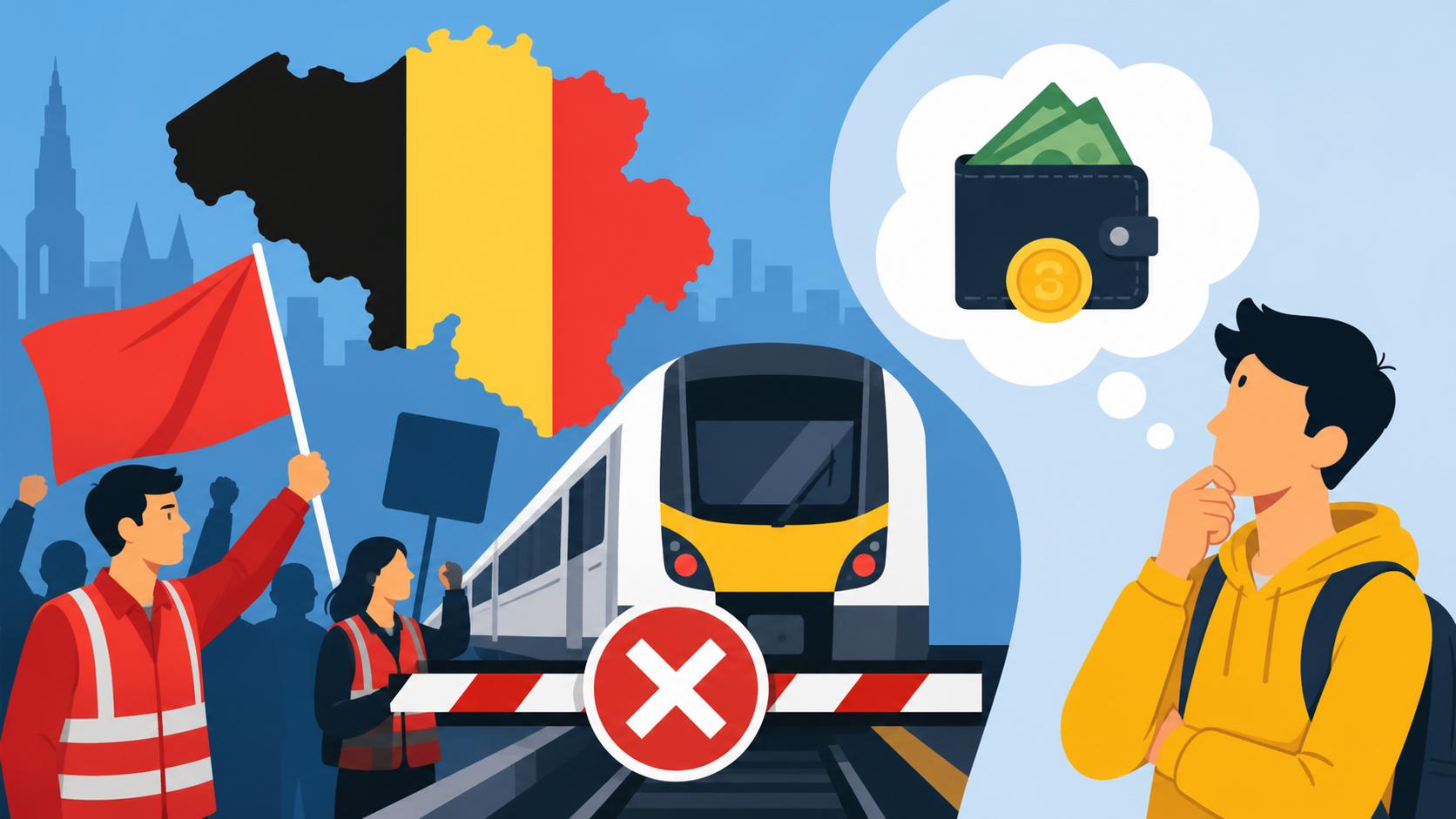
Striking in Belgium: Do You Get Paid When Trains Stop?
The morning you wake up to a "grève" notification on your phone is a rite of passage for every foreigner living in Belgium. I still remember the first time I stood on a freezing platform at Gare du Nord, staring at a sea of red "Sprimé" signs while my boss expected me in the office for a 9:00 AM presentation. This guide breaks down the complex intersection of Belgian labor law and transport strikes to ensure you know exactly where you stand regarding your paycheck when the trains inevitably stop.
The Reality of the Belgian Strike Culture
Belgium has a deeply ingrained culture of social dialogue, which often manifests as a strike, or "grève" in French and "staking" in Dutch. While these disruptions are frustrating, they are a fundamental part of the Belgian social model. Usually, the national rail operator, SNCB/NMBS, or the regional bus and tram networks like STIB/MIVB in Brussels and De Lijn in Flanders, provide a minimum service. However, "minimum" often means one train every three hours, leading to overcrowded platforms and significant delays.
Understanding why these strikes happen can help take the edge off the frustration. Most often, they are organized by the major Trade Unions in Belgium (CSC, FGTB, CGSLB) to protest changes in pension age, working conditions, or the Indexation of Salaries in Belgium. Because these unions are powerful and have high membership rates, a strike call is almost always followed by significant participation. As an expat, your first priority is to understand how this affects your legal obligation to show up at your desk.
Do You Get Paid if You Cannot Reach the Office
The short answer is usually no, but the legal nuance is where things get interesting. In Belgian labor law, the general principle is that the employer must pay you for "guaranteed daily wage" only if you were fit for work, started your commute normally, and were prevented from reaching work by a cause that occurred on your way to the office—provided that cause was independent of your will.
The catch with transport strikes is the "unforeseen" element. Most strikes in Belgium are announced days, if not weeks, in advance. This means they are technically foreseeable. Because you had prior warning, the law assumes you should have made "reasonable efforts" to find an alternative. If you simply stay home and tell your boss the trains aren't running, you are technically in a situation of "unjustified absence" and the employer is not legally required to pay you for those hours.
However, many expats find that Belgian Work Culture: Bilingual Workplaces, Meetings, and Hierarchy is more flexible than the strict letter of the law suggests. Most modern contracts, especially for white-collar workers (employés), include provisions for remote work. If you can perform your duties from home, your pay remains unaffected. The conflict usually arises for those in roles that require a physical presence, such as retail, healthcare, or hospitality.
The Concept of Force Majeure in Transport
In legal terms, "force majeure" refers to an external, unforeseeable event that makes it impossible to fulfill a contract. A sudden, wildcat strike (one not announced in advance) might qualify as force majeure. In such a case, if you are stuck at a station with no way forward and no way to have planned an alternative, you might be entitled to your daily wage.
But for a standard, announced strike, you are expected to look at alternatives. This might include carpooling, taking a different bus route, or even biking if the distance is manageable. If you have a Company Cars, Mobility Budgets, and Bikes arrangement, your employer might point out that you have the tools to circumvent the rail network.
If you truly cannot find a way in and teleworking isn't an option, you can negotiate with your employer to take a day of "recuperation" (overtime hours) or a day of annual leave. This ensures you still get paid, even if it burns one of your precious vacation days. It is always better to reach out to HR or your manager the night before the strike to agree on this, rather than waiting until you are already late.
Practical Solutions and the Mobility Budget
In recent years, the Belgian government has pushed for more flexible transport options. If you find yourself frequently paralyzed by rail strikes, it might be time to discuss Understanding the Mobility Budget Alternative to Company Cars with your HR department. This budget allows you to spend your "car money" on various sustainable transport options, including e-scooters, shared bikes like Villo or Billy, or even international train tickets.
During a strike, having a subscription to a car-sharing service like Cambio or Poppy can be a lifesaver. These are often integrated into the mobility budget. Additionally, if your office is in a major hub like Brussels or Antwerp, you might find that while the SNCB is on strike, the local STIB/MIVB or De Lijn drivers are not. Using the Mobib Card: How to Load Tickets for All Belgian Transport ensures you can quickly pivot from a cancelled train to a regional bus without fumbling for cash or new apps.
If you are stuck at home and your work is caught in a lull because your colleagues also can't make it, it is a great time to invest in your professional development. I often use these "strike days" to catch up on certifications through platforms like Coursera or Udemy, which are highly valued by Belgian employers during year-end reviews.
Language Barriers and Staying Informed
One of the biggest hurdles for expats during a strike is the lack of real-time information in English. While the SNCB app is fairly good, the deep details of which lines are running "minimum service" are often buried in French or Dutch news reports. This is where French vs Dutch: Which Language is Better for Your Belgian Career? becomes a practical question rather than an academic one.
To stay ahead of the chaos, you should follow the social media accounts of the transport providers. They post updates frequently. If your language skills are still a work in progress, using a tool like DutchPod101 or FrenchPod101 can help you decode those "storing" (disturbance) and "vertraging" (delay) announcements over the PA system. I’ve found that even a basic grasp of the vocabulary used in Brussels Transport (STIB/MIVB): Metros, Trams, and Bus Networks can save you thirty minutes of standing on the wrong platform.
What Happens if You Are the One Striking
If you are a member of a union and you decide to participate in the strike yourself, you will not receive your salary from your employer. Instead, you receive a "strike indemnity" or strike pay from your union. This is a flat daily rate that helps cover your lost income.
To be eligible for this, you generally need to have been a member of the union for a minimum period, usually six months. If you are considering joining one of the Trade Unions in Belgium (CSC, FGTB, CGSLB): Should You Join?, this is one of the primary benefits people consider. However, for most expats in "management" or "specialist" roles, striking is less common than it is in the industrial or transport sectors.
| Scenario | Pay Status | Action Required |
|---|---|---|
| Announced Strike (Can't get to work) | Not Paid | Negotiate WFH or use a vacation day. |
| Wildcat/Unannounced Strike | Potentially Paid | Prove you started the journey and were blocked. |
| Working From Home during Strike | Fully Paid | Ensure your manager approves the remote day. |
| Participating in the Strike | Paid by Union | Must be a registered union member. |
| Technical Train Breakdown (Not a Strike) | Fully Paid | Get a "delay certificate" from the station master. |
Negotiating with Your Employer
The key to surviving strike culture in Belgium is proactive communication. Belgian managers generally value transparency over "heroic" attempts to show up three hours late. If a strike is announced, send an email or a message via your company's internal platform immediately.
Referencing your Working From Home (Télétravail) Allowances in Belgian Contracts can provide a solid foundation for your request. Most contracts nowadays allow for 1 to 3 days of remote work per week. Moving your "office days" to avoid the strike dates is the most common and accepted solution.
If your employer is particularly traditional and insists on physical presence despite the lack of trains, you might want to look into Handling Discrimination in the Belgian Recruitment Process or general workplace rights if you feel you are being unfairly penalized for something outside your control. While the employer doesn't have to pay you if you aren't there, they also cannot legally fire you for a single instance of being unable to reach work due to a national strike, provided you communicated the situation clearly.
Staying Productive During Disruptions
If you are stuck on a train that is moving at a snail's pace or waiting an hour for a bus, use that time effectively. Many expats use their commute to brush up on local languages using apps like Lingoda, which offers structured lessons that can fit into those unexpected gaps in your schedule.
If the strike means you are working from home and things are quiet, consider browsing Top Job Boards and Recruitment Agencies for Expats in Belgium to see how your current salary and benefits package compare to the market. Sometimes, the frustration of a difficult commute is the nudge you need to find a role closer to home or one with a more generous Mobility Budget Alternative to Company Cars.
Summary of Commuter Rights
Remember that your primary protection is your employment contract and the collective bargaining agreements (CBA) of your specific sector, known as the "Joint Committee." If you are under Joint Committee (Commission Paritaire/Paritair Comité) 200, which covers a huge number of white-collar workers, there are specific norms regarding work flexibility.
Always get a "certificate of delay" if you do eventually make it to work late. You can often download these directly from the SNCB website or app. While it doesn't force your boss to pay you for the lost hour, it serves as professional proof that you made the effort, which goes a long way in maintaining a good relationship with your Belgian colleagues.
Disclaimer
This guide is for informational purposes only and does not constitute legal or professional advice. Belgian labor laws and transport regulations are subject to change and can vary significantly based on your specific employment contract, sector (joint committee), and regional regulations. Always consult with your HR department, a legal professional, or your trade union representative regarding your individual situation.