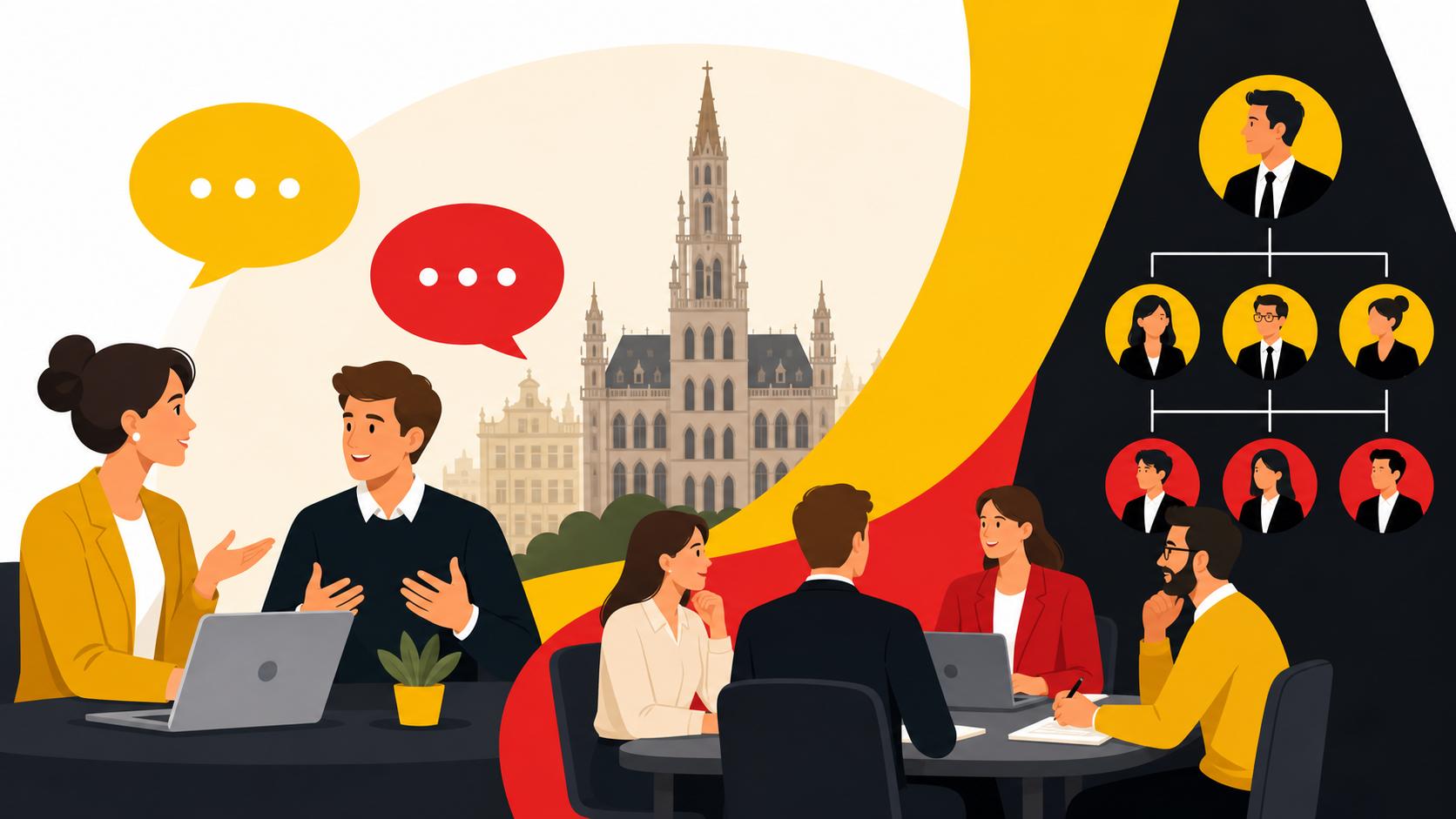
Belgian Work Culture: Bilingual Workplaces, Meetings, and Hierarchy
Navigating the "invisible" social rules of a Brussels office is often significantly harder than the technical requirements of the job itself. I remember my first week sitting in a departmental meeting where my colleagues switched between three languages seamlessly while I just stared at my coffee, terrified to say "bonjour" in case the office was strictly Dutch-speaking that day. This guide solves the Belgian workplace puzzle by deconstructing the linguistic tightrope, the subtle hierarchy, and the social etiquette you need to thrive.
The Linguistic Tightrope: Navigating Bilingualism in the Workplace
Belgium’s linguistic divide is not just a political talking point; it is a daily reality that dictates how you answer the phone, write an email, and interact at the coffee machine. In a country split into French-speaking Wallonia, Dutch-speaking Flanders, and the officially bilingual Brussels-Capital Region, the language you choose acts as a social signal. For an expat, this can feel like walking through a minefield where every "dank u" or "merci" carries weight.
The Brussels Bubble vs. Flanders and Wallonia
In Brussels, the workplace is a melting pot where French is the lingua franca, but English is rapidly becoming the bridge between Dutch and French speakers, especially in international sectors. If you are working in the European Quarter or near the North Station (Gare du Nord), you will find that code-switching is a survival skill. It is common to start a sentence in French and finish it in English. However, if your office is in Antwerp or Ghent, the culture is firmly Dutch-speaking. Attempting to speak French there as a first resort can sometimes be met with a cool reception, as it ignores the regional identity. Conversely, in Liège or Charleroi, French is the absolute standard, and English proficiency may be lower than in the north.
To stay competitive, many expats find that taking structured courses is the only way to move beyond "restaurant French." Platforms like FrenchPod101 or DutchPod101 are excellent for picking up the workplace slang that textbooks often ignore. Understanding the regional nuances—like when to use "wij" versus "nous"—can be the difference between being seen as a "temporary guest" and a "permanent colleague."
Franglais and Vlerick English in Meetings
Even when a company claims its official language is English, what you will often hear is "Belgian English." This is a unique blend of English grammar infused with French or Dutch structures. You might hear colleagues say they will "fix an appointment" (meaning schedule one) or refer to "the realization of a project" (meaning its completion). In Flanders, the influence of the prestigious Vlerick Business School often leads to a very specific, direct, and jargon-heavy business English.
For the newcomer, this can be confusing. You might think you understand the instructions, but the cultural weight behind the words is different. If you want to refine your professional communication to match global standards while living here, using resources like Coursera to take business communication courses can help you bridge the gap between "Belgian English" and "International English." It’s about learning to decode what your boss means when they say a project is "un peu délicat" (which usually means it’s a total disaster).
Language Laws and Employment Contracts
Belgium has strict laws regarding the language of labor relations. By law, the language of your employment contract and official company communications must be the language of the region where the company’s "exploitation seat" is located. If you work in Flanders, your contract must be in Dutch. In Wallonia, it must be in French. In Brussels, it can be either, depending on the language of the employee.
This often leads to a confusing situation where an expat signs a document they cannot read. It is highly recommended to ask for a "translation for information purposes." Knowing the legalities is crucial, especially when discussing French vs Dutch: Which Language is Better for Your Belgian Career? with your HR department. Never assume that because everyone speaks English in the office, your legal rights are protected in English.
| Region | Primary Language | Business Language Norm | Expat Strategy |
|---|---|---|---|
| Flanders | Dutch | Formal Dutch / English | Learn basic Dutch for social integration. |
| Wallonia | French | Formal French | French is essential; English is rare in SMEs. |
| Brussels | Bilingual | French / English / Dutch | Be a linguistic chameleon; focus on French first. |
Hierarchy and Decision-Making: The Consensus Model
If you come from the rigid hierarchy of France or the hyper-flat structure of the Netherlands, Belgium will feel like a strange middle ground. There is a deep respect for authority, yet a profound obsession with reaching a consensus. This often leads to the famous "Compromis à la belge," where a decision is made that nobody particularly likes, but everyone can live with.
Flat Structure with Hidden Layers
On the surface, Belgian offices look modern and egalitarian. You will likely call your boss by their first name and share an open-plan office. However, don't let the casual attire fool you. There are deep-seated layers of "status" often linked to seniority and education. A manager might ask for your opinion in a meeting, but the actual decision-making often happens behind closed doors after everyone has had their say.
This can be frustrating for those used to the "commander-and-control" style of management. You might feel like meetings go in circles without a clear "winner." Validation of your frustration is necessary here: yes, it takes longer to get things done in Belgium because everyone’s "sensibilities" must be managed. Understanding Company Types in Belgium: ASBL/VZW vs SA/NV and Work Culture will give you a better idea of how these power dynamics shift depending on the legal structure of your employer.
The Polder Model Influence in Flanders
In the north, the work culture leans closer to the Nordic or Dutch "Polder Model." This emphasizes cooperation between employers and employees. There is a higher degree of transparency, and subordinates are generally encouraged to be more direct. If you are working in a tech startup in Ghent, you will find that the hierarchy is nearly invisible.
However, even in Flanders, there is a limit to directness. Unlike the Dutch, who can be brutally honest, Flemings are slightly more reserved. They value "modesty" (bescheidenheid). Bragging about your achievements in a meeting will not win you points; instead, it might make you look like you aren't a team player. If you're looking to advance, focusing on technical certifications from Udemy can prove your worth through skills rather than self-promotion.
French Formalism in Walloon Management
In Wallonia and among older French-speaking firms in Brussels, the "esprit de corps" and formal hierarchy are more pronounced. The "Chef" is clearly the Chef. While the "tutoiement" (using 'tu') is becoming common, many people still prefer the "vouvoiement" (using 'vous') in formal settings or when speaking to someone several levels above them.
The management style here is often more paternalistic. There is a sense that the company is a family, and the leader is the head of that family. This means that loyalty is highly prized. If you are trying to navigate this, pay close attention to Networking Etiquette: Bises (Kissing) vs Handshakes at Work to ensure you are striking the right tone of respect versus friendliness.
Meeting Etiquette: From Bises to Bullet Points
Meetings in Belgium are less about "making decisions" and more about "sharing information" and "social bonding." If you go into a Belgian meeting expecting a 15-minute high-octane strategy session, you are going to be disappointed.
The Art of the Belgian Coffee Break
The meeting effectively starts at the coffee machine ten minutes before the scheduled time. This is where the real work happens. Belgians place a high value on "gezelligheid" or "convivialité"—the sense of being comfortable and social with colleagues. Skipping the small talk to "get straight to business" is often perceived as rude or robotic.
I once worked with a project manager who tried to ban "non-essential talk" during the first five minutes of our Monday briefings. The result? The team stopped sharing crucial, unofficial information entirely. In Belgium, knowing about a colleague’s weekend trip to the Ardennes is actually a professional asset. It builds the trust required to reach that elusive consensus later on.
Punctuality and The Belgian Quarter Hour
There is a subtle difference in punctuality across the regions. In Flanders, being five minutes early is considered on time. In Brussels and Wallonia, the "quart d'heure de politesse" (the polite fifteen minutes) is often invoked. If a meeting is set for 10:00, people might start trickling in at 10:05, and the actual content won't start until 10:15.
However, as an expat, you should always aim to be exactly on time. You are already an outsider, and being the "late foreigner" is a label that sticks. Once the meeting starts, expect it to be long. Belgians love to debate the "process" as much as the "result." If you find yourself losing focus, remember that this is the time to observe the CVs and Cover Letters in Belgium: Formats and Interview Norms of your colleagues—how they present themselves and their ideas will tell you a lot about how to get promoted.
Conflict Resolution and Indirect Communication
Belgians generally dislike open confrontation in the workplace. If someone disagrees with your proposal, they rarely say "No, that’s a bad idea." Instead, they might say "C'est une approche intéressante, mais peut-être difficile à mettre en œuvre" (It’s an interesting approach, but perhaps difficult to implement).
To a newcomer, this sounds like "maybe." In reality, it usually means "no." Learning to read these indirect cues is vital. If you push too hard for a direct answer, you will be seen as aggressive. It is better to pull a colleague aside for a one-on-one sandwich lunch—the "broodjeslunch"—to discuss the issue in a more relaxed environment.
Work-Life Balance: The Work to Live Philosophy
One of the greatest shocks for expats from the US or UK is the Belgian approach to time. In Belgium, you "work to live," you do not "live to work." This is backed by some of the strongest labor protections in Europe.
The Sacred 38-Hour Week
The standard working week is 38 hours. While many white-collar professionals work more, they are often compensated with RTT (Réduction du Temps de Travail) days. These are extra vacation days granted because you worked 40 hours instead of 38. It is not uncommon for a Belgian employee to have 30 or 35 days of paid leave per year.
The boundary between work and home is strictly guarded. Emails sent at 8:00 PM will likely be ignored until 8:30 AM the next morning. If you try to be the "hero" who stays until 9:00 PM every night, your Belgian colleagues won't be impressed; they will likely worry that you are inefficient or that you don't have a life outside the office. You should use your free time to upskill on platforms like Lingoda to improve your language skills, which shows a different kind of dedication.
Extra-Legal Benefits and Meal Vouchers
Because the tax on personal income in Belgium is among the highest in the world, companies get creative with "extra-legal benefits." You must understand how Meal Vouchers (Cheques Repas): How This Employee Benefit Works as they are a staple of the Belgian salary package. They are essentially tax-free money for food, and your colleagues will definitely use them for the daily "broodje."
Beyond vouchers, things like company cars, fuel cards, and eco-vouchers are common. When you see your first paycheck, do not panic at the difference between the "brut" and "net" amounts. Instead, study Gross vs Net Salary in Belgium: Why the Difference is So Big to understand how these benefits fill the gap.
Summer Holidays and the August Shutdown
In July and August, the Belgian economy slows to a crawl. In some sectors, especially construction and traditional manufacturing, entire companies close for "collectieve sluiting." Even in the corporate world, decision-makers disappear for three weeks to the south of France or the Belgian coast.
Planning a major project launch in August is professional suicide. You will find that nobody is available to sign off on anything. Embrace this. Use this time to recharge and perhaps take some online courses via Coursera to prepare for the "rentrée" in September, which is when the real work year begins.
Professional Socializing: Networking and After-Work Drinks
Building a career in Belgium is about building a network. However, "networking" here doesn't mean swapping business cards at a stiff event. It means building genuine, long-term relationships over a glass of beer.
The Friday After-Work Culture
Friday afternoons are sacred. Around 4:00 PM or 5:00 PM, the atmosphere shifts. In many offices, someone will produce a crate of beer or a bottle of cava. This "After-Work" culture is where the hierarchy finally dissolves. If your boss invites you for a drink at the local café, go. Even if you only stay for one "pintje."
This is where the most important office politics are discussed. If you want to know who is really in line for the next promotion or why the IT department is always angry, the Friday pub visit is the place to find out. It is also a great place to practice your informal language skills. If you've been using DutchPod101, this is your chance to try out those slang phrases in a low-pressure environment.
Gift Giving and Office Birthdays
Office birthdays are a big deal. The tradition in Belgium is that the person having the birthday brings treats for everyone else. Do not wait for your colleagues to buy you a cake; you are expected to bring in "koffiekoeken" (pastries) or a box of Leonidas chocolates.
This small gesture goes a long way in establishing you as part of the team. Conversely, forgetting to bring something on your birthday can be seen as a minor social snub. If you are ever unsure of the office protocol, check How to Read Your First Belgian Payslip (Fiche de Paie) to see if there are any small deductions for a "social fund" which often covers larger events like retirement parties.
Integration through Shared Lunches
The "lunch at the desk" culture is actively discouraged in most Belgian workplaces. Most people go to the "refter" (canteen) or a local sandwich shop together. Lunch is a social hour. It is considered slightly antisocial to eat alone while staring at your monitor.
If you are new, ask "Is it okay if I join you for lunch?" Most Belgians are shy but welcoming once the ice is broken. Sharing a meal is the fastest way to overcome the "expat barrier." During these lunches, you will often hear about the Indexation of Salaries in Belgium: How Inflation Adjustments Work, which is a favorite topic of conversation among local workers.
Administrative Realities: Understanding Your Belgian Rights
Belgium is a country of rules, forms, and "annexes." Your professional life will be governed by a complex web of social security and labor laws that you must understand to avoid being taken advantage of.
Social Security and the ONSS
Every month, a significant portion of your salary goes to the ONSS (Office National de Sécurité Sociale). This isn't just a tax; it’s an insurance policy. It covers your healthcare, your pension, and your unemployment benefits. As an expat, you have the same rights to these services as a local, provided you are registered correctly.
You should be aware of how Educational Leave (Congé-Éducation/Educatief Verlof) for Workers works. If you decide to take a language course or a professional certification, the government might actually pay for your hours away from work. This is a fantastic benefit that many expats overlook because the paperwork is in French or Dutch.
Salary Indexation and Bonus Culture
Belgium is one of the few countries in the world with automatic salary indexation. When the cost of living (the "health index") goes up, your salary must legally increase by a corresponding percentage. This usually happens once a year or whenever the index hits a certain "trigger."
In addition to indexation, you will likely receive a "13th-month" bonus in December and "double holiday pay" in May or June. These aren't gifts from your boss; they are legal entitlements. Understanding the timing of these payments is essential for budgeting. To see how this affects your take-home pay, keep a close eye on your "fiche de paie."
Trade Unions and Collective Bargaining
Trade unions (syndicats) are incredibly powerful in Belgium. They aren't just for factory workers; even high-level white-collar employees are often members. They negotiate the "Sectoral Agreements" (Conventions Collectives de Travail) that determine everything from your minimum wage to your travel allowances.
Even if you don't join a union, you are protected by their negotiations. Every sector has a "Joint Committee" (Commission Paritaire). For example, most international office workers fall under CP 200. Knowing your committee number allows you to look up the specific rules for your job.
Upskilling as an Expat: Staying Competitive
The Belgian job market is highly skilled. To move up, you cannot rely solely on your past experience from home. You need to demonstrate a commitment to "lifelong learning."
Lifelong Learning and Training Vouchers
The Belgian government often provides "training vouchers" (chèques-formation) to employees to help them stay competitive. These can be used for everything from management training to specialized IT courses. Many expats use these to fund courses on Udemy or other accredited platforms.
If your company doesn't offer internal training, don't be afraid to ask your manager if they will support your external learning. Showing initiative is highly valued, especially if that initiative involves learning a national language or mastering a new software relevant to the Belgian market.
Remote Work and Digital Nomadism in Belgium
Since 2020, "télétravail" (teleworking) has become a standard part of the Belgian work contract. Most offices allow 2 or 3 days of remote work per week. However, there are tax implications if you work from home. Employers often provide a small "office allowance" to cover your internet and electricity costs.
If you are a freelancer or "indépendant," the rules are different. You will need to navigate a whole different set of social security requirements. Before making the jump to self-employment, ensure you have researched the local requirements thoroughly.
Mastering the Local Languages for Promotion
Let’s be honest: you can survive in Brussels with only English, but you cannot "thrive" or reach the C-suite in a traditional Belgian firm without French or Dutch. The higher you go in the hierarchy, the more politics matter. And politics in Belgium happen in the national languages.
Investing time in Lingoda for intensive sessions or using Coursera for professional certifications in French or Dutch will pay off massively in the long run. Being the "only foreigner who speaks Dutch" in a Brussels office is a superpower. It makes you a bridge between the different linguistic groups and marks you as someone who is truly invested in the country.
Disclaimer
This guide is intended for informational purposes and reflects the personal experiences of expatriates in Belgium. Labor laws, tax regulations, and social security rules are subject to change and may vary based on individual circumstances, employment contracts, and regional legislation. Always consult with a qualified legal professional, HR specialist, or the official Belgian labor authorities (SPF Emploi, Travail et Concertation sociale) before making significant career or legal decisions.