Car Inspection (Contrôle Technique / Autokeuring) in Belgium
Navigating the Belgian car inspection is a rite of passage that can make even the most seasoned expat break into a cold sweat when that dreaded green invitation card arrives in the mail. I remember sitting in a three-hour queue in Schaerbeek during my first year, clutching my paperwork with no idea why the man in the overalls was shouting about my "CO2 levels." This guide breaks down the Contrôle Technique or Autokeuring so you can pass without the panic.
Understanding the Timing and Frequency of Belgian Car Inspections
In Belgium, the car inspection system is rigorous, and the rules change depending on the age of your vehicle and how you use it. If you have just purchased a brand-new car, you generally have a four-year "grace period" before your first mandatory visit. However, once that fourth anniversary hits, the inspection becomes an annual requirement. There are some exceptions where you might qualify for a two-year certificate, specifically if your car has fewer than 100,000 kilometers, is less than six years old, and passed its previous inspection with a full green card.
The system is split regionally but follows national standards. Whether you call it the Contrôle Technique in Wallonia and Brussels or the Autokeuring in Flanders, the technical requirements remain largely the same. You will receive an invitation by post about two months before your current certificate expires. Do not ignore this letter. While you can technically go to any center in the country, most people stick to their local region. If you are currently looking for a home and need a place with a garage to keep your car in top shape, checking listings on HousingAnywhere can help you find expat-friendly neighborhoods with better parking infrastructure.
It is also important to note that an inspection is mandatory whenever a vehicle changes hands. If you are looking into Buying a Used Car (Voiture d'Occasion) with Car-Pass Guarantee, the seller must provide a valid "inspection for sale" certificate that is less than two months old. This ensures that the vehicle is roadworthy before the registration is transferred to your name.
The Periodic Inspection Schedule
For most of us driving standard passenger cars, the schedule is predictable. After the initial four-year mark, you return every 12 months. If you miss your deadline, even by a day, you will be hit with a late fee that increases the longer you wait. The Belgian police are increasingly using ANPR cameras to flag vehicles without a valid inspection, so keeping your "green card" up to date is essential for staying legal on the road.
Inspections After Accidents or Modifications
If your vehicle has been involved in a serious accident where the suspension, steering, or braking systems were affected, the insurance company or police may mandate a "post-accident" inspection. This is separate from your annual check and is far more invasive. Similarly, if you decide to lower your car’s suspension or add a tow bar, you must take the car for a "validation" inspection. Belgium is very strict about aftermarket modifications; if it isn't on the original conformity certificate, it needs to be inspected and taxed accordingly.
Booking Your Appointment and Preparation Strategies
The days of just "showing up" and hoping for the short line are largely over, especially in Brussels and major Flemish cities. While some centers still offer walk-in hours (usually early morning or late afternoon), booking online is the only way to guarantee you won't waste an entire Saturday in a tailpipe-fume-filled queue. Each region has its own booking portal—AIBV or Autosecurite for the French-speaking areas and GOCA for Flanders.
Before you even think about driving to the center, you need to perform a "pre-check" at home. I’ve seen people fail for the simplest things, like a burnt-out license plate bulb or an empty windshield washer reservoir. You can find basic replacement kits and high-quality wiper blades on Amazon Belgium to fix these minor issues yourself for a fraction of the cost of a garage visit.
Essential Document Checklist
When you arrive at the lane, the inspector will first ask for your documents. If you are missing even one, they will send you home, and you will still have to pay a partial fee. You must bring:
- The Registration Certificate (the "Grey Card," which is actually yellow and pink and comes in two parts—bring both!).
- The Certificate of Conformity (COC), which proves the car meets European standards.
- Your Insurance Green Card (which is now often white, but still called the green card).
- The previous Inspection Certificate (if applicable).
If you have recently moved to the country, make sure your registration is fully processed. You can read more about this in our guide on Registering a Foreign Car in Belgium: Customs, Taxes, and Plates.
Mechanical Self-Correction Before the Test
Check your tires. Not just the tread depth (which must be at least 1.6mm), but also the "age" and the pressure. If your tires are mismatched on the same axle, you will fail. Ensure your headlights are aimed correctly; this is a very common failure point in Belgium. If you find your car's light aim is off, any local garage can perform a "Pre-Contrôle" for about €30 to €50. It is a small investment to avoid a re-test fee.
The Inspection Process Step-by-Step
When you enter the inspection lane, you are essentially on a conveyor belt of bureaucracy. You will stay in your car for most of the process, following the instructions of the inspectors. In Flanders, they will usually speak Dutch; in Brussels, a mix of French and Dutch; and in Wallonia, French. If your language skills are still a work in progress, don't worry—most instructions are given with very clear hand signals. If you are waiting in line and need to translate technical terms on the fly, having a reliable data connection via Airalo ensures you aren't stuck without a signal inside the metal-clad inspection hangars.
The Emissions and Gas Test
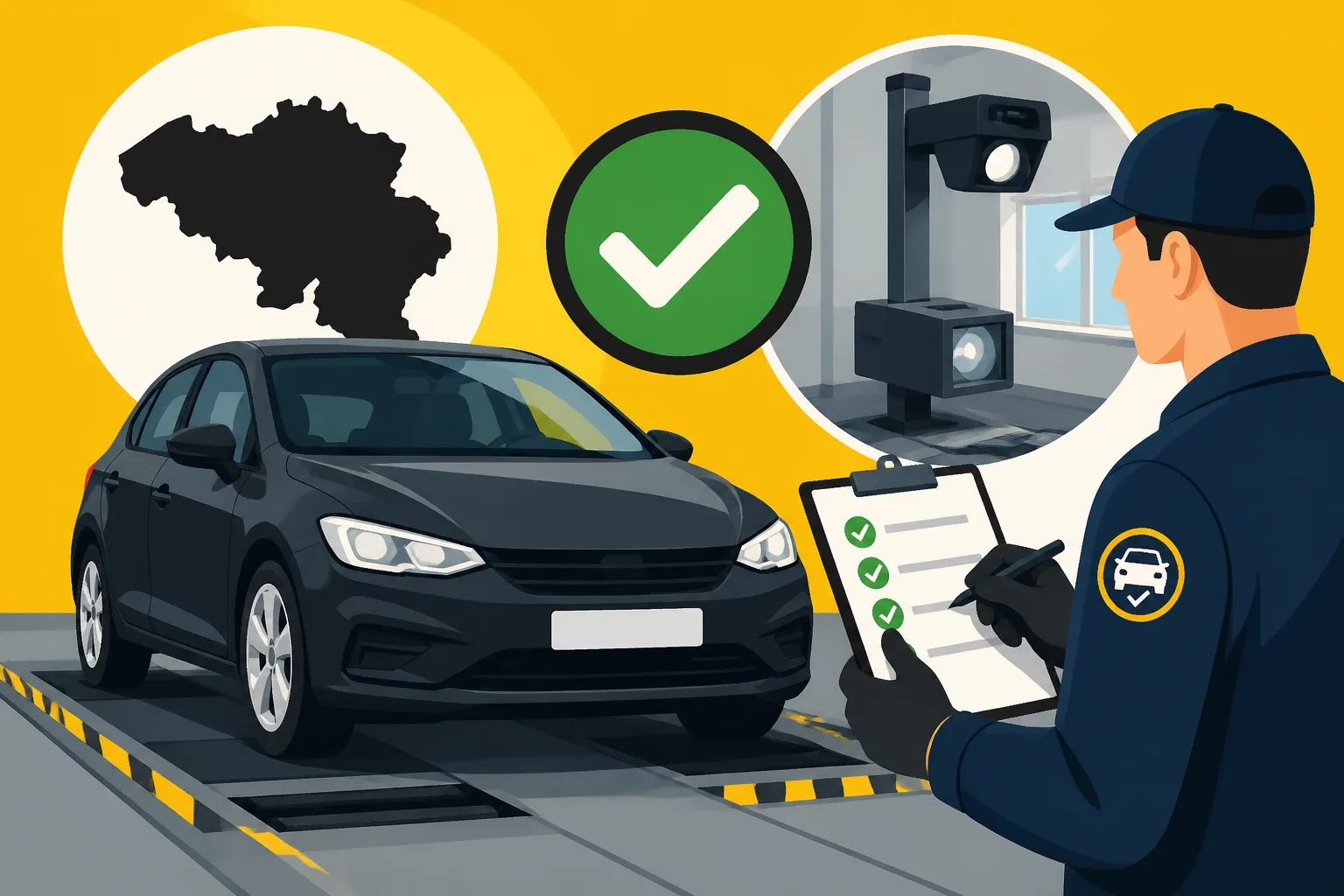
The first stop is usually the exhaust gas analysis. For petrol cars, they measure CO2 and Lambda values. For diesel cars, they perform a smoke opacity test. This is often where older diesel cars struggle. A pro-tip from a veteran expat: drive your car on the highway for 20 minutes at high RPMs before arriving at the center. This helps clear out soot from the DPF (Diesel Particulate Filter) and gives you a much better chance of passing the emissions test.
Suspension, Brakes, and the Pit
After the gas test, you will drive onto a shaking platform that tests your suspension's efficiency. Then comes the brake test, where you'll be told to "brake hard" on rollers. Finally, you will drive over "the pit," where an inspector stands underneath your car with a flashlight. They are looking for oil leaks, rust on the chassis, and worn-out bushings. During this time, you will also be asked to turn on all your lights—high beams, indicators, fog lights, and even the reverse light.
| Inspection Stage | What They Check | Common Failure Reason |
|---|---|---|
| Emissions | CO2, Lambda, Particulates | Clogged DPF or faulty sensors |
| Brakes | Balance and Force | Uneven wear or old brake fluid |
| Lights | Alignment and Function | Cracked lenses or wrong bulb type |
| Suspension | Shock absorbers and play | Leaking struts or worn joints |
| Documents | Chassis number and papers | Missing part 2 of the registration |
Decoding the Results: Green, Orange, and Red Cards
Once you reach the final booth, you will pay the fee (usually between €40 and €60 depending on the tests required) and receive your verdict. This is the moment of truth. The inspector will hand you a colored document that determines your driving fate for the next year.
The Green Card (Certificat Vert / Groen Bewijs)
This is the goal. A green card means your car is roadworthy. Sometimes you will get a "Green Card with Remarks." These are minor issues—like a small chip in the windshield or a slightly worn tire—that don't require a re-test but must be fixed before the next annual inspection. If you have been following the advice in our Driving in Belgium: Licenses, Car Registration, and Traffic Rules guide, you should be well-prepared for this outcome.
The Red Card (Certificat Rouge / Rood Bewijs)
A red card is every expat's nightmare. There are two types:
- Red Card with 15-day validity: You are allowed to drive the car, but only to go home or to a garage. You have exactly 15 days to fix the listed faults and return for a "re-check" (revisite).
- Red Card with "Prohibited from Driving": This is rare and only happens if your car is a danger to the public (e.g., total brake failure or a major fuel leak). The car must be towed from the center.
The Orange Card and Technical Remarks
Technically, the "Orange Card" is often used for administrative issues or specific technical warnings that require attention but haven't yet reached the "Red" threshold. Always read the back of the paper; the codes are standardized across Belgium. If you see a code like "4.1.2.b.2," you can look it up online to see exactly what part of the headlight was criticized.
Special Inspections for Expats and New Arrivals
If you have just arrived in Belgium with a car from your home country, the process is slightly more complex. You cannot simply go for a "periodic" inspection. You must first go through customs (E705 form) and then take the car for an "Import Inspection." This is more thorough and includes a full weighing of the vehicle to determine its Belgian road tax.
Importing a Vehicle from the EU vs. Non-EU
If your car was registered in another EU country, the process is streamlined because of the European Certificate of Conformity. However, if you are bringing a car from the US or UK, you may need a "single vehicle approval" if the car doesn't have a European type-approval number. For more on the paperwork side, check our section on Registering for Public Health Insurance: Step-by-Step at Your Commune, as the commune is often the place where you finalize your car's registration after the inspection is done.
Selling Your Car and the Car-Pass
When you decide to leave Belgium or upgrade your vehicle, you must take the car for a "sale inspection." This is where the car is given a Car-Pass, a document that tracks the mileage to prevent odometer fraud. The buyer cannot register the car without the "pink form" (demande d'immatriculation) that the inspection center provides after a successful sale check. This is a vital protection when Buying a Used Car (Voiture d'Occasion) with Car-Pass Guarantee.
Survival Tips for the Inspection Day
After living through several Belgian winters and inspection cycles, I’ve learned a few tricks to make the day go smoother. First, always bring a coat. Even in the summer, the inspection hangars are drafty and cold. Second, ensure your car is clean—inside and out. An inspector who has to dig through trash to find your seatbelt buckles is an inspector who is looking for reasons to be difficult.
Dealing with Language Barriers
While many inspectors speak English, they are not required to. If you are nervous, bring a friend who speaks the local language or have a translation app ready. Most of the commands are simple: "claxon" (honk), "freinez" (brake), "phares" (headlights). If you are struggling with the local terminology, referring to our guide on French vs Dutch: Which Language is Better for Your Belgian Career? might give you a head start on the basic vocabulary used in public administration.
What to Do if You Fail
Don't panic. If you get a red card, take the document straight to a local garage. They see these papers every day and know exactly how to fix the specific issues the inspectors highlighted. Often, a "re-check" only takes 10 minutes because they only inspect the specific items that failed the first time. Just remember to book your re-check appointment within the 15-day window, or you will have to pay for a full inspection all over again.
Essential Belgian Apps and Digital Resources
To keep your car life organized, there are several apps you should have on your phone. The SNCB app is great for when your car is in the shop and you need the train, but for car owners, the Itsme app is essential. It allows you to log into the "MyMinfin" portal to check your road tax status and view your electronic car inspection certificates.
Using Airalo for a local data plan is particularly helpful when you’re stuck in those long queues. You can check the "real-time" wait clocks that many centers now provide on their websites. This allows you to see which center in your region has the shortest line if you haven't made an appointment.
Finally, keep a copy of your Emergency Numbers: Calling 112 in Belgium and What to Expect in your glove box. If you fail the inspection due to a major safety issue and break down on the way to the garage, you'll need to know who to call for a tow.
Standard Fees for Car Inspections 2026
Prices are indexed annually. Below is a rough estimate of what you can expect to pay at a center in 2026. Note that diesel cars always pay more due to the additional smoke test.
| Type of Inspection | Estimated Cost (Euro) |
|---|---|
| Periodic Petrol | €39.50 |
| Periodic Diesel (with soot filter test) | €56.00 |
| Re-check (Administrative) | €9.00 |
| Re-check (Technical) | €15.50 |
| Late Fee (under 1 month) | €10.00 |
| Late Fee (over 6 months) | €35.00 |
Disclaimer
The information provided in this guide is for general informational purposes only and reflects the rules and regulations in Belgium as of 2026. While every effort is made to ensure accuracy, Belgian traffic laws and inspection procedures can change frequently. Always consult the official websites of GOCA, AIBV, or Autosecurite for the most current requirements and pricing before your appointment. The author and publisher are not responsible for any fines, failures, or legal issues resulting from the use of this guide.