International Driving Permits and Non-EU License Restrictions
You’ve just arrived in Brussels, the boxes are half-unpacked, and you’re ready to drive to the nearest furniture store to make your new house feel like a home. Then you realize your non-EU license might as well be a library card after your first few months of residency. I spent my first season here driving on a prayer before I realized the 185-day clock was ticking. This guide breaks down the legal maze of International Driving Permits and non-EU license restrictions so you don't end up on the wrong side of a Belgian police officer.
The 185 Day Rule: The Expat Grace Period
When you first land in Belgium, you are generally treated as a visitor. For those of us arriving from outside the European Economic Area, the rules are surprisingly generous at first, but they come with a hard expiration date. You are permitted to drive using your valid national non-EU license for up to 185 days from the date you are officially registered in the population register of your commune.
Understanding Normal Residence
The concept of "normal residence" is the pivot point for all Belgian driving laws. You are considered a resident once you have spent at least 185 days in the country per calendar year due to personal or occupational ties. However, for administrative purposes, the clock starts the moment the police perform your address check and you receive your temporary residence documents. During this initial window, your foreign license is perfectly legal, provided it is still valid and has not expired in its country of origin.
Many expats make the mistake of thinking this six-month window resets if they leave the country for a weekend trip to Paris or London. It does not. The Belgian authorities look at your registration date at the Maison Communale. If you are caught driving on a non-EU license after this period without having initiated an exchange, you are technically driving without a valid permit. This can lead to the immediate impounding of your vehicle and a complete refusal of coverage from your insurance provider. If you are still looking for your permanent home during this transition, using a platform like HousingAnywhere can help you secure a spot with the necessary registration papers to get your commune file started early.
The Significance of the Commune Registration Date
Your first interaction with Belgian bureaucracy usually involves Registering at the Commune: The 8-Day Rule After Arrival. This date is etched into the federal database. If you are stopped by the police in Schaerbeek or Etterbeek, they will scan your eID or check your orange card (Annex 15) against your driving license. If the gap between your arrival and the current date exceeds 185 days, you are in a legal gray area that rarely ends well for the driver.
I remember a colleague who ignored this rule, thinking his California license was "international" enough. When he was involved in a minor fender-bender in Ixelles, the police realized he had been a resident for eight months. Even though the accident wasn't his fault, his insurance company used his invalid license status to deny the claim, leaving him with a five-figure bill for a damaged Mercedes. The lesson here is that the commune registration is not just a residency formality; it is the heartbeat of your legal right to be on the road.
International Driving Permits: Translation vs Authority
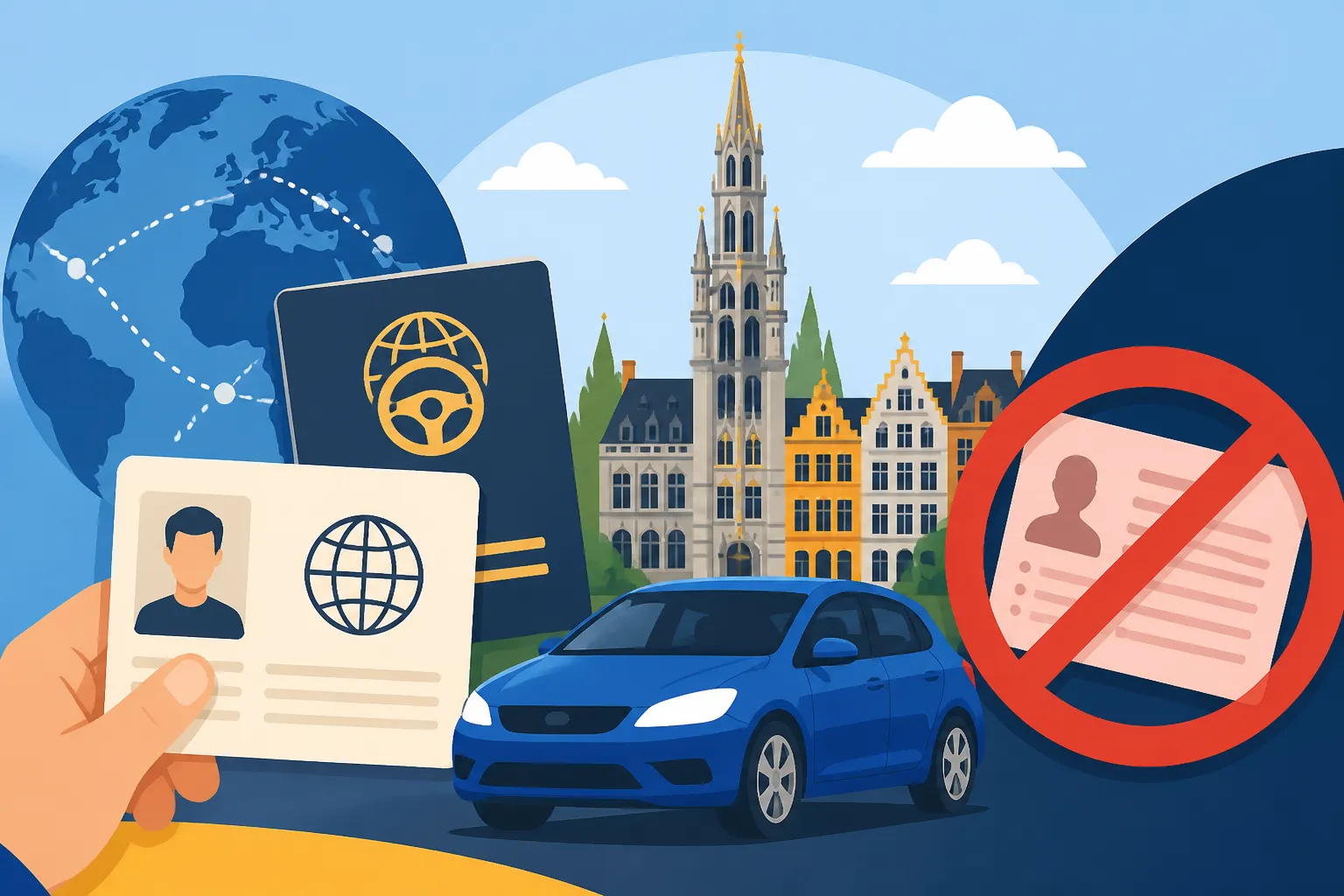
A common misconception is that an International Driving Permit (IDP) is a standalone license. It is not. In Belgium, an IDP is essentially a standardized translation of your home country’s permit. If your non-EU license is not written in French, Dutch, or German, or if it doesn't follow the specific format of the Vienna or Geneva Conventions on Road Traffic, you are legally required to carry an IDP alongside your original license.
When an IDP is Mandatory
If you are a tourist or a new expat in those first 185 days, the IDP acts as your shield against language barriers. If you are pulled over near the Grand Place and hand over a license written in Mandarin, Arabic, or even some versions of English that don't match the EU standard, the officer may not be able to verify your driving categories. The IDP provides that verification in a format they recognize.
You must obtain your IDP in your home country before you move. You cannot get a Canadian or American IDP once you are already living in Ghent or Antwerp. If you forgot to get one, you might need to use a service like RushTranslate to get a sworn translation of your license, though an official IDP is always preferred by the police. It is also worth noting that an IDP is typically only valid for one to three years, depending on which convention your home country follows. If your IDP expires while you are still in your first six months of Belgian residency, you must stop driving until you resolve the translation issue or complete your license exchange.
The Trap of Carrying Only the IDP
I have seen countless newcomers make the mistake of leaving their "real" license at home and only carrying the IDP booklet in their glovebox. In the eyes of Belgian law, the IDP is worthless without the underlying national permit. If you are stopped and cannot produce the original plastic card or paper license from your home country, you will be treated as if you have no license at all.
This is particularly important when renting a car. Most rental agencies at Zaventem airport will demand to see both. If you are relying on mobile data to look up these rules on the fly, having a reliable eSIM from a provider like Airalo ensures you aren't stuck at the rental desk without an internet connection to prove the law to a stubborn clerk. Always keep both documents together in a secure folder, and never assume the IDP replaces the original.
The Exchange Process for Recognized Countries
Belgium has bilateral agreements with several non-EU countries that allow for a direct exchange of licenses without the need for a new driving test. This is the "holy grail" for expats. If you are from Canada, Australia, Japan, or certain US states (the list is specific and changes), you can simply trade your old license for a shiny Belgian one.
Checking the List of Recognized Permits
The list of recognized countries is maintained by the Federal Public Service for Mobility and Transport. It is a meticulous document. For example, some countries are recognized for Category B (cars) but not for Category A (motorcycles). Before you get your hopes up, you need to verify if your specific license category is covered. If it is, the process involves visiting your commune, handing over your original foreign license (which they will keep and often send back to your home embassy), and paying a small fee.
During this period, you will usually be given a temporary document allowing you to drive within Belgium, but be careful—this temporary paper is often not valid for driving across the border into Germany or Luxembourg. If you are planning a road trip, wait until the actual plastic card arrives. This is also a good time to ensure your vehicle is up to date with Everyday Rules in Belgium: Garbage Sorting, Noise, and Etiquette and other local regulations that might affect your driving habits, such as the ubiquitous "priority to the right" rule.
Dealing with Non-Recognized Licenses
If your country is not on the list, the news is a bit harder to swallow. You will effectively have to start from scratch. This means passing a theoretical exam (available in English in some centers for an extra fee) and a practical driving test. While this feels like a personal insult to someone who has been driving for twenty years, it is a non-negotiable part of Belgian law.
The theoretical exam is notoriously tricky, focusing heavily on tram priority and specific European road signs. I highly recommend buying a study guide on Amazon Belgium to prep for the nuances of the Belgian Highway Code. Failing the test twice often triggers a mandatory requirement to attend a certain number of hours at a certified driving school, which can cost upwards of 1,000 euros. Taking the time to study Driving in Belgium: Licenses, Car Registration, and Traffic Rules before you sit the exam is the best way to save both time and money.
| License Status | Validity Period | IDP Requirement | Exchange Possibility |
|---|---|---|---|
| Non-EU Tourist | 90 Days | Recommended/Mandatory | No |
| New Resident (0-6 months) | 185 Days | Required for non-EU formats | Yes (if recognized) |
| Resident (6+ months) | Invalid | N/A | Must have Belgian License |
| EU/EEA License | Until Expiry | No | Optional/Recommended |
Insurance and Liability Restrictions
One of the most overlooked aspects of driving on a non-EU license is how it affects your insurance. Belgian insurance companies are risk-averse by nature. Even if you manage to find a company willing to insure you on a foreign license, the premiums are often significantly higher than they would be for a Belgian license holder.
The "Invalid License" Clause in Policies
Almost every car insurance contract in Belgium contains a clause stating that the policy is only valid if the driver holds a "lawful and valid permit for the territory." The moment you hit day 186 of residency, your non-EU license is no longer "lawful" in the eyes of the Belgian state. If you have an accident on day 187, your insurer has every right to refuse to pay for the damages to your car or, more importantly, the damages to the other party.
This can lead to a nightmare scenario where the Belgian "Fonds de Garantie" pays the victim and then sues you personally for the entire amount. To avoid this, you must inform your insurer the moment you receive your Belgian license. They will often recalculate your premium, and you might even get a small refund if you can prove your previous driving history. For those looking at Car Insurance in Belgium: Third-Party vs Omnium Coverage, being transparent about your license status during the application process is vital to ensure you are actually covered when it matters.
Proving Your Claims History
A major hurdle for non-EU drivers is the "Bonus-Malus" system. Belgium uses this to reward drivers who haven't had accidents. If you are moving from a non-EU country, try to get a signed, official letter from your previous insurance company detailing your claims history for the last five to ten years. While not all Belgian insurers will accept this, some specialized expat brokers will use it to lower your starting rate. Without this, you will be treated as a "young driver," regardless of whether you are 20 or 50 years old, resulting in some of the highest insurance costs in Europe.
Road Safety and Local Restrictions
Driving in Belgium is not just about the license; it is about the specific environment of the Low Countries. From the narrow streets of Ghent to the complex tunnels of the Brussels ring road, the restrictions on non-EU drivers often manifest in how they interact with local infrastructure.
Low Emission Zones (LEZ) and Registration
Regardless of your license, if you are driving a car with foreign plates or a car you just bought, you must be aware of the Low Emission Zones (LEZ) in Brussels, Antwerp, and Ghent. Non-Belgian plates must be registered in the LEZ database before entering these cities, even if the car meets the environmental standards. Failure to do so results in an automatic fine of 150 euros, which is tracked via cameras.
If you are Buying a car in Belgium: Circulation Tax and Registration Costs, the dealer will usually handle the LEZ registration for the specific city where the car is registered, but it is your responsibility to check if you are moving between regions. Many expats on non-EU licenses find themselves driving older, imported cars that may not even be allowed in the city centers anymore. Always check the Euro-norm of your vehicle before committing to a purchase.
Priority to the Right and Unique Signs
The most dangerous thing for a non-EU driver in Belgium is the "Priority to the Right" (Priorité à droite / Voorrang van rechts). Unless a sign indicates otherwise (like the orange diamond for a priority road), any car coming from a side street on your right has the right of way. In many non-EU countries, the car on the "main" road always has priority. In Belgium, if there is no sign, you must slow down and prepare to stop for anyone exiting a tiny side street on your right.
This rule is a frequent cause of accidents for newcomers. If you are involved in a collision because you failed to yield to the right, your non-EU license status will be scrutinized even more heavily. Familiarizing yourself with local signage and Exchanging a foreign driver’s license for a Belgian one early on will give you the confidence to navigate these cultural driving quirks without risking a crash or a heavy fine.
Summary of Immediate Actions for New Arrivals
If you have just moved to Belgium and plan to drive, your first week should involve a few critical steps. First, ensure you have your original license and an IDP (or sworn translation) in your vehicle at all times. Second, check your country's status on the exchange list immediately. If you are lucky enough to be from a recognized country, start the exchange process at your commune as soon as you have your Annex 15 or eID.
If you are planning on Buying a used car (Voiture d'Occasion) with Car-Pass guarantee, remember that you cannot register a car in your name until you have a Belgian national number, which comes with your residency. In the meantime, you might need to rely on public transport or car-sharing apps. Don't let the complexity of the paperwork discourage you. Once you have that Belgian license in your wallet, the rest of Europe opens up, and you can enjoy the freedom of the open road without the constant fear of a bureaucratic "gotcha."
Disclaimer
This guide is for informational purposes only and does not constitute legal advice. Belgian immigration and transport laws are subject to frequent change. Always verify current requirements with your local Maison Communale (Commune) or the Federal Public Service for Mobility and Transport before driving or initiating a license exchange.