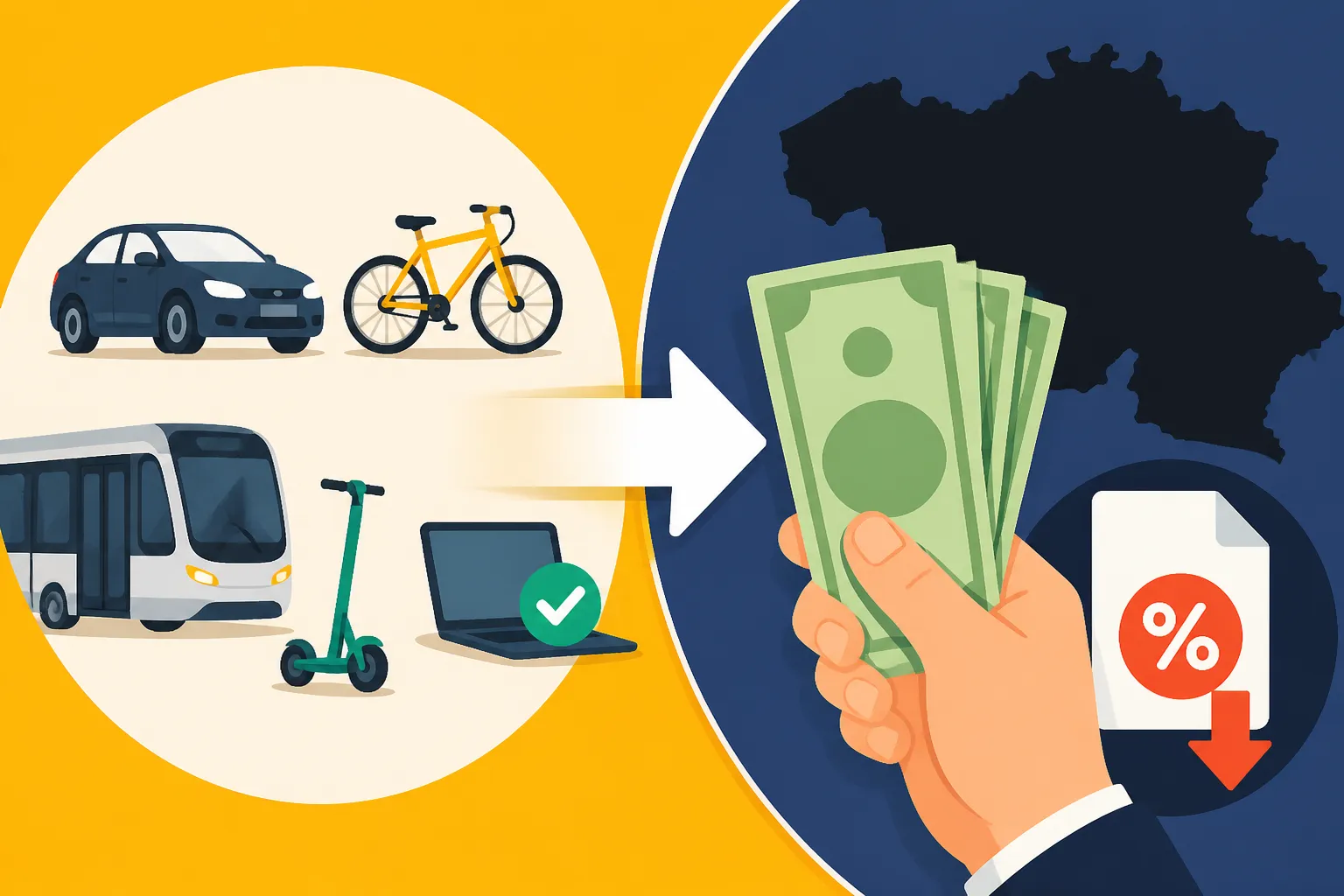
Getting a Mobility Budget Payout in Cash: Tax Implications
Navigating the complex world of Belgian company benefits often feels like trying to solve a Rubik’s cube while blindfolded. I remember staring at my very first Belgian payslip, completely baffled by the sheer volume of deductions and acronyms. If you are considering ditching your company car for the federal mobility budget, understanding the tax implications of that final cash payout is the only way to ensure you are actually coming out ahead.
The Belgian Mobility Budget Framework in 2026
To understand how the cash payout works, we first have to look at the structure of the mobility budget itself. In Belgium, this system is designed to be "cost-neutral" for the employer, meaning the total cost of the car you are giving up (the Total Cost of Ownership or TCO) becomes your annual budget. This budget is then split into three potential "pillars," and the order in which you use them matters immensely for your wallet.
For those of us who have lived through the administrative hurdles here, the mobility budget is a breath of fresh air compared to the rigid car-centric culture of a decade ago. However, the Belgian tax authorities never give anything away for free. The system is designed to encourage specific behaviors, and the cash payout—known as Pillar 3—is actually the least tax-efficient way to use your money. It is essentially the "safety net" for whatever money you didn't spend on greener options.
When you look at your Banking and Finance in Belgium: Complete Expat Guide (2027), you will notice that Belgian fiscality heavily rewards "sustainable" choices. The mobility budget is the prime example of this. You can choose to spend your TCO on an electric car (Pillar 1), sustainable transport like trains or even rent/mortgage payments (Pillar 2), or take the rest home in cash (Pillar 3).
The Hierarchy of Spending
Most expats I talk to are tempted to go straight for the cash. Why wouldn't you want more liquid money in your account? But in Belgium, cash is king only after the taxman has taken his slice. Before you decide to take the payout, you must understand that Pillar 2 expenses are 100% exempt from tax and social security. This means if you use your budget to pay for your train tickets or your rent, 1 Euro of budget equals 1 Euro in your pocket.
If you skip those options and wait for the cash payout at the end of the year, that ratio changes drastically. You aren't just getting "extra salary"; you are getting a specific type of compensation that carries its own unique tax rate. Understanding this distinction is vital for accurate Healthcare Budgeting: Copays, DMG/GMD, and Reimbursements and general financial planning.
Pillar 3: The Reality of the Cash Payout
Pillar 3 is the "remainder." At the end of the calendar year (usually in January of the following year), your employer calculates what is left of your TCO after all Pillar 1 and Pillar 2 expenses have been deducted. This remaining amount is paid out to you in cash.
Here is the "I've-been-there" reality: that payout is subject to a special social security contribution of 38.07%. This is a flat rate. While it sounds high—and it is—the silver lining is that this payout is entirely exempt from personal income tax. In the world of Taxes in Belgium for Expats: Personal Income Tax System 2026, where top earners can see 50% of their income disappear, a 38.07% total "tax" is actually quite favorable.
Why the 38.07 Percent Rate Exists
The Belgian government arrived at this specific number because it represents the total social security burden (employer + employee) that would typically be paid on a benefit of this size. By charging this amount, the state ensures that the "cash" option doesn't become a loophole for tax-free salary.
However, because this isn't technically "salary," it doesn't get added to your taxable base for the year. This is a huge advantage. If you are already in the 50% tax bracket, receiving a cash payout that only costs you 38.07% in social contributions means you are effectively keeping more of your money than if your employer had simply given you a standard raise. This is a nuance often missed when people discuss Gross vs Net Salary in Belgium: Why the Difference is So Big.
Impact on Your Social Rights
It is important to note that because you are paying a social security contribution on this cash payout, the amount does count toward your social rights in Belgium. This includes your pension calculations, disability insurance, and unemployment benefits. This is a major point of differentiation from other "net" benefits like meal vouchers or eco-cheques, which do not contribute to your long-term social safety net.
When I first transitioned to a mobility budget, I was worried that my pension would suffer because I was "earning" less gross salary. But the Pillar 3 payout bridges that gap. It is a sophisticated way of getting Social Security in Belgium: Employer and Employee Contributions to work in your favor while still providing liquidity.
Comparing Tax Efficiencies of the Mobility Budget
To truly see the value of the cash payout, we need to compare it to the other ways you can receive money in Belgium. The following table illustrates how 1,000 Euros of employer cost (TCO) translates into your actual pocket depending on the "bucket" it falls into.
| Benefit Type | Employee Net (Approximate) | Tax / Social Charges | Best For |
|---|---|---|---|
| Standard Gross Salary | €450 – €530 | ~47% – 55% | General spending, high pension impact |
| Mobility Pillar 2 (Rent/Train) | €1,000 | 0% | Anyone living within 10km of work |
| Mobility Pillar 3 (Cash) | €619.30 | 38.07% | Saving, investing, or foreign expenses |
| End of Year Bonus (13th Month) | €350 – €450 | ~55% – 65% | Traditional corporate structures |
As you can see, the cash payout (Pillar 3) is significantly more efficient than a standard bonus or a simple gross salary increase, but it pale in comparison to the efficiency of Pillar 2. This is why I always tell new arrivals to check if they qualify for the "housing" benefit under Pillar 2 before settling for the cash payout. If you live within 10km of your office (or if you work from home at least 50% of the time), you can use your mobility budget to pay your rent or mortgage interest tax-free.
Using that budget for rent is the ultimate "life hack" in the Belgian system. But if you don't qualify, or if your rent is lower than your total budget, the Pillar 3 cash payout is your next best friend. You might use that extra liquidity to fund your Cost of Living in Belgium 2026: Budgeting for Cities and Families or send it to an investment account.
Strategic Financial Planning with Your Payout
Once that cash hits your account in January, what should you do with it? Since this is "extra" money that isn't tied up in your monthly survival budget, it is the perfect capital for building wealth. Many expats use this yearly windfall to fund international accounts or diversify their portfolios.
If you are looking to move that money across borders, using a service like Wise is often much more cost-effective than a traditional Belgian bank. Traditional banks in Belgium are great for stability, but their exchange rates for non-EUR currencies can be punishing. Using the cash payout to top up a Trade Republic account is another popular move among the local expat community, as it allows you to earn interest on your uninvested cash or put it into low-cost ETFs.
For those with a higher risk tolerance, some of my colleagues have even diverted a portion of their Pillar 3 payout into digital assets via Binance, though I always caution that you should only do this with money you are prepared to see fluctuate. The key is that because the mobility budget payout comes as a lump sum once a year, it encourages a "save and invest" mindset rather than just disappearing into your monthly grocery bill.
Managing the Timing of the Payout
One frustration I frequently hear from foreigners is the wait time. Unlike a company car, which you enjoy every day, the cash payout is retrospective. You have to wait until the end of the year for the accounting to be finalized. If you started your job in March, you won't see that cash until January of the next year.
This requires a bit of mental accounting. You are "earning" that money every month, but you can't touch it. It’s a forced savings plan. Make sure you don't accidentally overspend during the year expecting that money to hit your account monthly. It is one of those Getting Paid in Belgium: Salary Deductions and Bonus Taxes quirks that takes a cycle or two to get used to.
Common Pitfalls and Administrative Hurdles
Even though the law is clear, the implementation of the mobility budget can vary between companies. Not every employer is legally obliged to offer it; it is a voluntary system. If your company does offer it, make sure you have a clear "Mobility Policy" in writing.
I once helped a friend who thought he was getting a cash payout, only to find out his employer had a "use it or lose it" policy for Pillar 2, which is actually illegal under the federal framework but still happens in smaller firms. The federal law states that any unspent budget must be paid out in cash under Pillar 3. If your HR department tells you otherwise, point them toward the official federal mobility budget portal.
The Problem of "Double Dipping"
Another trap is the interaction between the mobility budget and other transport benefits. If you take the mobility budget, you usually have to give up your "employer-paid train subscription" or your "bicycle allowance" if those were previously separate. The mobility budget is meant to be a single, all-encompassing pot of money.
If you are trying to understand How to Read Your First Belgian Payslip (Fiche de Paie), keep an eye out for any residual transport deductions that shouldn't be there once you have switched to the mobility budget. Any errors here can complicate your Pillar 3 calculation at the end of the year.
Setting Up the Right Account
When the payout finally happens, you want it to land in an account that works for you. Most expats start by Opening a Belgian Bank Account: Documents Needed and Roadblocks, but as you become more settled, you might want to separate your "payout" money from your "daily" money.
Using a multi-currency account through Wise can be particularly helpful if you plan on using that payout for a summer holiday back home or to pay off student loans in another currency. It prevents the "stealth fees" of currency conversion from eating into that 61.9% net you worked so hard to keep.
Practical Steps to Maximize Your Payout
To get the most out of your mobility budget in 2026, follow these "veteran" steps:
- Verify your TCO: Ensure your employer has calculated the Total Cost of Ownership correctly. This should include the lease price, fuel/charging, insurance, and taxes of the car you would have had.
- Exhaust Pillar 2 first: Check every possible expense. Did you know you can use Pillar 2 to buy a bike for your spouse or children? Or to pay for a "Blue-bike" subscription? Every Euro spent here is 0% tax.
- Check the 10km Rule: If you moved recently, map the distance between your front door and your office "as the crow flies." If it's under 10km, your rent/mortgage interest is a Pillar 2 expense.
- Work from Home Check: If you work from home at least 50% of the time, the 10km rule is waived. This is a massive win for remote-heavy expat roles.
- Plan your January: Know that the Pillar 3 payout will be on your January or February fiche de paie. Use that time to plan your yearly investments.
If you are still waiting for your residence card to finalize your financial setup, check out the guide on Accessing Belgian Healthcare Without an eID: Temporary Certificates to see how temporary status affects your administrative life. Managing your Sending Money In and Out of Belgium: Remittance and Currency becomes much easier once you have a predictable yearly windfall like the mobility payout.
Ultimately, the mobility budget is one of the best financial tools available to expats in Belgium today. It rewards those who are willing to do a little bit of math and look past the "free car" allure. While a 38.07% deduction on the cash payout feels steep, it remains one of the most efficient ways to extract value from a Belgian salary package in 2026.
Disclaimer
This guide is provided for informational purposes only and does not constitute professional tax, legal, or financial advice. Belgian tax laws are subject to frequent changes and individual interpretations by the tax authorities. Always consult with a qualified tax advisor or your company’s HR department to confirm how the mobility budget applies to your specific professional and personal situation.