Accessing Contraception in Belgium: Pill, IUD, and Costs
Walking into a Belgian pharmacy for the first time can feel like a high-stakes guessing game, especially when you realize that birth control methods you bought over-the-counter back home require a formal doctor’s signature here. I vividly remember my own confusion, standing at a counter in Ixelles while a pharmacist politely explained that my half-empty pack of pills from home couldn't be refilled without a local "ordonnance." This guide clears up the administrative fog, detailing exactly how to secure a prescription, what you’ll pay, and how to navigate the reimbursement system as an expat.
Understanding the Belgian Medical Consultation Process
To access most forms of contraception in Belgium, your first stop isn't the pharmacy, but a medical professional. Unlike some countries where you might visit a specialized sexual health clinic for every refill, the Belgian system is heavily integrated into general practice. You have two primary choices: a General Practitioner (GP) or a gynecologist. While a GP is perfectly capable of prescribing the pill or the patch, many expats prefer seeing a specialist for the initial fitting of an IUD or an implant.
If you are new to the country and still setting up your life, you might find the process of Finding Medical Care in Belgium: GPs, Specialists, and Hospitals slightly daunting. It is common to book these appointments via platforms like Doctena or Rosa. When you go, be prepared to discuss your medical history in detail. Belgian doctors are generally very thorough and will want to ensure the hormonal balance of a specific pill brand suits your lifestyle. If you are covered by a comprehensive international plan like Cigna Global, you may have more flexibility in choosing private specialists who offer faster appointment times than those strictly working within the state-funded system.
During this first visit, you should also ask the doctor about the Global Medical Record (known as the DMG in French or GMD in Dutch). This is a digital file that centralizes your health data. Beyond the medical benefits, having your GP manage this record actually lowers your out-of-pocket costs for the consultation itself. You can learn more about this in our guide on Healthcare Budgeting: Copays, DMG/GMD, and Reimbursements. Once the doctor issues your prescription, it is often sent digitally to your eID (electronic identity card), meaning you just need to slide your ID card into the reader at the pharmacy to collect your medication.
The Different Types of Contraception Available
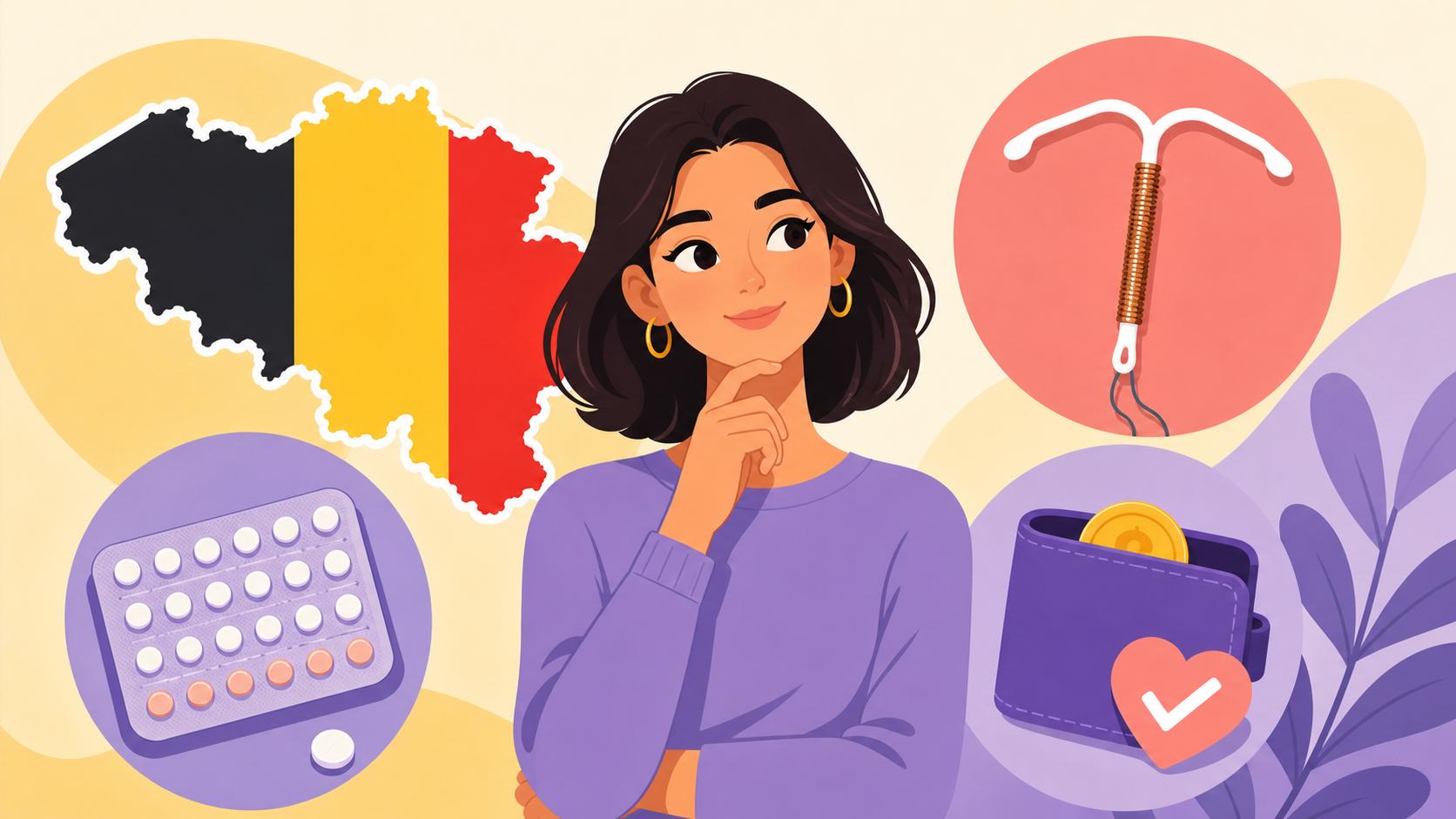
Belgium offers a wide spectrum of contraceptive options, and most are readily available at any local "apotheek" or "pharmacie." However, the brand names might differ from what you are used to. For instance, if you were taking a specific brand in the US or UK, your Belgian doctor will likely find the local equivalent with the same active ingredients.
Oral Contraceptive Pills and Patches
The "pill" is the most common form of birth control in Belgium. It is sold in three-month or six-month packs. While the convenience is high, the requirement for a prescription is strict. If you are transitioning between brands or need supplements to support your cycle health—such as folic acid or specific vitamins—you can often find those via online platforms like iHerb to save a few euros, but the hormonal medication itself must come from a physical pharmacy in Belgium. For a deeper look at how these shops function, check out Pharmacies and Medication in Belgium: Prescriptions and OTC Rules.
Long-Acting Reversible Contraception (LARC)
If you prefer "set it and forget it" methods, IUDs (Intrauterine Devices) and hormonal implants (like Nexplanon) are very popular among the expat community. To get an IUD, you usually need two appointments: one for the prescription and a preliminary check-up, and a second for the actual insertion. You will physically buy the IUD at the pharmacy with your prescription and bring it with you to the doctor's office. This was a "wait, what?" moment for me—carrying a medical device in my handbag to my appointment—but it’s the standard procedure here.
Emergency Contraception
The morning-after pill is one of the few exceptions to the prescription rule. You can walk into any pharmacy and buy it over-the-counter. The pharmacist will likely take you to a private corner to ask a few basic safety questions. If you are under 25, this is often free or heavily discounted, but even for older adults, the price is relatively accessible. For the specifics on timing and brands, see our detailed post on Morning-After Pill in Belgium: Pharmacy Access and Age Rules.
Costs and the Mutuelle Reimbursement System
The cost of contraception in Belgium is a bit of a moving target because it depends heavily on your age and which Mutuelle and Ziekenfonds: Public Health Insurance Registration Guide you have joined. Generally, the Belgian state wants to make birth control accessible, so there are significant subsidies in place, particularly for young people.
For those under the age of 25, many forms of contraception (including the pill, the patch, and the IUD) are almost entirely reimbursed by the compulsory health insurance. You might pay a small "symbolic" euro at the counter, or nothing at all. Once you turn 25, the "social" discount disappears, but you are still entitled to the standard reimbursement rates if the medication is on the government's approved list. This is where things get a little tricky: not every brand is reimbursed. If your doctor prescribes a "lifestyle" brand that isn't on the list, you might pay the full price, which can range from €10 to €15 per month.
| Method | Estimated Cost (Out of Pocket) | Reimbursement Status (Over 25) | Reimbursement Status (Under 25) |
|---|---|---|---|
| Combined Pill (3 months) | €15 – €45 | 0% to 50% (Brand dependent) | Mostly 100% |
| Hormonal IUD | €120 – €150 | Partial (approx. €20-€30) | Usually 100% |
| Copper IUD | €50 – €80 | Partial | Usually 100% |
| Contraceptive Patch | €35 (3 months) | Low to None | High |
| Emergency Pill | €10 – €25 | None (usually) | 100% |
If you are currently waiting for your residency paperwork and don't have an eID yet, don't panic. You can still access these services. Check our advice on Accessing Belgian Healthcare Without an eID: Temporary Certificates to see how to bridge the gap so you aren't paying full price for medical visits in the meantime.
Where to Find English-Speaking and Specialized Care
One of the biggest hurdles for any expat is explaining delicate health concerns in a second language. While most Belgian doctors speak excellent English, there are specific hubs where you are guaranteed to find "expat-friendly" care. In Brussels, the "Planning Familial" (Family Planning) clinics are an incredible resource. These centers offer consultations on a sliding scale based on your income, and they are very used to helping foreigners navigate the system.
If you are living in Flanders, you would look for a "Centrum voor Gezinsplanning." These centers are not just for contraception; they provide a holistic approach to sexual health. If you are worried about costs or don't yet have your mutuelle sorted, these centers are often more flexible than a private gynecologist's office. You can also find help with Women’s Health in Belgium: Gynecology, Screenings, and Birth Control through these organizations, including smears and routine checks.
For those who prefer a traditional hospital setting, many of the large university hospitals (like UZ Leuven or CHU Saint-Pierre in Brussels) have dedicated departments for reproductive health. When booking, specifically ask for a "conventioned" doctor if you want to keep your costs down. A conventioned doctor agrees to the official state prices, whereas non-conventioned doctors can charge supplements. You can find more details on this in our guide on Finding English-Speaking Doctors in Brussels, Antwerp, and Ghent.
Navigating Sexual Health Beyond Contraception
Accessing contraception is often just one part of a larger conversation about reproductive health. In Belgium, it is standard practice for a doctor to suggest a routine screening if you are starting a new contraceptive method or changing partners. Unlike some countries where there is a stigma around asking for tests, Belgian GPs are very matter-of-fact about it.
If you are looking for more discreet options, there are clinics that offer anonymous testing. This is particularly useful if you are in a transitional period with your insurance or simply value your privacy. We've mapped out exactly where to go in our article on STI Testing in Belgium: Anonymous Clinics and Regular GP Visits. Additionally, for general wellness products that support your reproductive health, many expats use iHerb to order items like high-quality probiotics or ovulation tracking kits that might be significantly more expensive in the local Belgian boutiques.
Finally, keep in mind that the Belgian healthcare system relies on you being proactive. Your doctor won't usually call you to remind you that your pill prescription is about to expire or that your IUD has been in for five years. It is up to you to manage these timelines. If you have international coverage through Cigna Global, make sure to check if they require a referral from a GP before you see a gynecologist, as this can vary by policy. Being prepared will save you from a last-minute scramble at the Pharmacies (Apotheek/Pharmacie) in Belgium: Operating Hours and Services on a Saturday night.
Important Disclaimer
This guide is intended for informational purposes only and is based on personal experience and general research into the Belgian healthcare system. Medical regulations, pricing, and reimbursement policies are subject to change by the Belgian federal government and individual insurance providers. Always consult with a qualified medical professional in Belgium before starting or changing any form of contraception. The author is not a medical professional, and this content should not be taken as professional medical advice or a substitute for a formal consultation with a doctor. For specific insurance coverage details, please contact your Mutuelle or private insurance provider directly.