Oversized Waste (Encombrants): Booking a Pickup or Using Recyparks
You have finally reached the point in your Belgian journey where that old, lumpy sofa or the half-broken IKEA desk needs to go, but it certainly won't fit into a standard white garbage bag. I remember my first week in Brussels, staring at a discarded mattress on my sidewalk and wondering if I’d be fined for just looking at it. This guide solves the complex puzzle of Belgian oversized waste disposal, ensuring you clear your space without the stress of "dépôt sauvage" fines.
Understanding the Categories of Oversized Waste in Belgium
Before you even think about dragging a fridge to the curb, you have to understand what the Belgian authorities actually define as oversized waste, or "encombrants" in French and "grofvuil" in Dutch. This isn't a catch-all for everything that doesn't fit in your bin. It is a specific category of household items that are too heavy or too large to be handled by regular collection rounds. Generally, this includes furniture, mattresses, large appliances, and sometimes carpets or large toys.
In my experience, the most common mistake expats make is mixing "small" trash with oversized items. If you put a box of old kitchen utensils on top of a sofa, the collection crew will likely leave the whole pile behind. They are very strict about what qualifies. Most communes also distinguish between household oversized waste and construction debris. If you are doing a renovation, those bags of plaster and old tiles are not "encombrants." They require a specialized "Big Bag" service or a trip to a specific container park that handles industrial waste.
Regional differences are the backbone of Belgian life, and waste is no exception. In Brussels, you are dealing with Bruxelles-Propreté. In Flanders, you might be under the jurisdiction of IVAGO in Ghent or IOK in other areas. In Wallonia, inter-communal agencies like BEP or Intradel take the lead. Each has its own list of what is allowed. For instance, some areas allow a certain amount of "white goods" (appliances) for free, while others charge by the item. Before you start clearing out, checking Renting in Belgium: Apartments, Contracts, and Tenant Rights (2027) is useful because your lease might actually specify where your building's designated trash zone is located.
Household Furniture and Large Textiles
Furniture is the most straightforward category. This includes wardrobes, bed frames, tables, and sofas. However, there is a catch: size limits often apply. Many communes require you to dismantle large items. If you have a massive oak wardrobe from the 1920s, you can't just put it on the street whole. You’ll need to break it down into manageable panels. Similarly, carpets should usually be rolled up and tied.
Mattresses are a frequent source of confusion. In some years, they are collected with general oversized waste; in others, they have a separate "Valumat" recycling stream. When you are moving out of a place you found through HousingAnywhere, make sure you don't leave these items in the common hallway of the building. Neighbors in Belgium are quick to report "dépôt sauvage," and the fines can reach hundreds of euros depending on the volume.
Electronic and Electric Waste (WEEE)
Anything with a plug—fridges, washing machines, old televisions—is handled differently. These are often referred to as "blanc" (white goods) or "brun" (brown goods like electronics). While they are "oversized," they contain hazardous materials or valuable metals that must be recycled. In many Belgian cities, you can actually get these picked up for free by specialized organizations or through the Recupel system.
If you’ve recently bought a new TV on Amazon Belgium, remember that the retailer is legally obligated to take back your old device for free. This "one-for-one" rule is a lifesaver if you don't have a car to visit a Recypark. However, if you're just disposing of an old microwave without a replacement, you'll need to book a specific "electro" pickup or take it to a Recypark yourself.
Prohibited Items in Oversized Collection
Knowing what they won't take is just as important as knowing what they will. You cannot put out tires, batteries, paint cans, or chemicals. These are "déchets dangereux" and must go to a "Proxy Chimik" or a specific section of the Recypark. I once saw a neighbor try to hide old paint cans inside a sofa—the collectors saw the leak, left the sofa, and a police officer was at their door by noon.
Building materials like stones, bricks, and toilets are also usually excluded from standard home pickups. For these, you’ll need to rent a skip or use a professional service. If you are preparing for a move and need to clear out years of accumulated "stuff," consulting a Moving Companies in Belgium: Dockx Rental Trucks vs Full Service guide can help you find professionals who include waste disposal in their packages.
Booking a Home Pickup Step by Step
For most expats living in city centers like Brussels, Antwerp, or Liège, a home pickup is the only realistic option because few of us own a van. In Brussels, Bruxelles-Propreté offers a certain amount of free collection per year for residents—usually up to 3 cubic meters. Once you exceed this, you pay per cubic meter. The "free" aspect is tied to your status as a resident paying local taxes, which is why they will often ask for your eID or national register number.
The process has moved almost entirely online. You’ll need a stable internet connection—I recommend using Airalo for an immediate data eSIM if you’ve just arrived and haven't set up your home wifi yet—to access the portal of your local waste agency. You log in, select the items you have, and choose an available date. Be warned: in high-density areas like Etterbeek or Ixelles, wait times for a pickup can be two to three weeks. Plan your exit strategy well in advance.
Once you have a date, you’ll receive a confirmation email. Some communes require you to print a specific document or write a reference number on a piece of paper and tape it to the items. This proves the pile is a legitimate, booked pickup and not illegal dumping. This is a crucial step in maintaining a good relationship with your landlord, especially when they are conducting the Inventory of Fixtures (État des Lieux): Why It's Crucial Before Moving In.
Managing the Timing and Placement
In Belgium, the rules about when you can put your items on the street are down to the hour. Usually, you are allowed to place items on the sidewalk after 8:00 PM the night before or before 6:00 AM the morning of the collection. Leaving a sofa on the sidewalk for two days while waiting for your pickup is a surefire way to get a "GAS-boete" (administrative fine).
Placement is also key. Items must be on the sidewalk but not blocking pedestrians, strollers, or wheelchairs. They must be visible from the street so the truck driver can see them. If you live in a "pedestrian zone" or a very narrow street, there might be a specific collection point a few meters away from your door. Checking your local Garbage Sorting Rules: Blue, Yellow, White, and Green Bags Explained can often give you clues about these hyper-local collection zones.
Volume and Weight Limits
Even with a booked pickup, you cannot put out an unlimited amount. Most services cap the volume at 2 or 3 cubic meters per intervention. If you are clearing out an entire apartment's worth of furniture, you might need to book multiple appointments over several months. There are also weight limits—usually, no single item can weigh more than 50kg to 70kg, as the workers need to be able to lift it manually.
If you find yourself with an overwhelming amount of waste that exceeds these limits, you might consider Hiring a Domestic Cleaner via Titres-Services (Dienstencheques) to help you organize and sort smaller items, or looking into professional junk removal services. These private companies charge more but don't have the same strict volume limits as the commune services.
Costs and Payment Methods
While many cities offer one or two free pickups a year, additional ones carry a fee. In Brussels, the current rate for extra volume is approximately €25 to €30 per cubic meter. Some communes in Flanders use a "pay-as-you-throw" system where you buy specific stickers or "grofvuil" labels from the city hall or local supermarkets and attach them to each item.
Payment is usually handled online during the booking process via Bancontact or apps like Payconiq. If you haven't set up your local banking yet, you might find it difficult to use the official portals. Ensuring your Itsme Authentication: How to Set Up Belgium's Vital Digital ID is ready will make accessing these government services much smoother.
| Service Type | Typical Cost | Volume Limit | Best For |
|---|---|---|---|
| Communal Pickup | Free (1-2x per year) or ~€30/m3 | 3 cubic meters | Standard furniture, mattresses |
| Recypark (DIY) | Free (within quota) or small fee | Varies (e.g., 2m3 per visit) | Appliances, small wood, metal |
| Private Junk Removal | €150 – €500+ | Unlimited | Full apartment clear-outs |
| Retailer Take-back | Free (with new purchase) | 1-for-1 | Large appliances, TVs |
Using a Recypark: The DIY Approach
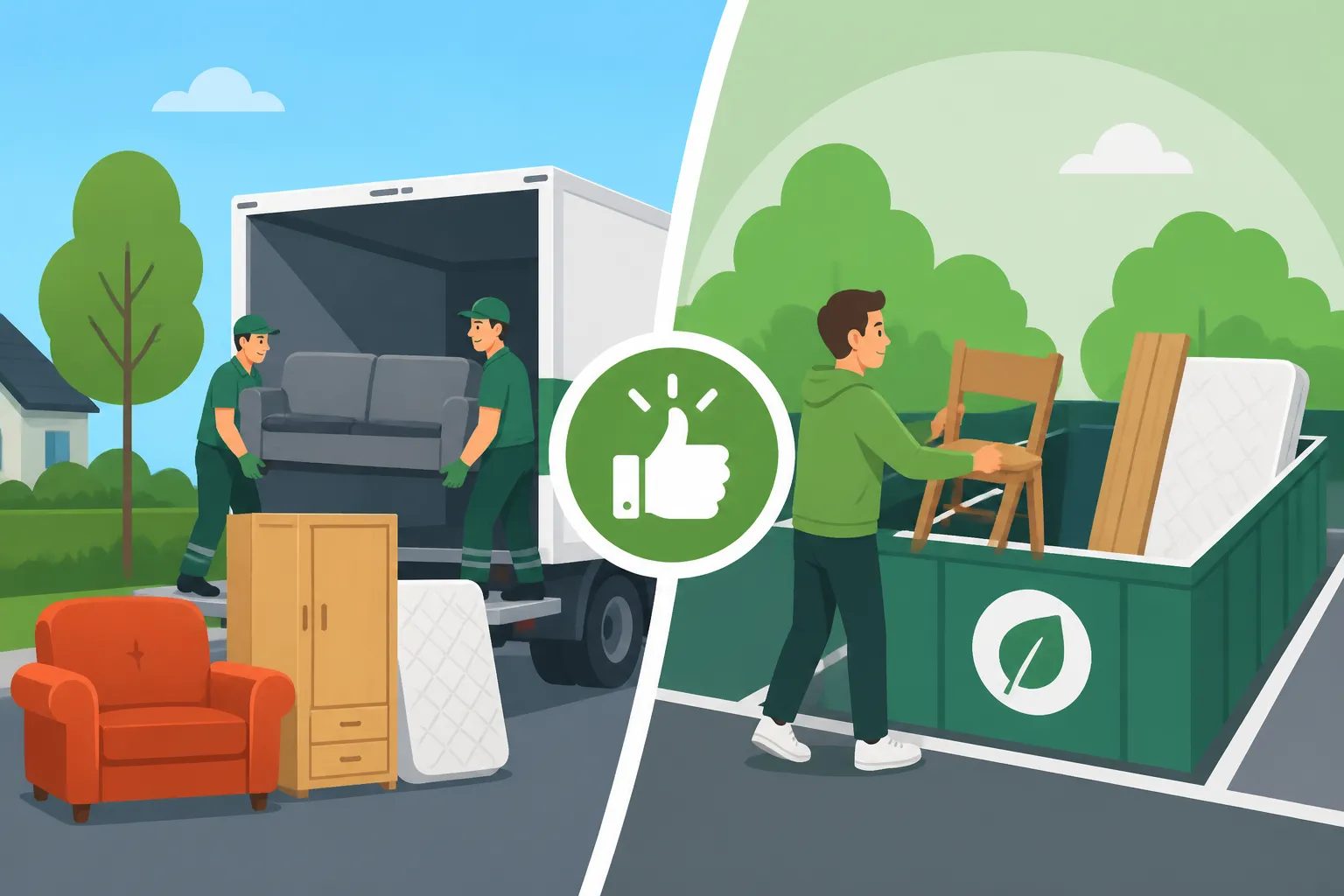
If you have access to a car or can rent a van, the Recypark (or Containerpark) is the most efficient way to get rid of oversized waste. These are large, supervised facilities where you drive in and dump your waste into massive industrial bins sorted by material. For an expat, the first visit can be intimidating. There is usually a "parkwachter" (guard) who will inspect your car's contents and tell you exactly which bin to use.
Access to these parks is strictly regulated by residency. You cannot just drive to a park in a different commune because you think their bins look nicer. You will be asked to scan your Belgian eID card at the gate. The system tracks how many kilograms or cubic meters of waste you bring in per year. Most residents get a generous "free" quota—for example, 1,000kg per year—and pay a small fee per kilo once that is exceeded.
If you are just arriving in Belgium and still looking for a home, perhaps through Finding an Apartment: Immoweb, Immovlan, and Facebook Groups, you won't have an eID yet. In this case, you can usually show your temporary "Annex" document and a utility bill as proof of address. However, it's much easier to wait until your Itsme Authentication: How to Set Up Belgium's Vital Digital ID is fully functional.
Sorting is Not Optional
The hallmark of a Belgian Recypark is the granular level of sorting. You won't find a single bin for "trash." Instead, you will find separate containers for:
- Bois (Hout): Treated and untreated wood.
- Métaux (Metalen): All types of metal.
- Inertes: Stones, ceramics, and tiles.
- Encombrants non-recyclables: The "real" oversized waste that can't be recycled.
- DEEE: Electronics and appliances.
The guards are very strict. If they see you throwing a wooden chair with a metal frame into the wood bin, they will stop you and ask you to remove the metal parts. It pays to do some "pre-sorting" at home. Bring a set of tools so you can dismantle items on-site if needed.
Vehicle Restrictions and Rental Vans
If you are planning to rent a van from a service like Moving Companies in Belgium: Dockx Rental Trucks vs Full Service, be careful about the vehicle's height and weight. Many Recyparks have height barriers (often 1.9m or 2.1m) to prevent large commercial trucks from using residential facilities. If you show up in a massive "Camionette," you might be turned away or redirected to a professional-only facility where you'll have to pay commercial rates.
Also, check the rules for "professional" looking vehicles. If you borrow a van from a friend who uses it for their construction business, the park guards might assume you are disposing of business waste. You may need to sign a declaration stating the waste is purely personal. While you're driving around, having Airalo data is great for checking the real-time "busy-ness" of the park, as many cities now have webcams or live status updates for their container parks.
Safety and Etiquette at the Park
Recyparks are busy places with cars, vans, and heavy machinery moving around. You are usually required to wear sturdy shoes (no flip-flops) and sometimes a high-visibility vest. Children and pets must stay inside the vehicle at all times.
The etiquette is simple: work fast and clean up after yourself. If you spill some gravel or glass while unloading, grab the broom nearby and sweep it up. Being polite to the guards goes a long way; they are the ones who decide if your slightly-dubious item counts as "free wood" or "paid waste." If you're setting up a new home with items from Amazon Belgium, you'll likely have a lot of cardboard; the Recypark is perfect for this, as they usually have a dedicated compactor for large volumes of paper.
Sustainability: When the Dump Isn't the Answer
Belgium has a very strong "circular economy" culture. Before you book a pickup for a sofa that is still in decent shape, consider the alternatives. Throwing away usable furniture is increasingly frowned upon, and there are several ways to give your items a second life. Not only is this better for the environment, but it can also save you the hassle of coordinating with Bruxelles-Propreté.
The most famous institution for this is Les Petits Riens (in French) or De Kringwinkel (in Dutch). These are massive second-hand social enterprises. If your furniture is in good condition, they will often come to your house and pick it up for free. This is a "win-win": you get a free pickup, and the items are sold to fund social programs. However, they are selective. If the sofa has a giant tea stain or the wardrobe is missing a door, they will refuse it, and you'll be back to square one.
If you are moving into a new place you found on HousingAnywhere, you might actually need some of this second-hand furniture. Checking out these shops is a rite of passage for any new expat. It's often where you'll find the best deals on Buying Furniture and Appliances: IKEA, Krefel, and Second-Hand Shops.
Online "Give" Groups and Marketplaces
The "Give" culture in Belgium is vibrant, especially on Facebook. Groups like "Brussels Freecycle" or "Donner à Bruxelles" are full of people who will happily drive to your house to pick up something you no longer want. I once got rid of a working but old washing machine in under two hours just by posting a photo on a local "Gefit" group.
There is also 2dehands.be (or 2ememain.be), the Belgian version of eBay/Craigslist. Even if you list an item for "€0" or "a pack of beer," it often attracts more reliable people than the "free" groups. If you're selling, be prepared to answer questions in a mix of French, Dutch, and English.
Repair Cafés and Social Projects
For items that are "slightly" broken—a toaster with a finicky switch or a chair with a loose leg—consider a Repair Café. These are community events where volunteers help you fix your items for free. It’s a great way to meet locals and save money. If you've just moved and are still Setting Up Electricity and Gas: Engie, Luminus, and Peak Tariffs, saving a few appliances can really help your initial budget.
Avoiding "Trash Tourism"
A word of caution: do not simply leave "free" items on the sidewalk with a "S'il vous plaît" sign unless your commune explicitly allows it. In some neighborhoods, this is tolerated for an hour or two, but in most, it is considered illegal dumping. If the item isn't gone by nightfall, you are responsible for bringing it back inside or disposing of it properly. Always aim for a direct hand-off via an online group rather than leaving things to chance on the pavement.
Avoiding Fines and Administrative Pitfalls
The Belgian "Police de la Propreté" (Cleanliness Police) are more active than you might think. They frequently go through abandoned trash looking for letters or invoices that link the waste to an address. If they find your name on a stray envelope inside a box of "encombrants" that wasn't booked, you will receive a hefty fine.
The fines for "dépôt sauvage" vary by commune but generally start around €150 and can escalate to over €600 for large volumes or hazardous materials. Furthermore, many communes now use mobile cameras to monitor "hotspots" where people frequently dump mattresses or electronics. It’s simply not worth the risk.
If you are a tenant, the situation is even more delicate. Landlords often include clauses in the lease about trash management. If you leave oversized waste in the building's basement or common courtyard, the landlord might use your security deposit to pay for professional removal. This is a common point of contention during the final inspection, so ensure everything is cleared out properly. You can refer to our guide on Inventory of Fixtures (État des Lieux): Why It's Crucial Before Moving In to see how to document your exit properly.
Shared Building Rules
If you live in a large apartment block, there is usually a "syndic" (building manager) who sets the rules. Some buildings have a designated day once a month where a private company comes to collect oversized items from all residents. Others strictly forbid any storage of large items in common areas.
Before you move your old fridge out of your unit, send a quick email to your building manager. They might even have a trolley you can borrow or a specific loading dock you should use. This is especially important if you are using Moving Companies in Belgium: Dockx Rental Trucks vs Full Service, as they will need clear access to the building's entrance.
What to Do if Your Pickup is Missed
Sometimes, despite your best efforts, the truck doesn't show up. This can happen due to strikes (common in Belgium), mechanical failure, or simply because the crew couldn't find your items. If your scheduled day passes and the items are still there, do not leave them on the street.
Bring them back inside (if possible) or at least move them as close to your facade as possible and call the waste agency immediately. Usually, they will send a "rattrapage" (catch-up) truck within 24 to 48 hours. If you leave them out without calling, the regular police might mark them as abandoned waste. Having your Airalo data handy to check the agency's Twitter or website for strike announcements can save you a lot of wasted effort on collection day.
Disclaimer
The information provided in this guide is for general informational purposes only and reflects the rules and regulations as of June 2026. Belgian waste management policies are subject to frequent changes at the regional and communal levels. We strongly recommend verifying current procedures, fees, and collection schedules directly with your local waste management agency (e.g., Bruxelles-Propreté, IVAGO, BEP) before disposing of any items. The author and publisher are not responsible for any fines, legal issues, or damages resulting from the use of this information.