Transportation in Belgium: SNCB Trains, Trams, and Mobib Cards
Trying to navigate Belgium’s public transport system for the first time feels like being dropped into a high-stakes logic puzzle where the rules change every time you cross a regional border. I remember my first week in Brussels, standing on a tram platform in the rain, frantically tapping my credit card against a machine that refused to acknowledge my existence while locals zipped past me with knowing smirks. This guide breaks down the Belgian transit maze so you can travel with confidence.
The Backbone of the Country: SNCB National Trains
The Société Nationale des Chemins de Fer Belges (SNCB), or Nationale Maatschappij der Belgische Spoorwegen (NMBS) if you are in Flanders, is the primary rail operator connecting every corner of the Kingdom. Whether you are commuting from a quiet suburb in Wallonia or taking a weekend trip to the coast, the train is your primary mode of movement. Unlike some neighboring countries, Belgium’s rail network is incredibly dense, meaning you can reach almost any town of significance by rail, though the frequency and "smoothness" of the journey can vary wildly depending on the line.
Understanding the Network and Ticket Types
Belgium’s rail system operates on a fairly straightforward pricing model, but the nuances are where most expats lose money. The standard ticket is a point-to-point fare, but the real value lies in the specialized products. If you are under 26, the Youth Ticket (formerly the Go Pass) offers a heavily discounted flat rate for any journey within the country. For the rest of us, the Weekend Ticket is a lifesaver; it offers a 50% discount on return journeys from Friday evening through Sunday night. I always tell newcomers that if you are planning a trip to Bruges or Ghent, wait for the weekend—it is the easiest way to keep your Cost of Living in Belgium 2026: Budgeting for Cities and Families under control.
For frequent travelers, the "Standard Multi" (formerly the Rail Pass) is a paper or digital card giving you 10 journeys for a fixed price. This is particularly useful for longer cross-country trips, such as going from Arlon to Ostend, where a standard ticket would be significantly more expensive. However, a common mistake I see is people using a "Multi" for short hops, like Brussels to Leuven, where the individual ticket price is actually lower than the cost of one line on the pass. Always check the individual price on the app before "validing" a pass line.
Navigating the Stations and Platforms
Belgian train stations are architectural marvels, ranging from the palatial Antwerp-Centraal to the ultra-modern Liège-Guillemins. However, they can be intimidating. In Brussels, the "North-Central-South" (Noord-Centraal-Zuid) axis is the busiest rail tunnel in the world. Most trains stopping in Brussels will hit all three, but always double-check the Departure boards. If you are looking for Public Transport: SNCB/NMBS (National Trains) Fares and Passes, you will find kiosks in every station, but be warned: some older machines only take Belgian Bancontact cards or coins, though most have been updated to accept international credit cards.
Platforms are often announced in two or three languages depending on where you are. In Brussels, you’ll hear French and Dutch. In Flanders, only Dutch; in Wallonia, only French. If you see "Spoor" on a sign, that’s your platform in Dutch; "Quai" is the French equivalent. A frequent trap for expats is the "splitting train." Some trains leave the station as one long unit but decouple halfway through the journey to head to two different destinations. Always check the digital screens on the side of the train carriage itself before boarding to ensure you are in the correct half.
The SNCB App and Digital Features
The SNCB app has become quite robust, offering real-time tracking that is actually fairly accurate. You can buy tickets directly through the app, which saves you from the 7-euro surcharge for buying a ticket from the conductor on the train. A particularly helpful feature is the "occupancy indicator," which tells you how crowded a train is likely to be. If you see three little "person" icons in red, expect to stand for the whole journey.
When you arrive at your new home—perhaps one you found through HousingAnywhere to be near a major hub—your first task should be downloading the app and registering your profile. Make sure you have a reliable data connection; I often suggest expats grab an eSIM from Airalo as soon as they land so they aren't stuck at a station without Wi-Fi trying to download their digital ticket while the conductor is walking down the aisle. If you lose your phone or the battery dies, you are technically traveling without a valid ticket, so keeping a small power bank from Amazon Belgium in your bag is a veteran move.
Urban Mobility: STIB, De Lijn, and TEC Explained
The most confusing part of Belgian life isn't the taxes or the grey weather; it's the fact that there are three separate companies for buses and trams depending on which region you are standing in. If you are in Brussels, you use STIB (MIVB in Dutch). If you step ten meters across the border into Flanders, you are now in De Lijn territory. If you head south into Wallonia, you belong to TEC. They do not naturally share tickets, and getting on a De Lijn bus with a STIB ticket is a one-way ticket to a 50-euro fine.
Brussels and the STIB/MIVB Network
Brussels has a fantastic metro system complemented by an extensive tram and bus network. The metro lines (1, 2, 5, and 6) are the fastest way to get across the city. The trams, however, are the "soul" of Brussels. Lines like the 92 and 93 take you through the historic heart of the city, passing the Royal Palace and the Petit Sablon. For a deep dive into the capital’s specifics, check out our guide on Brussels Transport (STIB/MIVB): Metros, Trams, and Bus Networks.
One thing you must know about Brussels is the "check-out" rule for the metro. While you only need to tap "in" for buses and trams, the metro stations have gates that require you to tap your card or phone to exit. I’ve seen many a frustrated expat stuck behind a glass gate because they buried their card at the bottom of their bag after entering. Since 2020, STIB has allowed contactless payment via credit card or phone, which is perfect for tourists, but as a resident, you’ll want a dedicated card for better rates.
Flanders and Wallonia: De Lijn vs. TEC
Outside of Brussels, things get regional. De Lijn handles all of Flanders, including major cities like Antwerp, Ghent, and Leuven. Their coastal tram (the Kusttram) is the longest tram line in the world, running the entire length of the Belgian coast. TEC handles Wallonia, covering cities like Charleroi, Liège, and Namur. The ticketing systems for these two are almost entirely digital now. You can buy a ticket via SMS or through their respective apps.
The biggest challenge for expats is the "inter-regional" commute. If you live in a Flemish suburb like Tervuren but work in the EU quarter of Brussels, you might need to use a De Lijn bus to get to a STIB metro station. This is where the specialized "Brupass" comes into play, which I will explain in the Mobib section below. Without a unified ticket, you are paying double for your commute, which is a common pitfall when navigating Everyday Rules in Belgium: Garbage Sorting, Noise, and Etiquette and other local logistics.
Integrating Different Networks
The dream of a perfectly unified Belgian transport system is still a work in progress, but the "Brupass" and "Brupass XL" zones have made it much easier. The Brupass covers all operators (SNCB, STIB, De Lijn, and TEC) within the 19 communes of Brussels. The Brupass XL extends this to several surrounding communes in Flanders and Wallonia.
If you are living in the "periphery" (the suburbs just outside Brussels), always check if your commune falls under the XL zone. It allows you to jump from a De Lijn bus to an SNCB train to a STIB metro all with a single validation on your card. It’s a massive time-saver and prevents the "ticket anxiety" that plagues new residents. Just remember that you must validate your card every time you change vehicles, even if you are staying within the same zone.
The Essential Mobib Card: Your Golden Ticket
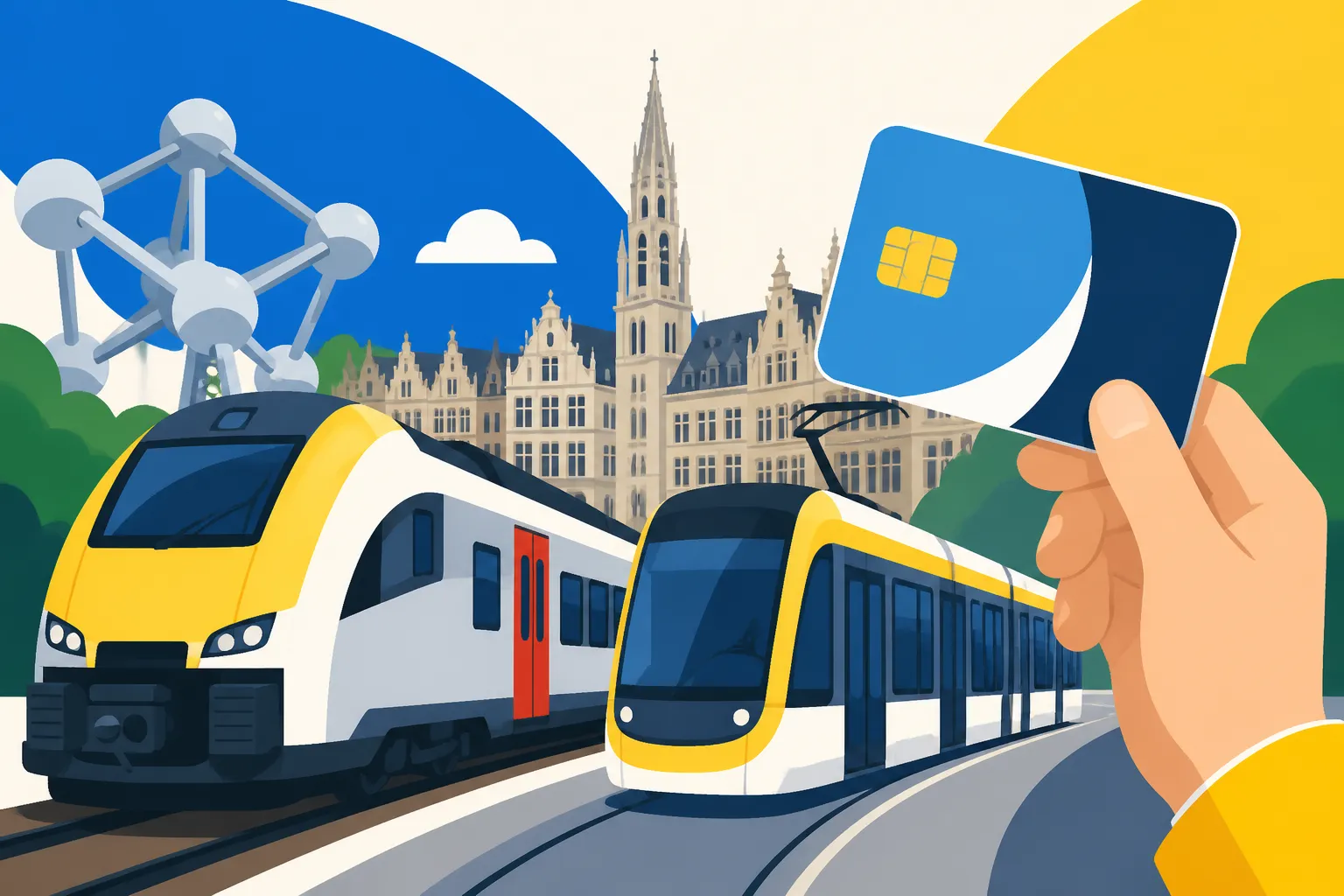
The Mobib card is a central pillar of Belgian life. It is a smart card, similar to London’s Oyster or Paris’s Navigo, that can hold various types of tickets and subscriptions from all the different operators. Even if you only plan on using the train, having a Mobib card is essential for loading your The Mobib Card: How to Load Tickets for All Belgian Transport and managing your travel history.
Personal vs. Basic Mobib Cards
There are two types of Mobib cards: Personal and Basic. A Personal Mobib card costs 5 euros, is valid for five years, and features your name and photo. You need this if you want to buy a monthly or annual subscription (abonnement). The benefit of the Personal card is that if you lose it, you can have it replaced for a small fee and your remaining balance or subscription will be transferred to the new card.
The Mobib Basic is an anonymous card, also costing 5 euros. You can buy this at any "Kiosk" or "Bootik" (STIB’s names for their service centers) without providing ID. It can hold 10-journey passes or day tickets, but it cannot hold a monthly subscription. I usually recommend that visitors or those who only use transport occasionally get a Basic card, but if you are here for more than a month, the Personal card is worth the administrative hurdle.
How to Load and Validate Your Card
You can load your Mobib card at the red "GO" machines found in all metro stations and many major tram stops. You can also load it online via the MySTIB portal or the websites of De Lijn and TEC. However, a major "Belgian quirk" is the delay in online syncing. If you buy a ticket online, it can take up to 24 hours to actually "arrive" on your card. If you need to travel immediately, load it at a physical machine.
Validation is mandatory and strict. You must tap your card against the red validators every time you board a vehicle. If you are transferring from one tram to another, you must tap again. You won't be charged extra for a transfer within 60 minutes, but failing to tap is considered "fraud" and can result in a heavy fine if a "controleur" boards the vehicle. These ticket inspectors are notorious for being uncompromising with expats who claim they "didn't know" the rules.
Using Mobib for Multi-Operator Travel
The beauty of the Mobib card is its ability to hold "contracts" from different companies. You can have a STIB monthly subscription and a 10-journey SNCB pass on the same physical card. When you tap the validator, the system is supposed to "smart-pick" the correct ticket.
| Ticket Type | Coverage | Best For |
|---|---|---|
| STIB 10 Journeys | Brussels city limits (Bus/Tram/Metro) | Occasional city travel |
| Brupass 10 Journeys | All operators in Brussels | Commuters using mixed transit |
| Brupass XL | Brussels + 11 surrounding communes | Suburban residents |
| SNCB Standard Multi | 10 journeys between any Belgian stations | Weekend explorers |
| De Lijn Lijnkaart | 10 journeys on Flemish buses/trams | Residents in Flanders |
Navigating Costs: Discounts, Subscriptions, and Employer Benefits
Belgium is a country of high taxes but also high social benefits, and this extends to transportation. If you are working for a Belgian company, you are likely entitled to have a significant portion of your commuting costs reimbursed by your employer. This is a crucial part of understanding Social Security Contributions: How Employers Deduct Health Costs and your overall compensation package.
Commuter Passes and Employer Reimbursements
By law, Belgian employers must contribute to the travel expenses of employees who commute by public transport. Often, this means they pay for 70% to 100% of your annual train or STIB subscription. Some companies even offer a "third-party payer" (derdebetalersregeling) system where they pay the transport company directly, and you get your Mobib card for free.
When you start a new job, ask your HR department about Commuter Passes (Abonnement): How Employers Refund Transport Costs. You will usually need to provide them with a "Certificate of Subscription" which you can download from the SNCB or STIB website once you’ve purchased your pass. This is one of the biggest financial wins for expats, effectively making your daily transit free.
Special Fare Classes for Youth, Seniors, and Large Families
If you are not working or are a student, there are still plenty of ways to save. The "Student Subscription" is heavily subsidized for those under 25 enrolled in a Belgian university. Seniors (65+) can get an annual pass for the entire STIB network for a symbolic price (currently around 12 euros per year).
Large families (families with 3 or more children) are also entitled to a special status that gives them significant discounts on SNCB tickets. You have to apply for a "Large Family Card" at a train station with proof of your family composition from your local commune. It’s a bit of paperwork, but for a family of five, it can save hundreds of euros a year on weekend trips.
Maximum Billing and Social Rates
Belgium has a "Maximum Billing" system for healthcare, and a similar philosophy applies to some transport costs for those on lower incomes. If you are entitled to "increased reimbursement" (BIM/RVV status) from your health insurance, you can get a "Social Subscription" for transport. This reduces the cost of a yearly pass to almost nothing. You’ll need to have your status updated on your eID card first, which then links to the transport company’s database.
Alternative and Sustainable Transit Options
While trains and trams are the backbone, Belgium is rapidly evolving into a multi-modal hub. The flat landscape of Flanders and the increasing number of bike lanes in Brussels make cycling a very viable alternative.
The Cycling Revolution: Villo!, Blue-bike, and Swapfiets
In Brussels, the Villo! system allows you to pick up a bike at one station and drop it off at another. It’s cheap but the bikes are heavy and the hills in the southern part of the city can be punishing. For commuters, Blue-bike is a fantastic service available at almost every major train station in the country. For a small annual fee, you can rent a comfortable city bike for just a few euros a day to handle the "last mile" from the station to your office.
If you prefer to have your own bike without the maintenance hassle, Swapfiets is very popular. You pay a monthly subscription for a bike, and if it breaks or gets a flat tire, they come and fix it or swap it within 24 hours. Just make sure to buy a high-quality U-lock from Amazon Belgium, as bike theft is unfortunately a common occurrence in the larger cities. For more on the rules of the road, see Biking in Belgium: Villo!, Swapfiets, and Dedicated Bike Lanes.
Shared Mobility: Poppy, Cambio, and E-scooters
For those times when public transport doesn't cut it—like a trip to IKEA or moving small furniture—car-sharing is the way to go. Cambio is a station-based system where you book a car in advance and return it to the same spot. It’s great for planned trips. Poppy and Miles offer "free-floating" cars that you can pick up and leave anywhere within their designated zones using an app.
These services are particularly useful for navigating the Low Emission Zones (LEZ) in Brussels, Antwerp, and Ghent since all shared cars are compliant with the latest environmental standards. For those who enjoy the "zip" of an electric scooter, companies like Dott and Tier are everywhere in Brussels, though regulations have tightened recently, requiring you to park them in designated "drop zones" to avoid fines. Check out our guide on Using Poppy, Cambio, and Miles Car Sharing in Belgium for more details.
Airport Connections: Getting to Zaventem and Charleroi
Getting to Brussels Airport (Zaventem) is easy via train, but there is a "hidden" cost: the Diabolo fee. This is a special airport supplement added to every train ticket to the airport. If you have an annual subscription, the fee is usually included, but if you are using a 10-journey pass, you must buy a separate "Diabolo" ticket from the machine or app to pass through the airport gates. For a cheaper alternative, the STIB Bus 12 runs from the EU quarter directly to the airport. Check the STIB/MIVB Airport Line: Cheapest Way from Zaventem to City Center for schedules.
Charleroi Airport (Brussels South) is a different story. It is not directly connected by train. You either take a train to Charleroi-Central and then a local "A" bus, or you take the Flibco shuttle bus from Brussels-South (Midi) station. The Flibco is more expensive but much more convenient for those with luggage. For a full breakdown, see our Airport Transportation: Charleroi (CRL) Shuttle Bus Guide.
Practical Survival Tips for the Daily Commute
After years of commuting in this country, I have learned that the "official" schedule is often more of a suggestion. Survival requires a mix of patience and technology.
Dealing with Delays, Strikes, and "Works on the Line"
Strikes (grèves/stakingen) are a part of Belgian life. They are usually announced in advance, but they can still cripple your day. The SNCB and STIB apps will generally show "disrupted service" icons. On strike days, don't even try to follow the schedule; just head to the station and see what turns up, or better yet, work from home if you can.
"Works on the line" are another constant, especially on weekends. The SNCB often replaces trains with "replacement buses" (bus de substitution). These are always slower than the train. If you are planning a weekend trip, check the "Planned Works" section of the SNCB website first. I once spent four hours trying to get from Brussels to Namur because of an unannounced track closure; don't let that be you.
Etiquette and Safety on Belgian Transport
Belgian transport is generally safe, but there are unspoken rules. On trains, the "Silence" zones (clearly marked on the windows) are strictly enforced by the glares of fellow passengers. Don't take phone calls there. When boarding a bus or tram, it is polite to say "Bonjour" or "Goedgedag" to the driver, though this is less common in the middle of a Brussels rush hour.
At night, major stations like Brussels-South (Midi) can feel a bit sketchy. While there is a lot of police presence, it’s best to stay in the well-lit, populated areas of the concourse rather than waiting on a dark platform. If you are traveling to London or Paris, you will likely be spending time here; see our guide on Eurostar and Thalys: Fast Trains to London, Paris, and Amsterdam for tips on navigating international departures.
Accessibility for Families and People with Reduced Mobility
Most modern Belgian trains and metros are accessible, but older tram lines and "kot" (student) neighborhood stations often have steep steps. If you are traveling with a stroller or a wheelchair, look for the blue "wheelchair" icon on the doors of the newer "Flexity" trams in Brussels or the "M7" trains on the SNCB network.
For train travel, you can request assistance 24 hours in advance via the SNCB website or app. A staff member will meet you with a ramp to help you board and disembark. It’s a surprisingly reliable service, though it does require that "Belgian planning" mindset.
Transportation Summary Table
| Mode | Operator | Primary Region | Best For | Contactless/App Pay? |
|---|---|---|---|---|
| Train | SNCB / NMBS | National | Inter-city travel | Yes (App) |
| Metro | STIB / MIVB | Brussels | Fast city transit | Yes (Contactless) |
| Tram | STIB / De Lijn | Brussels / Flanders | Local neighborhoods | Yes |
| Bus | STIB / De Lijn / TEC | All Regions | Suburban access | Yes |
| Shared Bike | Villo! / Blue-bike | Urban / Stations | Last-mile transit | Yes (App) |
Disclaimer
The information provided in this guide is for informational purposes only and reflects the Belgian transportation landscape as of mid-2026. Transport operators frequently update their fare structures, zones, and terms of service. Always check the official websites of SNCB, STIB, De Lijn, or TEC before purchasing long-term subscriptions or traveling on new routes to ensure compliance with current regulations and avoid fines.