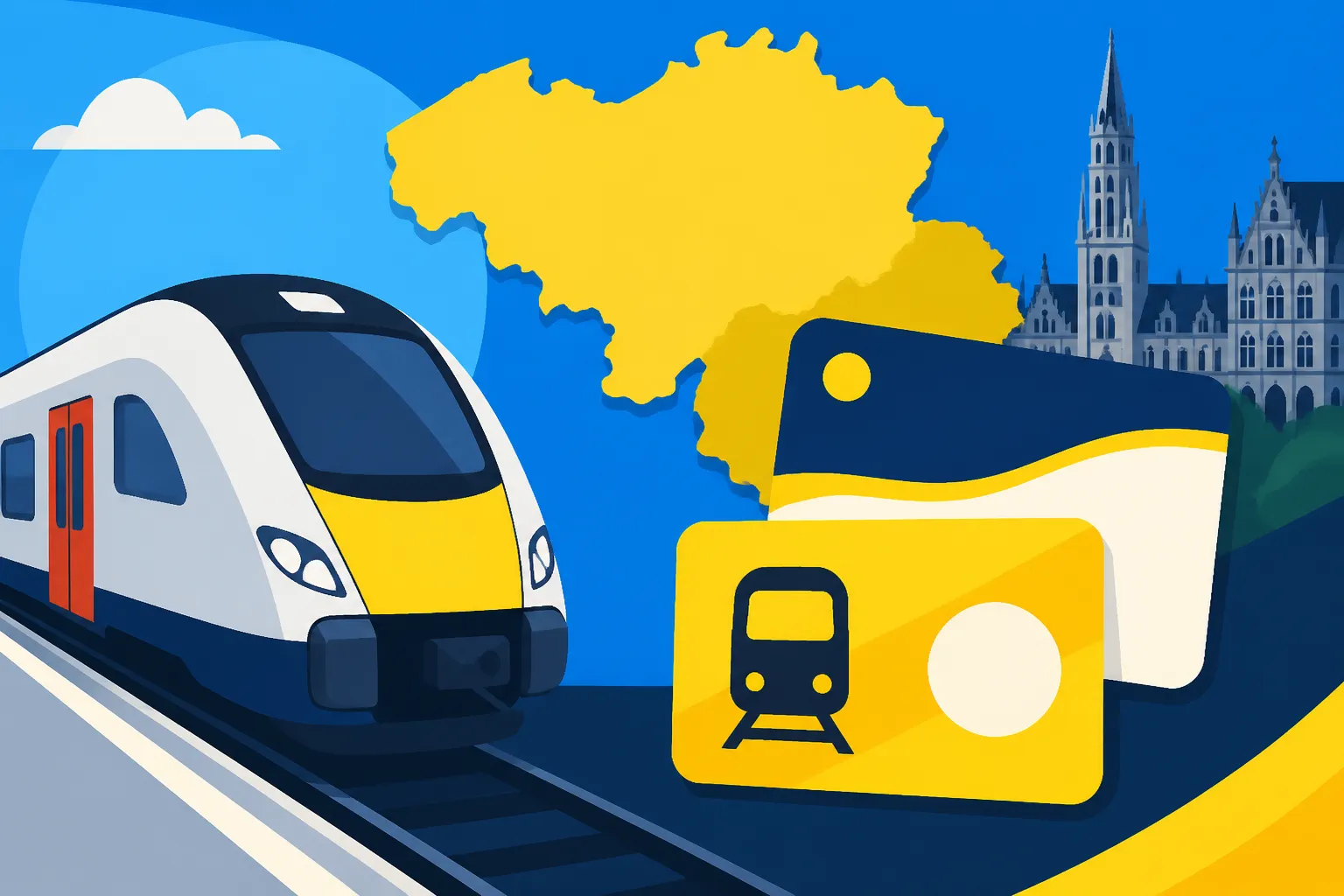
Public Transport: SNCB/NMBS (National Trains) Fares and Passes
Standing on a crowded platform at Brussels-Central, squinting at a flip-board while trying to figure out if "Louvain" and "Leuven" are the same place, is a rite of passage every expat undergoes. I remember nearly missing my first work meeting in Antwerp because I couldn't navigate the bilingual ticket machine. This guide decodes the SNCB/NMBS system to ensure you never overpay for a journey again.
Navigating the Bilingual Rails: SNCB vs. NMBS
The first thing you’ll notice when you arrive at any station is that the national rail company seems to have two names. SNCB (Société Nationale des Chemins de fer Belges) is the French name, while NMBS (Nationale Maatschappij der Belgische Spoorwegen) is the Dutch equivalent. Depending on whether you are in Wallonia, Flanders, or the bilingual capital of Brussels, the signage and announcements will shift. This is the first hurdle of many, and it often leads to confusion when looking at your phone for directions.
To keep your sanity while navigating these linguistic shifts, I highly recommend getting your digital life sorted early. Most expats find that using a local eSIM from a provider like Airalo allows them to keep the SNCB app open at all times, which is vital because platform changes are frequent and often announced only in the local language of the station. If you’re at a station in Ghent and an announcement blares in Dutch that your train has moved from Platform 3 to Platform 12, your app will be the only thing providing that update in English in real-time.
Understanding Station Naming Conventions
Belgium is a country of linguistic "border" crossings. If you are traveling from Liege to Antwerp, your departure board will show "Anvers," but as you cross the regional line, the signs on the station platforms will change to "Antwerpen." This can be terrifying if you think you’ve missed your stop. Brussels is the epicenter of this confusion. There are three main stations: North (Nord/Noord), Central (Central/Centraal), and South (Midi/Zuid).
Never assume a train stopping at "Brussels" stops at all three. Most international trains, like the Eurostar or TGV, only serve Brussels-Midi. If your apartment is near Ixelles, you might actually need the smaller Brussels-Luxembourg station. When you are still in the process of Where to Live in Belgium: Brussels, Antwerp, Ghent, or Leuven? you should pay close attention to the proximity of these smaller stations. They often provide a much faster commute than the major hubs.
The Power of the SNCB App
The SNCB app has become more than just a schedule; it is your primary ticket office. You can buy tickets, renew subscriptions, and even check the "occupancy" of the train cars to see where you’re most likely to find a seat. I’ve spent many mornings checking the app while finishing my coffee, waiting to see if the 08:12 to Brussels-Schuman is running late before I even leave the house.
One tip I learned the hard way: always activate your digital ticket before you step onto the train. If you are caught activating it as the conductor approaches, they can legally consider it "fare dodging" and issue a heavy fine. This is a common pain point for newcomers who aren't used to the strictness of the Belgian controllers. To avoid the stress of a dead phone battery, many expats pick up a reliable power bank from Amazon Belgium to keep in their work bag, as the older trains still lack USB charging ports.
Standard Fares and One-Off Tickets
For the occasional traveler or the visitor just arriving, the standard fare system is the most straightforward but also the most expensive. These tickets are valid for a specific journey between two points on a specific date. Unlike some other European countries, you don't necessarily "book" a specific train time for domestic travel; your ticket is valid for any train on that route during that calendar day.
If you are just starting your life here and haven't quite figured out your permanent Transportation in Belgium: SNCB Trains, Trams, and Mobib Cards strategy, you’ll likely be buying these standard tickets. They are perfect for those one-off trips to the commune or to visit a potential new home.
The Standard Ticket and Class Differences
A standard ticket is calculated based on the distance between your departure and arrival stations. There is a price cap, meaning once you hit a certain distance, the price stops increasing. You have the choice between 1st and 2nd class. In my years of commuting, I’ve found that 2nd class is perfectly adequate for journeys under 45 minutes. However, during peak rush hour on the Brussels-Luxembourg line, 1st class can be a lifesaver if you need to work on your laptop.
If you are moving heavy boxes or furniture from Amazon Belgium to your new flat, be aware that you might need a separate "bike/large item" supplement. I once tried to bring a flat-packed desk on a train during a quiet Sunday, and while the conductor was kind, he reminded me that officially, large items shouldn't block the aisles. It's always better to check the luggage rules on the app first.
The Weekend Ticket: The Expat’s Best Friend
If there is one thing I tell every new arrival, it’s this: never pay full price for a trip on the weekend. The Weekend Ticket offers a 50% discount on return trips between Friday evening (after 7:00 PM) and Sunday night. This also applies to public holidays.
This makes exploring the country incredibly affordable. You can head from Brussels to the coast or deep into the Ardennes for the price of a couple of beers. It’s a great way to handle the Weekend Travel: Best Domestic Trips to Bruges, Ardennes, and Coast without breaking your initial relocation budget. Just remember that the ticket must be a return journey to qualify for the discount.
Multi-Trip Passes: The Best Value for Frequent Travelers
Once you are settled, you will quickly realize that buying individual tickets is a drain on your wallet. This is where the "Multi" passes come in. These are essentially 10-trip cards that offer a significant discount per journey compared to standard fares. When I first moved here, the "Rail Pass" (now simply called the Multi) was a physical paper card you had to fill out by hand. While the paper version still exists, most of us use the digital version in the app.
If you are using HousingAnywhere to find a mid-term rental while you look for a permanent home, you might find yourself traveling between cities frequently. A Multi pass is the most flexible way to manage this.
The Multi: For Everyone and Everywhere
The standard Multi is valid for 10 trips anywhere in Belgium. You can share it with friends; if three of you are traveling together, you simply "validate" three lines on your app or paper card. It is significantly cheaper than buying 10 individual tickets if you are traveling long distances, such as from Ostend to Arlon.
However, if your trips are very short (e.g., between Brussels and its immediate suburbs), check if the individual ticket price is lower than the cost per line of the Multi. I made the mistake for months of using my pass for a short 10-minute hop, only to realize I was actually overpaying. You should also check the Maximum Billing System (MAF): Capping Out-of-Pocket Health Costs if you are budgeting strictly, as transportation and healthcare are the two biggest variable costs for new residents.
Specialized Multi-Passes: Youth and Local Options
If you are under 26, you are in luck. The Youth Multi (formerly the Go Pass 10) is incredibly cheap. It allows young expats to traverse the entire country for a fraction of the adult price. It's one of the best perks of being a student or young professional in Belgium. For those who stay within a specific geographic zone, the Local Multi is a smaller, cheaper pass designed for short-range travel.
| Pass Type | Best For | Usage Rule | Approx. Price (2026) |
|---|---|---|---|
| Standard Multi | Long-distance explorers | 10 trips, any Belgian station | €105.00 |
| Youth Multi | Under 26s | 10 trips, any Belgian station | €60.00 |
| Local Multi | Short-range commuters | 10 trips within a specific zone | €30.00 |
| Weekend Ticket | Weekend getaways | Return journey (Fri 7pm – Sun) | 50% discount |
Commuter Subscriptions for Daily Workers
If your Belgian dream involves a daily commute from a quiet town like Mechelen into the "EU Bubble" of Brussels, you need a subscription. The Belgian labor law is actually quite generous here; most employers are legally required to contribute to the cost of your train subscription. Sometimes, they even cover 100% of it.
Before you sign your work contract, make sure you understand the Social Security Contributions: How Employers Deduct Health Costs and how your commute fits into your "gross vs net" salary conversation. Many companies now offer a "mobility budget" instead of a traditional company car, which you can use to pay for a premium 1st class train subscription.
The Standard Subscription
The standard subscription is tied to a specific route. You can choose a monthly, three-month, or annual validity. It’s loaded onto your MoBIB card—the central electronic chip card used for all Public Transport: SNCB/NMBS (National Trains) Fares and Passes in Belgium. You don't need to "tap" in or out at most Belgian stations, but you must have the card ready for the conductor to scan.
One vital tip: if you forget your MoBIB card at home, don't just board the train. Go to the ticket counter. They can usually issue a temporary "forget pass" for a small fee, which is much cheaper than the fine you'll get on board. I’ve had to do this twice during my first year when I was still adjusting to the "Belgium pace."
Flexible Subscriptions for the Hybrid Era
Since the shift to remote work, the SNCB has introduced "Flex" subscriptions. These are designed for people who only go to the office 2 or 3 days a week. Instead of a monthly pass that assumes daily travel, you get a bundle of days that you can activate whenever you decide to head into the city.
This is a game-changer for those who used HousingAnywhere to find a place in a quieter city like Ghent but work in a Brussels-based tech firm. It allows you to save money on the days you stay home in your pajamas. Just remember that these flexible passes also need to be validated in the app before you board. If you find the SNCB app isn't loading because of poor signal at the station, having that Airalo data connection as a backup is a literal lifesaver.
Special Categories and Hidden Discounts
The Belgian rail system is full of niche discounts that aren't always advertised to foreigners. If you fall into a specific category, you could be saving a fortune. For example, large families (those with three or more children) are entitled to significant permanent discounts on all rail travel. You have to apply for a special card at the station, but once you have it, the savings are massive.
This is particularly helpful when you are Moving to Belgium with Family: Housing, Schools, and Childcare and need to transport the whole clan to look at schools or parks.
Senior Tickets and the "65+" Advantage
If you are over 65, or have parents visiting you, the Senior Ticket is incredible. For a flat fee (usually around €8-€10 return), a senior can travel anywhere in Belgium. There are time restrictions—you generally can't use it before 9:00 AM on weekdays to avoid the morning rush—but for a day trip to the Ardennes, it’s unbeatable.
My parents use this every time they visit. It allows them to explore small towns like Dinant or Namur without me having to drive them, giving them a sense of independence in a country where they don't speak the language. It’s part of that essential Everyday Rules in Belgium: Garbage Sorting, Noise, and Etiquette—respecting the quiet hours and the "off-peak" flow of the elderly population.
Combining SNCB with STIB/MIVB, De Lijn, or TEC
If your journey involves a train and then a metro or bus in Brussels, you can buy a "Brupass" or "Brupass XL." This single ticket or subscription allows you to use the SNCB trains within the Brussels zone AND all STIB/MIVB buses, trams, and metros.
The Brupass XL extends this to the "near suburbs," including places like Zaventem or Tervuren. It’s much cheaper than paying for two separate subscriptions. When you are calculating your Cost of Living in Belgium 2026: Singles, Couples, and Families, always check if your home and office fall within these Brupass zones. It can save a household over €50 a month per person.
Essential Tips for the Belgian Rail Experience
Even with the right ticket, the Belgian rail system has its quirks. The most important thing to know is that you should never, ever buy your ticket on the train unless the station you departed from had no working machines or counters. If you buy "on board," the conductor is required to add a "Brussels Zone" or "On-Board" surcharge, which is currently around €9.00 on top of the ticket price.
I once saw a tourist get into a heated argument with a conductor because their ticket was €5 but the surcharge made it €14. Save yourself the stress: use the app or the machines at the station. If you need travel accessories to make your trip more comfortable, like a good neck pillow or noise-canceling headphones for those noisy Friday evening trains, you can find plenty of options on Amazon Belgium.
Dealing with Strikes and Delays
Belgian rail workers are known for their frequent "grèves" (strikes). These are usually announced in advance, but they can still derail your plans. During a strike, a "minimum service" is usually guaranteed, meaning some trains will run, but they will be incredibly crowded.
If your train is delayed by more than 60 minutes, you are entitled to a refund. You can submit a claim through the SNCB website. It takes a while to process, but if you are a frequent commuter, those refunds can add up. It’s just another part of Dealing with Belgian Bureaucracy Burnout: Mental Health for Expats. Don't let it get to you; just have a backup plan, like a car-sharing app or a good book.
Finding English-Speaking Assistance
While most staff at major stations speak excellent English, the smaller stations in rural Wallonia or Flanders might be a challenge. If you run into trouble, look for the "SNCB Assist" points or the ticket counters at the big hubs like Brussels-Midi or Antwerp-Central.
If you are still in the early stages of your move and haven't quite mastered the local greetings, don't worry. The staff are generally very helpful to expats. Just remember to start with a polite "Bonjour" or "Goedendag" before launching into your question. It goes a long way in Belgian culture. For more on the social nuances, you might want to check out Building Community: Making Friends and Cultural Integration.
Disclaimer
This guide is intended for informational purposes and reflects the Belgian rail system as of mid-2026. While I strive for hyper-accuracy, the SNCB/NMBS frequently updates its fare structures, terms of service, and digital platforms. Always verify the latest prices and travel conditions directly on the official SNCB/NMBS app or website before finalizing your travel plans. Transportation laws and employer reimbursement mandates may vary based on individual employment contracts and regional regulations.