Everyday Rules in Belgium: Garbage Sorting, Noise, and Etiquette
Getting an angry, handwritten note from a neighbor because you vacuumed on a Sunday morning is a rite of passage for most newcomers in Brussels or Antwerp. I vividly remember my own first month in Ixelles, staring at five different colored garbage bags in a state of total paralysis, terrified of a fine. This guide solves the mystery of Belgian "hidden rules," from garbage sorting to social etiquette, so you can thrive without the side-eye.
Mastering the Belgian Garbage Maze
One of the first things you will notice when you move into your new place—perhaps one you found through a platform like HousingAnywhere—is the complexity of the trash system. It is not just about "throwing things away"; it is a highly regulated, color-coded logistical operation. If you put the wrong bag out on the wrong day, or worse, if you put the wrong item in the wrong bag, the local "Bruxelles-Propreté" or your Flemish/Walloon equivalent will simply leave it on the curb with a large, shaming sticker. In some cases, they will even sift through the trash to find a stray envelope with your name on it to issue a fine.
The Rainbow of Bags: White, Blue, Yellow, and Orange
The core of the system is the bag color. In Brussels, the white bag is for "everything else" or residual waste that cannot be recycled. However, don't let the "everything" fool you; it is the most expensive bag to buy because the government wants to discourage its use. You can buy these bags at almost any supermarket, but you have to ask for them at the checkout or find them in a specific aisle. They are sold in rolls of 10 or 20, and the price includes the cost of collection and processing. You can find more detail in our specific guide on Garbage Sorting Rules: Blue, Yellow, White, and Green Bags Explained.
The blue bag (PMC) is for plastic packaging, metal packaging, and drink cartons. This is the bag that has seen the most changes recently, with "New PMC" rules now allowing almost all plastic containers, including yogurt pots and butter tubs. The yellow bag is strictly for paper and cardboard. A common mistake is putting "dirty" cardboard, like a greasy pizza box, into the yellow bag. That belongs in the white bag or the orange bag. The orange bag is for organic waste—food scraps, coffee grounds, and vegetable peels. Since 2023, sorting organic waste has become mandatory in many regions, and while it might feel messy at first, it significantly reduces the smell of your general waste.
Glass Paper and Oversized Waste
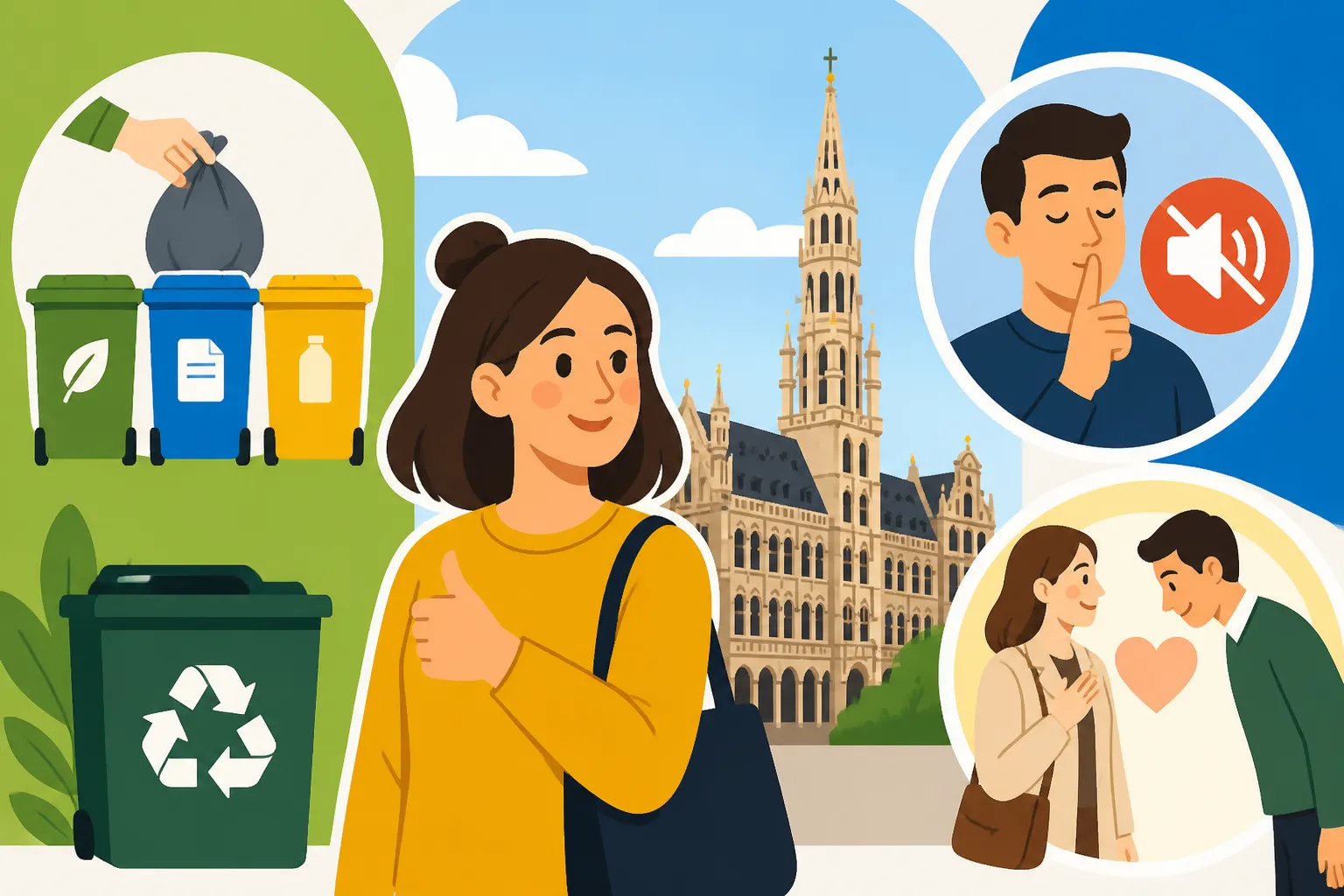
You will rarely see a bag for glass. Instead, Belgium relies on a system of "bulles à verre" (glass bins) located at strategic corners in every neighborhood. You must separate your glass by color—white glass goes in the white bin, and colored glass (green, brown, blue) goes in the green bin. Be mindful of the time; it is considered extremely rude, and often illegal, to dump glass into these bins before 7:00 AM or after 10:00 PM because of the noise. If you have bulky items like an old mattress or a broken desk, you cannot just leave them on the street. You must schedule a "collecte d'encombrants" (oversized waste collection) with your commune or drive them to a Recypark.
Many expats find that managing these different streams requires a bit of home organization. I personally recommend ordering a set of slim, stackable bins from Amazon Belgium to keep under your sink or in a hallway closet. It makes the daily habit of sorting much less of a chore. If you are still waiting for your permanent internet to be installed to look up your local collection calendar, using an eSIM from Airalo can keep you connected so you don't miss the Tuesday morning yellow bag pickup.
Recyparks and Local Collection Calendars
The collection schedule is the "holy book" of Belgian household management. Each commune has its own specific days for different bags. In some areas, white bags are collected twice a week, while yellow and blue are once every two weeks. You can usually find a printed calendar at your local Maison Communale/Stadhuis, or you can download apps like "Recycle!" which give you push notifications the night before. This is particularly important because if you miss a window, you are stuck with those bags for another week or two, and storing an orange bag of food scraps in a small apartment during a Belgian heatwave is an experience you want to avoid.
When you have items that don't fit in any bag—like batteries, lightbulbs, old electronics, or chemicals—you must take them to a Recypark (or container park). These facilities are free for residents, but you will often need to show your Belgian eID card to enter. It is a very efficient system, but the rules are strict; you will be directed to different containers for wood, metal, "hard" plastics, and inert waste like bricks or tiles. If you are currently Renting in Belgium: Apartments, Contracts, and Tenant Rights (2027), check with your landlord if there is a shared cellar area for these items, though usually, the responsibility falls on the tenant.
Living in Harmony: Noise Regulations and Apartment Etiquette
Belgians value their "rust" (peace/quiet) immensely. The transition from a bustling global city to a Belgian residential street can be a shock because of how quiet it becomes after dark. The social contract here is built on the idea that your home is a sanctuary, and you should not infringe on the peace of your neighbors. This is especially true in the "maisons de maître" (converted townhouses) where sound insulation is often non-existent. Understanding Noise and Apartment Etiquette: Quiet Hours and Sunday Rules is the difference between a friendly "Bonjour" in the hallway and a formal complaint to the police.
The Silent Sunday Rule and Evening Hours
Sunday in Belgium is a "sacred" day of rest, but not necessarily in the religious sense. It is a day where noisy activities are strictly prohibited. This includes mowing your lawn with a petrol mower, using a power drill, or even doing heavy hammering for DIY projects. While the law varies slightly by commune, the general rule is that Sunday is a day of silence. If you decide to build that IKEA bookshelf on a Sunday afternoon, don't be surprised if there is a knock on your door within twenty minutes.
On weekdays and Saturdays, the "quiet hours" usually begin at 10:00 PM and last until 7:00 AM. This doesn't mean you can't live your life, but it does mean you should avoid running the washing machine, vacuuming, or having loud conversations on your balcony. Many apartment buildings have internal rules (règlement de copropriété) that are even stricter than the communal laws. If you are living in a shared building, you might be paying for Common Charges (Charges Communes): What Exactly Are You Paying For?, which often includes the maintenance of quiet, clean hallways, and violating these can lead to administrative fines.
Parties and Neighborly Notifications
Belgians are generally very tolerant of social gatherings if they are handled correctly. If you are planning a housewarming party or a birthday celebration, the "gold standard" of etiquette is to leave a small, polite note in the mailboxes of your immediate neighbors (and the ones above and below you) at least three days in advance. Mention that there might be some noise and provide your phone number so they can text you if it gets too loud.
This simple gesture acts as a "buffer." Most neighbors will be much more forgiving if they know there is an end time and a way to contact you. However, "notifying" doesn't give you a legal right to blast music until 4:00 AM. In Belgium, "tapage nocturne" (nightly disturbance) is a serious offense, and the police have the right to enter and shut down a party if they receive complaints. Always aim to bring the volume down significantly by midnight.
Managing Common Areas and Syndic Meetings
If you own an apartment or are a long-term tenant, you will eventually encounter the "Syndic." This is the professional or volunteer manager of the building's common areas. Etiquette in common areas is vital. You should never leave your bike, stroller, or garbage bags in the hallway, as these are considered fire hazards and an eyesore. Even if you see a neighbor doing it, don't follow suit; the "Syndic" will eventually send a stern letter to everyone.
Participation in the "Assemblée Générale" (AG) is where the real politics of the building happen. While tenants usually don't attend (the landlord does), the decisions made there affect your daily life—from when the heating is turned on to the rules about pets. If you are a tenant, ensure you did a thorough Inventory of Fixtures (État des Lieux): Why It's Crucial Before Moving In, as many disputes about "etiquette" and "care of the property" arise when you move out. Treating the common staircase as an extension of your home—meaning keeping it clean and quiet—will win you the respect of the long-term Belgian residents who likely have lived there for decades.
Navigating Public Spaces and Transportation Etiquette
Belgian public life is governed by a blend of northern European reserve and southern European warmth. It can be confusing for an expat to know whether to shake hands, kiss, or simply nod. Similarly, the way people move through the cities—whether by train, tram, or bike—has its own set of unwritten (and some very written) rules.
The Art of the Belgian Greeting: Bises vs Handshakes
The "Belgian kiss" (la bise) is a source of eternal confusion. Unlike in parts of France where it is two, three, or four kisses, in most of Belgium (especially Brussels and Wallonia), the standard is just one kiss on the cheek. This is common between women, and between men and women who are friends or acquaintances. In Flanders, a handshake is more common for first meetings, and the "one kiss" is reserved for closer friends.
In a professional setting, a firm handshake is the only way to go. If you are meeting a group of people, it is polite to greet each person individually rather than waving at the room. When you enter a small shop, a bakery, or a doctor’s waiting room, it is standard etiquette to say a general "Bonjour/Goedendag" to everyone present. Leaving without saying "Merci, au revoir/Bedankt, tot ziens" is considered quite cold.
Train and Tram Etiquette: The Mobib Card Life
The Belgian rail system (SNCB/NMBS) is the backbone of the country. When using Public Transport: SNCB/NMBS (National Trains) Fares and Passes, remember that silence is the golden rule, especially in the designated "Silent Zones" on newer trains. Talking loudly on your phone or playing music without headphones will result in very pointed stares. If the train is crowded, it is expected that you move your bag off the seat next to you to let others sit.
In the cities, you will likely use the STIB (Brussels), De Lijn (Flanders), or TEC (Wallonia). You must always validate your ticket or your The Mobib Card: How to Load Tickets for All Belgian Transport every time you board, even if you have a monthly pass. Failure to "bip" your card can result in a fine if a ticket inspector boards. On buses and trams, you should always enter through the front or designated doors and exit through the others. Giving up your seat for the elderly or pregnant women is not just a suggestion; it is a deeply ingrained social expectation.
Cycling and Pedestrian Safety Norms
Belgium, particularly Flanders, is a cycling paradise, but it comes with strict rules. Cyclists must stay on designated paths, and in many "one-way" streets, cyclists are allowed to go both ways (look for the "SENS UNIQUE" sign with a bicycle icon and "EXCEPTÉ/UITGEZONDERD"). As a pedestrian, never step into a cycle lane without looking; cyclists in cities like Ghent or Antwerp move fast and have the right of way.
Pedestrians are expected to wait for the green light at crossings, even if no cars are coming. "Jaywalking" isn't as common as in the US or UK, and in some communes, police will actually fine you for crossing on red. If you are driving, be aware of the "Priorité à droite" (Priority from the right) rule. Unless there are signs stating otherwise (like a yellow diamond), you must yield to any vehicle coming from a street on your right. This is one of the most dangerous traps for new expat drivers.
Administrative and Household Maintenance Rules
Living in Belgium involves a fair amount of "paperwork" and "preventive care." The government and your landlord expect a high level of proactivity when it comes to maintaining your residence and your legal status. This isn't just about being a good neighbor; it's about avoiding legal liabilities.
Mandatory Boiler Maintenance and Tenant Duties
In many countries, if the heater works, you leave it alone. In Belgium, if you have a gas boiler, you are legally required to have it serviced every two years (every year for oil boilers). This is a tenant responsibility unless your contract specifically says otherwise. You must hire a certified technician to perform the Boiler Maintenance (Entretien Chaudière): Tenant Duty in Belgium and keep the certificate they give you. If there is a fire or a carbon monoxide leak and you cannot produce these certificates for the last few years, your insurance will likely refuse to pay out.
Additionally, tenants are responsible for small repairs and "good housekeeping." This includes bleeding the radiators in winter, cleaning the lime scale (calcaire) out of faucets and showerheads—which is a major issue due to Belgium's hard water—and ensuring the gutters are not blocked by leaves if you live in a house. These small tasks are often checked during the move-out inspection, and deductions from your deposit for "lack of maintenance" are very common.
Sidewalk Maintenance: Snow and Leaves
This is a rule that catches many by surprise: you are responsible for the sidewalk in front of your home. If it snows, you must clear a path and put down salt. If someone slips and falls on the ice in front of your door, you can be held legally liable for their medical expenses. The same applies to wet leaves in the autumn.
In apartment buildings, this task is usually handled by a "concièrge" or a cleaning company paid for through the common charges. However, if you live in a small building or a house, the duty is yours. It is a good idea to have a shovel and a bag of salt ready in your cellar before the first winter storm hits. You can find these at any Brico or Gamma, or order them in advance through Amazon Belgium.
Registering at the Commune and Identity Checks
Every foreigner moving to Belgium must complete the Registering at the Commune: The 8-Day Rule After Arrival. This is not just a suggestion; it is the beginning of your legal existence in the country. Once you register, a police officer will physically come to your home to verify that you actually live there. They might check your mailbox to see if your name is on it and ask a few basic questions. It is a strange experience for many, but it is a standard part of the process.
Once you have your residence card, you are legally required to carry it with you at all times. The police have the right to ask for your identification without "probable cause" in many situations. While this rarely happens in day-to-day life, if you are stopped for a minor traffic violation or are involved in a public incident and don't have your ID, you can be taken to the police station for identity verification.
Shopping, Service, and Tipping Culture
The Belgian consumer experience is different from the 24/7 convenience of the US or the high-service culture of Asia. It is a "work-to-live" society, which means businesses have strict closing times so that their employees can go home to their families.
Sunday Closures and Planning Ahead
The most important rule for shopping in Belgium: almost everything is closed on Sunday. Supermarkets, clothing stores, and pharmacies shut down. The exception is "Magasins de Proximité" (small Express versions of Carrefour or Delhaize) which might stay open until noon, and some bakeries that thrive on Sunday mornings as people buy fresh "pistolets" and pastries.
Most shops also close relatively early on weekdays, usually around 6:00 PM or 7:00 PM. On Fridays, some supermarkets stay open until 8:00 PM or 9:00 PM. This requires a significant shift in planning for many expats. If you realize at 9:00 PM on a Saturday that you are out of milk, you are likely out of luck until Monday morning. For non-perishable essentials, I often rely on Amazon Belgium, which offers reliable delivery, but even then, don't expect Sunday deliveries.
Tipping in Restaurants and Delivery Etiquette
Tipping in Belgium is a "bonus," not a requirement. Service is included in the price of your meal by law. However, if the service was particularly good, it is common to leave a small amount—usually rounding up to the nearest 5 or 10 Euro. For example, if your bill is 47 Euros, leaving 50 is seen as a very generous tip. You can read more about the nuances in Tipping Culture in Belgium: Restaurants, Cafes, and Deliveries.
When it comes to home delivery (Deliveroo, UberEats), tipping 1 or 2 Euros through the app is appreciated but not mandatory. The same goes for taxi drivers. Unlike in the US, you will never be chased down the street for not tipping. The "service included" philosophy means that staff are paid a living wage, though in the current economy, small tips are increasingly welcomed.
Supermarket Efficiency and the Cart Coin
When you go to a Belgian supermarket, you need a 1 or 2 Euro coin to unlock a shopping cart. You get the coin back when you return the cart to the bay. This ensures that carts aren't left rolling around the parking lot. At the checkout, the pace is fast. You are expected to bag your own groceries, and the cashier will not wait for you to finish before starting the next customer's order.
Bring your own reusable bags! Plastic bags are rarely free and are often discouraged. Most Belgians keep a "stash" of sturdy bags in their car or by their front door. If you forget yours, you'll have to buy a new one for about 30-50 cents. It is a small but constant reminder of the country's push toward sustainability.
Environmental and Energy Conservation Norms
Belgium is a small, densely populated country with a strong focus on "green" living. This translates into specific household habits that you are expected to adopt, both for the planet and to keep your utility bills from skyrocketing.
Water Conservation and Tap Water Habits
Tap water in Belgium is perfectly safe to drink, though it is very "hard" (high mineral content). While many Belgians still buy bottled water in bulk, the trend is shifting toward tap water with a filter. In restaurants, you will almost never be served "free" tap water; you are expected to buy bottled still or sparkling water. Asking for "carafe d'eau" is often met with a polite refusal, though this is slowly changing in more "eco-conscious" Brussels bistros.
In the home, water is expensive. Using a "half-flush" on the toilet and not letting the water run while brushing your teeth are standard practices. If you are living in an older building, be mindful of leaks; a dripping faucet or a running toilet can add hundreds of Euros to your bill over a few months.
EPC Ratings and Winter Heating Etiquette
Every rental property must have an Energy Performance Certificate (EPC/PEB). This rating (from A to G) tells you how much it will cost to heat the place. Because energy prices in Belgium are among the highest in Europe, "heating etiquette" is a major topic. Most Belgians keep their homes at 19-20°C during the day and drop it to 15-16°C at night.
Using "smart" thermostats is common, but even if you don't have one, it is expected that you turn off the heat in rooms you aren't using. If you have the window open for "airing out" (a common Belgian habit called "aérer"), make sure the radiator is turned off. If your landlord sees you with the windows wide open and the heating on full blast, they will see it as a sign of disrespect for the property. Understanding your Understanding the 3-6-9 Lease Contract: The Standard 9-Year Lease is helpful here, as it often outlines expectations for "good father" care of the property.
Low Emission Zones and Car Usage Rules
If you own a car, you must be aware of the Low Emission Zones (LEZ) in Brussels, Antwerp, and Ghent. Older diesel cars are banned from these cities entirely, and you will be automatically fined via camera if you enter without a compliant vehicle. You must register your car (even if it is compliant) on the city's LEZ website before entering.
Parking is another "rule-heavy" area. In many neighborhoods, you need a "blue disk" to park for a limited time (usually 2 hours). You must set the disk to your arrival time and display it clearly on the dashboard. Residents can apply for a parking permit from their commune, which allows them to park for free in their own neighborhood. If you don't have a permit or a disk where required, the "scancar" or a parking warden will find you with ruthless efficiency.
Summary of Essential Belgian Everyday Rules
| Topic | Rule / Etiquette | Potential Penalty / Consequence |
|---|---|---|
| Garbage | Must use specific commune-colored bags. | Fines from €50 to €200+ and non-collection. |
| Noise | No loud noise 10 PM – 7 AM; Silent Sundays. | Police intervention; neighbor disputes. |
| Sunday | Shops/services closed (except some bakeries). | Being unable to buy food/essentials. |
| Greeting | One kiss (social) or firm handshake (work). | Awkward social friction or perceived rudeness. |
| Sidewalks | You must clear snow/leaves in front of your home. | Legal liability for falls/injuries. |
| Boilers | Legal biennial maintenance for gas boilers. | Insurance claim denial; safety risks. |
| Transport | Must validate (bip) Mobib card every time. | Fines from €10 to €100+ during inspections. |
| Shopping | Bring your own bags; need coin for cart. | Paying for bags; no cart access. |
Disclaimer
The information provided in this guide is for general informational purposes only and does not constitute legal or professional advice. While we strive to keep the information up to date (as of 2026), Belgian laws and local communal regulations are subject to frequent changes. Always verify specific rules with your local Maison Communale/Stadhuis or legal counsel. No veteran expat, however experienced, can replace the official word of the Belgian authorities.