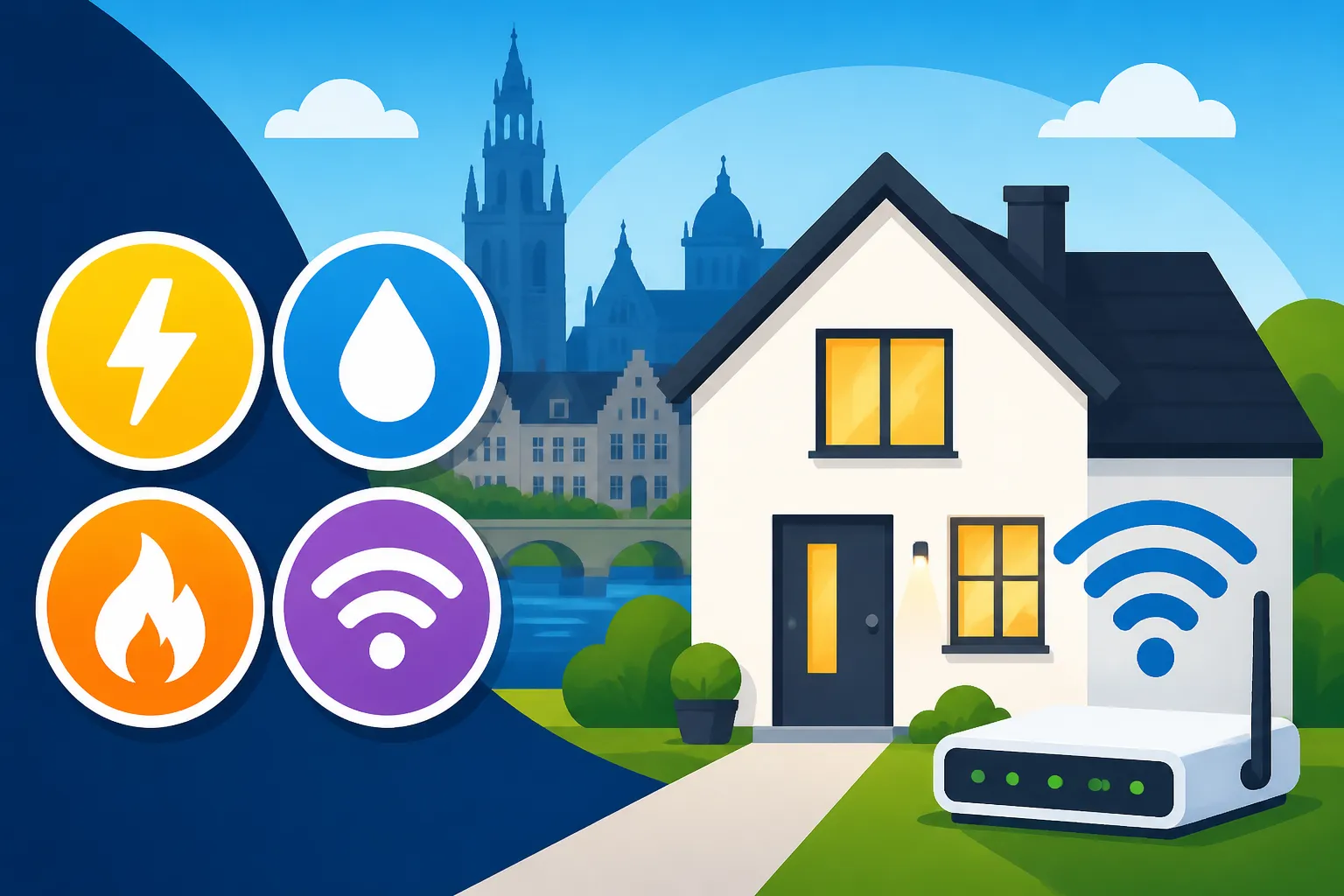
Utilities and Home Setup: Electricity, Water, Gas, and Internet
Moving into a Belgian apartment often feels like a victory until you realize the previous tenant took every single lightbulb and the gas meter is physically locked with a red plastic seal. I remember my first night in Ixelles, shivering under a stack of coats because I assumed the heat would "just work" upon arrival. This guide is your roadmap to avoiding those cold, dark nights by mastering the Belgian utility maze from day one.
Understanding the Belgian Utility Landscape
Setting up a home in Belgium is a decentralized process that varies significantly depending on whether you are in Brussels, Flanders, or Wallonia. Unlike some countries where a single municipal body handles everything, Belgium operates on a liberalized market for energy but maintains regional monopolies for water. This means you have the power to shop around for the best electricity and gas deals, but you are stuck with whoever provides water in your specific commune. It is a system that rewards the proactive and punishes the "I'll do it next week" procrastinator.
Liberalized Markets vs Regional Monopolies
In the energy sector, the market was opened up years ago to encourage competition. This is great for your wallet but confusing for your brain. You have to distinguish between the "Grid Operator" (the people who own the physical pipes and wires) and the "Supplier" (the company that sends you the bill). If your power goes out, you call the operator (like Sibelga in Brussels or Fluvius in Flanders). If you want a cheaper rate, you talk to your supplier. Understanding this distinction is vital because your supplier cannot help you if your physical meter is broken, and your grid operator cannot help you with a billing dispute.
When you first arrive, you might be overwhelmed by the choices. Many expats use HousingAnywhere to secure their initial housing, and these properties often come with utilities included for the short term. However, once you move into a long-term "unfurnished" rental, the responsibility shifts entirely to you. You are expected to choose a supplier and notify the grid operator within eight working days of moving in. If you fail to do this, the grid operator will eventually cut the supply, and getting it reconnected involves a hefty fine and a lot of administrative paperwork that can take weeks to resolve.
The Importance of the EAN Code
The most important thing you need to find—even before you unpack your first box—is the EAN code for your electricity and gas meters. An EAN (European Article Number) is a 18-digit code starting with 54 that identifies the specific connection point for your apartment. It is not the same as your meter serial number. Think of the EAN as the "GPS coordinates" for your energy supply. Every apartment has a unique one for electricity and usually a separate one for gas. Without these codes, no supplier can open an account for you.
You can usually find the EAN code on a sticker near the meter itself, or more reliably, on the previous tenant’s last energy bill. If the previous tenant didn't leave a copy, you must ask your landlord or the building’s "syndic" (the building manager). In some older Brussels buildings, meters are hidden in a basement labyrinth, so bring a flashlight. Pro tip: take a clear photo of the EAN code and the current meter reading the second you get your keys. This photo is your ultimate evidence if there is ever a dispute about when your consumption started.
Setting Up Electricity and Gas
The Belgian energy market is highly competitive, and while the "Big Three" (Engie, Luminus, and TotalEnergies) dominate, there are dozens of smaller "green" suppliers that might offer better rates or better customer service in English. Setting this up is usually the first "adult" task you will face after signing your lease and completing the Inventory of Fixtures (État des Lieux): Why It's Crucial Before Moving In. Because energy prices in Europe have been volatile recently, your choice of contract type can have a massive impact on your monthly budget.
Choosing Your Supplier
When selecting a supplier, do not just look at the price per kWh. Look at the "redevance fixe" (the annual administrative fee) and the quality of their digital portal. As an expat, you want a supplier with a robust app where you can easily adjust your monthly "acompte" (down payment). In Belgium, you don't pay for exactly what you used each month; instead, you pay a flat estimated fee, and at the end of the year, you either get a refund or a very scary "regularization" bill.
I highly recommend using a comparison tool like Brusim (for Brussels), Vtest (for Flanders), or Compari-Energie (for Wallonia). These are independent sites that will show you the cheapest options based on your estimated usage. If you are living alone in a small studio, your needs will be vastly different from a family in a four-bedroom house in Tervuren. Once you choose, the signup process is entirely online. You provide your EAN code, your bank details for a "domiciliation" (direct debit), and the meter readings from the day you moved in. The supplier handles the rest of the communication with the grid operator.
Variable vs Fixed Rate Contracts
This is the eternal debate in Belgian expat forums. A fixed-rate contract locks in your price for one, two, or three years. This provides peace of mind; even if a global crisis hits, your rate stays the same. However, fixed rates are often priced higher by the companies to cover their risk. A variable-rate contract fluctuates every month or quarter based on market prices. If energy prices drop, you save money automatically. If they spike, you’ll feel it in your regularization bill.
Given the recent history of energy prices in Belgium, many companies stopped offering fixed rates for a while, but they are slowly returning. If you are the type of person who needs a predictable budget, go for fixed. If you are okay with a bit of market gambling, variable is usually cheaper over a long period. Regardless of which you choose, make sure to ask about Standard vs Bi-Hourly Electricity Meters: Day and Night Tariffs. If you have a bi-hourly meter, you pay less for electricity at night and on weekends, which is the perfect time to run your dishwasher and laundry.
The Energy Handover Document
The "Document de Reprise des Énergies" is the single most important piece of paper in your Belgian administrative life. It is a four-page PDF where both the departing tenant and the arriving tenant record the meter readings and the EAN codes, then sign it. This document is not sent to the supplier; you keep it as a "proof of state." If the previous tenant had a massive debt or if the supplier tries to claim you used 5,000 units in your first week, this signed paper is your legal shield.
Never, under any circumstances, move into a place without this document. If the landlord says, "Don't worry, I'll take care of it," politely insist on signing the paper together. It protects the landlord, too. Once signed, you take the data from that paper and enter it into your chosen supplier's website. If you are moving into a building with Common Charges (Charges Communes): What Exactly Are You Paying For?, ensure you clarify which utilities are covered by the building and which ones you must contract individually. Usually, electricity for your unit is always your responsibility, while water or heating might be collective.
Navigating the Water System
Unlike energy, water is a regional monopoly. You don't get to choose your water provider; your address chooses it for you. In Brussels, it is almost always Vivaqua. In Flanders, it is often De Watergroep or Farys. In Wallonia, it is typically SWDE. Because there is no competition, the process is less about shopping around and more about mandatory registration.
Regional Providers and Registration
When you move in, you have a 15-day window to notify the water company of the change in occupancy. Similar to energy, there is a specific water handover form. You’ll need the meter serial number (usually found on the dial) and the reading. Most providers now allow you to do this via their website. If you are in a large apartment block, the water might be managed by the syndic, and the cost is folded into your monthly building charges. In this case, you don't need a separate contract, but you should still verify this with your landlord.
In Brussels, Vivaqua is the sole provider. Their billing cycle is usually quarterly, but they also use the "acompte" system where you pay an estimate and then settle the difference once a year after a technician visits to read the meter (or you submit the reading online). If you are moving to the suburbs, check your local commune’s website to find your provider. If you find yourself needing to buy bottled water or filters while you wait for your home setup, you can find everything on Amazon Belgium to be delivered right to your door.
Understanding Your Water Bill and Consumption
Water in Belgium is surprisingly expensive compared to many other EU countries. This is because your bill includes not just the "blue water" you drink, but also the "grey water" management and sewage treatment. In Brussels, the pricing is "progressive," meaning the first few cubic meters (the "vital" amount) are cheap, but the more you use, the higher the price per liter becomes. This is designed to discourage wasting water.
One thing to watch out for is a leaking toilet or a dripping faucet. Because of the progressive pricing, a small leak can lead to a bill of several thousand euros by the end of the year. I always suggest doing a "leak test" when you first move in: take a reading before you go to bed and another one when you wake up (without using any water in between). If the numbers changed, call your landlord immediately. This is a standard part of the Renting in Belgium: Apartments, Contracts, and Tenant Rights (2027) that you should be aware of.
High-Speed Internet and Mobile Connectivity
A house without internet is just a cave. Belgium has excellent infrastructure, with widespread fiber-optic rollout, but the "installation dance" can be frustrating. You have two main types of technology: DSL (via the phone line, dominated by Proximus) and Cable (via the TV coax cable, dominated by Telenet in Flanders/Brussels and VOO in Wallonia).
Proximus, Telenet, and VOO
Proximus is the national incumbent. They have the most extensive network and are currently the leaders in the fiber-to-the-home (FTTH) rollout. If your building has a little "Proximus Fiber" sticker in the hallway, go with them—the speeds are symmetrical and incredibly fast. Telenet, on the other hand, is known for very high download speeds via cable, but their upload speeds are generally lower than fiber. Telenet is the "premium" choice in Flanders and parts of Brussels.
| Provider | Tech Type | Regional Focus | Best For |
|---|---|---|---|
| Proximus | Fiber / DSL | National | Fiber speeds and mobile bundles |
| Telenet | Cable | Flanders / Brussels | High-speed cable and TV content |
| VOO | Cable | Wallonia / Brussels | Residents in French-speaking areas |
| Mobile Vikings | Fiber / DSL | National | No-nonsense internet for tech-savvy users |
| Scarlet | DSL | National | Budget-conscious expats |
Choosing between them often comes down to what is already wired into your apartment. If there is a Telenet box on the wall, that setup will be faster than installing Proximus from scratch. Always check the "eligibility" on their websites by entering your exact address and box number.
Installation Timelines and Hardware
Do not wait until you move in to order your internet. The lead time for a technician can be anywhere from three days to three weeks. In most cases, a technician must come to your home to "activate" the line, even if the hardware is already there. They are notorious for giving 4-hour windows (e.g., "we will arrive between 8:00 and 12:00"), so plan to be home.
If you are a gamer or work from home, ask specifically about the router's Wi-Fi 6 capabilities. Belgian walls are often made of thick brick or reinforced concrete, which are "Wi-Fi killers." You might need a "Wi-Fi Booster" or a Mesh system to get a signal in your bedroom. While waiting for your technician, you can use an eSIM from Airalo to stay connected on your phone and use it as a hotspot. It's a lifesaver for those first few days when you're trying to find the nearest grocery store or translate your lease.
Mobile Plans and Initial Connection
While your home internet is being sorted, you’ll need a local mobile number. Belgium has three physical network operators: Proximus, Orange, and Base. However, the "MVNOs" (smaller companies that rent the big networks) often have better deals. Mobile Vikings is a favorite among expats for their generous data packages and English-language support.
You can get a prepaid SIM card at any supermarket or "Night Shop," but you must register it with your ID. Due to anti-terrorism laws, anonymous SIM cards are illegal in Belgium. You can use your passport or your Belgian eID card to register at a kiosk. Once you have your Itsme Authentication: How to Set Up Belgium's Vital Digital ID, managing your mobile and internet accounts becomes much easier as you can log in to almost any Belgian service with just a fingerprint or PIN.
Waste Management and Regional Sorting Rules
Garbage is not just "garbage" in Belgium; it is a complex social contract. Each region has strict rules about which colors of bags you use and when you put them on the sidewalk. If you get it wrong, the "garbage police" (yes, they exist) can tear open your bag, find a stray envelope with your name on it, and send you a fine of €100 or more.
The Bag System: White, Blue, Yellow, Green
In Brussels, the system is color-coded. You must buy specific bags from the supermarket (Colruyt, Delhaize, or Carrefour). You cannot use generic black bags.
- White Bags: General non-recyclable waste. This is the most expensive bag because it goes to the incinerator.
- Blue Bags (PMC): Plastic bottles, metal packaging, and drink cartons. This is very cheap to encourage recycling.
- Yellow Bags: Paper and cardboard. Must be clean (no greasy pizza boxes).
- Green/Orange Bags: Food waste and garden waste. In many communes, this is now mandatory for composting.
Check the website of Bruxelles-Propreté or your local Flemish/Walloon inter-communal site for the "Calendrier de Collecte." You usually put the bags out the night before or early in the morning. If you leave them out on the wrong day, they will sit there, get ripped open by foxes or seagulls, and eventually lead to a fine. It’s one of those Everyday Rules in Belgium: Garbage Sorting, Noise, and Etiquette that takes a few weeks to memorize but is vital for being a good neighbor.
Recyparks and Oversized Waste
If you have large items—like the boxes from your Amazon Belgium furniture or an old mattress—you cannot just leave them on the street. You have two options: book a "pro-encombrants" pickup or visit a Recypark (container park). Most residents get a certain amount of free "large waste" pickup per year (usually 3 cubic meters), but you have to call and book it weeks in advance.
The Recyparks are great but require a Belgian ID or a "Recypark Card" to enter. They are very strict about sorting. You’ll be expected to put wood in the wood bin, metal in the metal bin, and "hard plastics" in another. It’s a bit of an ordeal, but it’s the only way to get rid of big stuff legally. If you are moving in and have a lot of trash, check our guide on Oversized Waste (Encombrants): Booking a Pickup or Using Recyparks.
Home Maintenance and Tenant Obligations
Many expats are surprised to learn that certain "industrial" maintenance tasks are the legal responsibility of the tenant, not the landlord. Failing to do these can result in your insurance being voided if something goes wrong.
Annual Boiler Maintenance
If your apartment has an individual gas boiler for heating and hot water, you are legally required to have it serviced by a certified professional every year (in Brussels and Wallonia) or every two years (in Flanders). You must pay for this service (usually €150–€200), and you must keep the "attestation" (the certificate) to show your landlord or your insurance company.
If the boiler breaks and you haven't had the mandatory Boiler Maintenance (Entretien Chaudière): Tenant Duty in Belgium done, the landlord can hold you liable for the full repair cost. I recommend setting a calendar reminder for the anniversary of your move-in date to book a "chauffagiste." It’s a small price to pay to ensure you don't lose your hot water in the middle of a Belgian winter.
Fire Insurance and Liability
In Flanders and Wallonia, fire insurance is a legal requirement for tenants. In Brussels, it is almost always written into the lease contract as a mandatory clause. This insurance doesn't just cover your belongings; more importantly, it covers your "tenant liability." If you leave a candle burning and the building catches fire, your insurance pays for the damage to the landlord's property.
You should also look into "Assurance Familiale" (Family Liability Insurance). It’s incredibly cheap (about €20–€30 a year) and covers you if you accidentally cause damage to others—like if your washing machine leaks and ruins the neighbor's ceiling or if you accidentally hit someone with your bike. For more details, see Mandatory Home Insurance for Tenants in Brussels and Wallonia.
Essential Apps and Digital Tools
Belgium has moved most of its utility management online. To survive and thrive, you need to set up your digital identity as soon as possible.
- Itsme: This is the gold standard. Once you have your residence card, you link it to the Itsme app. It allows you to log in to your bank, your energy supplier, and the government tax portals without needing a clunky card reader. It is truly the "one app to rule them all."
- Payconiq by Bancontact: While you’re waiting for your credit card, Payconiq allows you to pay at shops and restaurants (and even pay your friends back) using a QR code linked to your Belgian bank account. It’s part of the Bancontact and Payconiq: The Backbone of Belgian Payments system that makes life here so much smoother.
- Supplier Apps: Download the apps for Engie, Luminus, or Vivaqua. They often have a "check my consumption" feature that helps you avoid those nasty end-of-year price hikes.
Common Pitfalls and Moving-In Checklist
To wrap this up, let's look at the most common mistakes I see expats make in their first 30 days.
- Not taking photos of meters: If you don't have a photo with a timestamp, you have no way to prove you didn't use the electricity consumed by the previous tenant.
- Assuming "Charges" include everything: Often, "charges" in a lease only cover the elevator and hallway cleaning. Always ask, "Are heating, water, and electricity included?"
- Waiting for the eID to set up utilities: You do not need a Belgian ID to get electricity or internet. Your passport is sufficient. Don't wait, or you'll be sitting in the dark.
- Ignoring the "Stickers" (Vignettes): While not a utility, your health insurance stickers are vital for getting medical costs reimbursed. See What Are Mutuelle Stickers Used For and Where to Put Them to stay on top of your health budget.
| Task | Deadline | Document Needed |
|---|---|---|
| Sign Energy Handover | Day 0 (Move-in) | Document de Reprise |
| Contract Electricity/Gas | Within 8 days | EAN Codes |
| Register for Water | Within 15 days | Meter Serial Number |
| Order Internet | 2 weeks before move | Address + Box Number |
| Mandatory Insurance | Before Day 0 | Lease Agreement |
| First Garbage Day | Week 1 | Local Color Bags |
Setting up your home in Belgium is a test of patience and organization, but once the "Document de Reprise" is signed and your Fiber is humming, you can finally relax with a local beer and enjoy your new life. If you’re still looking for that perfect spot, don't forget to check out Where to Live in Belgium: Brussels, Antwerp, Ghent, or Leuven? to find the neighborhood that fits your vibe.
Disclaimer
The information provided in this guide is for general informational purposes only and does not constitute legal or financial advice. Utility regulations, pricing, and regional requirements in Belgium are subject to frequent changes. While we strive to keep this information up to date, please consult with your specific service providers, landlord, or a legal professional before making binding decisions. All prices and timelines mentioned are estimates based on standard 2026 practices.