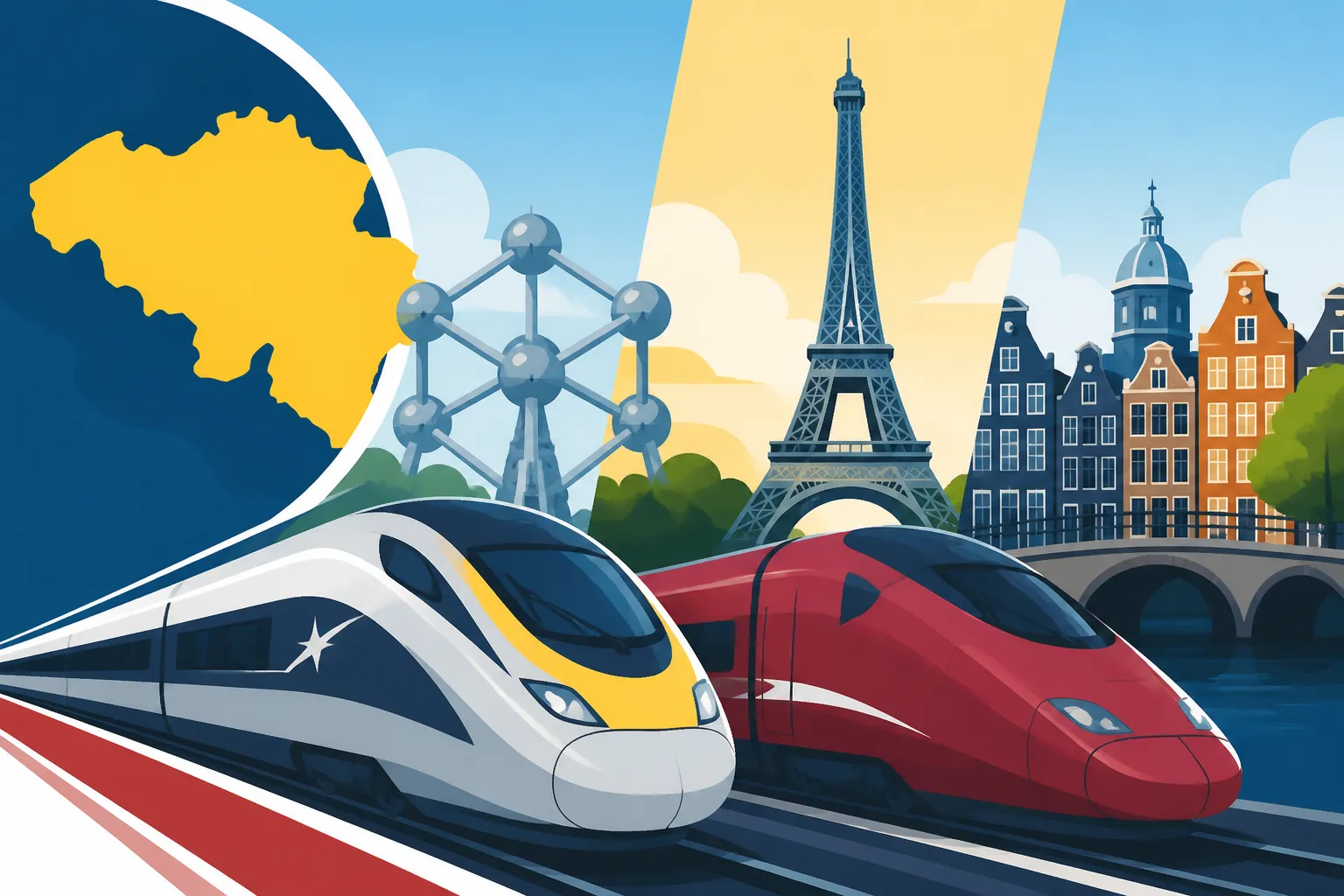
Eurostar and Thalys: Fast Trains to London, Paris, and Amsterdam
You are standing in the middle of Brussels-Midi, coffee in one hand and a heavy suitcase in the other, staring at a departure board that feels like it is written in a secret code. I once missed my first-ever train to Paris because I did not realize the high-speed platforms were a ten-minute hike from the main entrance. This guide demystifies the Eurostar network, ensuring you navigate the cross-border rails like a seasoned local.
The Evolution of High-Speed Travel: Eurostar and the Thalys Merger
For years, the distinction between "Eurostar" and "Thalys" was the cornerstone of Belgian rail travel. If you were going to London, you took the blue Eurostar; if you were heading to Paris, Amsterdam, or Cologne, you hopped on the red Thalys. As of late 2023 and solidified through 2024 and 2025, these two giants have merged under a single brand: Eurostar. While the trains still often carry their iconic red and blue liveries, the booking systems, loyalty programs, and service standards have been unified.
As an expat, this merger is a double-edged sword. On one hand, having a single app for all major European high-speed connections is a dream for organization. On the other hand, the pricing algorithms have become more "airline-like," meaning the days of finding a cheap last-minute seat to Amsterdam are largely behind us. You now need to treat a train trip to Paris with the same strategic planning you would a flight.
If you are just arriving in the country and looking for a place to call home before committing to a long-term lease, you might use HousingAnywhere to find a mid-term rental. Once you are settled, the proximity to Brussels-Midi becomes one of the biggest perks of living in Belgium. It is not just a station; it is a gateway to the rest of the continent. Understanding the nuances of this new unified Eurostar is essential for your weekend escapes and business trips.
Destinations and Durations: Mapping the High-Speed Network
The beauty of being based in Belgium is the sheer speed at which you can exit the country. Brussels is the literal "crossroads of Europe," and the high-speed rail lines are the arteries that make this possible.
Paris: The 82-Minute Commute
The journey from Brussels-Midi to Paris Gare du Nord is legendary. In just 1 hour and 22 minutes, you transition from the Gothic splendor of the Grand Place to the Haussmannian boulevards of Paris. For many expats Living in Brussels: Top Expat Neighborhoods (Ixelles, Etterbeek), this is faster than a cross-city commute in London or New York. The frequency is high, with trains departing nearly every hour.
However, remember that Paris Gare du Nord can be overwhelming. Just like Brussels-Midi, it requires a high level of situational awareness. If you are traveling for a weekend of sightseeing, ensure you have your mobile data sorted. I often recommend Airalo for travelers who haven't yet set up a permanent Belgian SIM, as it allows you to toggle between networks as you cross the border without incurring massive roaming fees.
Amsterdam: From Canals to Cobblestones
The route to Amsterdam Centraal takes approximately 1 hour and 52 minutes. This line also stops at Antwerp-Central and Schiphol Airport. If you are Living in Antwerp: Port City Vibe and Best Areas for Foreigners, you can skip the trip to Brussels entirely and board the Eurostar directly from one of the most beautiful train stations in the world. The Amsterdam route is particularly popular with "digital nomads" and tech workers, as the onboard Wi-Fi (now upgraded across the fleet) is generally reliable enough for emails and light document editing.
London: Crossing the Channel via the Tube
The Brussels-to-London route remains the "crown jewel" of the network. The journey to London St Pancras International takes roughly 2 hours and 1 minute. Unlike the Paris or Amsterdam routes, the London journey involves a "hard border." You are leaving the Schengen Area, which means you must go through both Belgian exit checks and UK entry passports before boarding.
This process adds an hour to your "travel time" that isn't reflected in the 2-hour rail duration. If you are moving your life between these two cities, check Moving to Belgium with Family: Housing Schools and Childcare to see how the logistics of international moves can be softened by using rail for your first few "suitcase trips."
The Brussels-Midi Experience: A Survivors Guide
Brussels-Midi (Brussel-Zuid) is the hub for all Eurostar services. Let’s be honest: it is not the most glamorous station in Europe. It can be confusing, crowded, and at times, a bit gritty. But once you know the layout, it becomes manageable.
The station is divided into several zones. The high-speed platforms (usually platforms 3 through 6) are separated from the local SNCB/NMBS (National Trains) Fares and Passes lines. If you are taking the Eurostar to London, you must go to the dedicated Eurostar Terminal located near the Place de la Constitution entrance. Here, you will find the check-in gates, security screening (similar to an airport), and passport control.
For Paris, Amsterdam, and German destinations, there is no formal check-in or security. You simply walk to the platform and board. However, don't let this lack of security fool you into arriving late. The platforms are long, and your carriage might be at the very far end. I have seen many people lose their breath sprinting 400 meters to Carriage 18 because they arrived only five minutes before departure.
Safety is a common concern at Midi. While the station is generally safe during the day, it is a magnet for pickpockets. Keep your luggage close and your phone in a secure pocket. If you are carrying a lot of gear, consider ordering travel locks or anti-theft backpacks from Amazon Belgium before your trip. It is a small investment that provides significant peace of mind when you are navigating the crowds near the Brussels Transport (STIB/MIVB): Metros, Trams, and Bus Networks connections.
Costs, Classes, and Booking Strategies
Eurostar operates a three-tier class system. Understanding what you get for your money is crucial for Cost of Living in Belgium 2026: Singles, Couples, and Families budgeting.
| Feature | Eurostar Standard | Eurostar Plus | Eurostar Premier |
|---|---|---|---|
| Booking Window | Up to 120 days | Up to 120 days | Up to 120 days |
| Flexibility | Fee for changes | Free changes (pay diff) | Full refund/Exchange |
| Meals | Buy at Cafe Metropole | Light snack/drink at seat | Full 3-course meal |
| Lounge Access | No | No | Yes (Brussels, Paris, London) |
| Luggage | 2 bags + 1 hand luggage | 2 bags + 1 hand luggage | 3 bags + 1 hand luggage |
The "Any Belgian Station" (ABS) Add-on
This is the best-kept secret for expats not living in the capital. When you book a Eurostar ticket, you can often select "Any Belgian Station" as your starting point. This add-on allows you to take any local SNCB train from places like Ghent, Bruges, or Leuven to Brussels-Midi to catch your high-speed connection.
The cost of this add-on is usually much lower than buying a separate ticket. More importantly, it provides a level of insurance. If your local train is delayed and you miss your Eurostar, the "Any Belgian Station" ticket ensures the staff will help you get on the next available high-speed train without a penalty. To understand how to navigate the local portion of this trip, familiarize yourself with Transportation in Belgium: SNCB Trains, Trams, and Mobib Cards.
When to Book
For the London route, the "sweet spot" is 120 days out. Prices can start as low as €44 but can skyrocket to over €250 if you book the week of travel. For Paris and Amsterdam, the fluctuation is slightly less dramatic, but the Friday evening and Sunday evening trains always sell out or become prohibitively expensive. If you are flexible, Tuesday and Wednesday mid-day trains offer the best value.
Onboard Comfort and Practicalities
Once you are on the train, the experience is remarkably civilized. Unlike short-haul flights, you have ample legroom and the ability to walk around.
Power and Connectivity
Almost all Eurostar trains now feature European and UK power sockets at every seat. The Wi-Fi is free, but its quality varies. In the tunnels between Brussels and Paris, it can drop out. If you are planning to work, download your documents beforehand. If you are using your phone as a hotspot, remember that the high-speed movement can make it difficult for your phone to "hand off" between cell towers. Again, having a reliable eSIM from Airalo ensures that as soon as the train slows down near a border or city, you'll reconnect instantly.
Luggage and Etiquette
There is no weight limit for luggage on Eurostar, which is a massive relief compared to the 20kg restrictions of airlines. As long as you can carry it yourself and it fits in the overhead racks or the luggage bays at the end of the carriages, you are good to go. This makes it the preferred method for expats who are bringing over specialized items or small kitchen appliances they ordered from Amazon Belgium but want to take to their vacation home.
Etiquette is important. The "Quiet Carriage" is strictly enforced on many routes. If you are traveling with children, try to book seats near the "Cafe Metropole" (the bar buffet car), as there is more space for them to move around without disturbing business travelers. For more tips on family travel, see The Mobib Card: How to Load Tickets for All Belgian Transport to learn how to manage the local leg of your journey with kids in tow.
Connecting the Rest of Europe
While London, Paris, and Amsterdam are the "Big Three," the high-speed network doesn't stop there. From Brussels-Midi, you can also catch the Eurostar (formerly Thalys) to Cologne (Köln) and Düsseldorf. This opens up the entire German ICE (InterCity Express) network.
If you are planning a longer European tour, the "Any Belgian Station" logic still applies. You can take a local train to Midi and then branch out to the south of France via the TGV (Train à Grande Vitesse) which runs from Brussels to Lyon, Marseille, and Nice during the summer months. These "Sun Thalys" or summer TGV routes are highly coveted and require booking the moment they are released in early spring.
Navigating the transition from a local SNCB/NMBS (National Trains) Fares and Passes ticket to a high-speed international ticket can be daunting the first time. The key is to always allow a minimum of 30 minutes for a "Schengen-to-Schengen" transfer and 90 minutes for a "Schengen-to-London" transfer. This account for the physical size of Brussels-Midi and the inevitable queue at the coffee stalls.
Disclaimer
The information provided in this guide is based on current rail operations, brand mergers, and travel regulations as of 2026. However, rail schedules, pricing structures, and border control requirements are subject to change by operators and government authorities. Always verify your specific travel requirements and ticket conditions on the official Eurostar website or app before departure. This guide is for informational purposes only and does not constitute legal or professional travel advice.