Visa Considerations When Moving from the Netherlands to Belgium
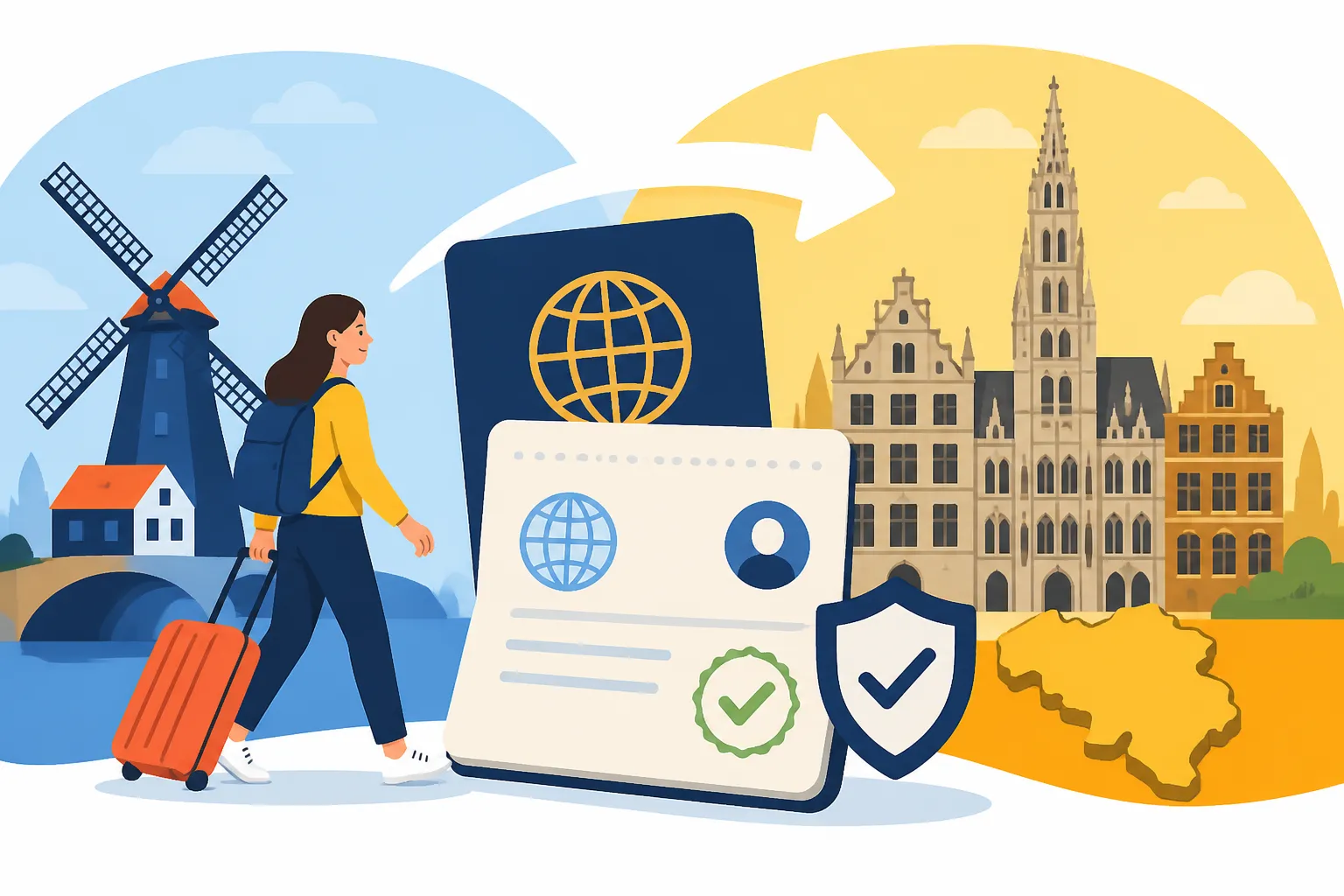
If you are currently living in the Netherlands, you might assume that moving south to Belgium will be a seamless transition. However, the administrative reality between these two neighbors is surprisingly different, and failing to understand the specific visa and residency requirements can lead to legal limbo. This guide breaks down the essential administrative hurdles and visa considerations for moving from the Netherlands to Belgium.
Understanding Your Residency Status: EU vs. Non-EU Citizens
The most significant factor in your move is your nationality, not just your current Dutch residence permit. Many expats mistakenly believe that a Dutch residence card (Verblijfstitel) grants them an automatic right to live and work in Belgium. While it allows for short-term travel within the Schengen area, the moment you decide to relocate your primary residence, the clock starts ticking on a entirely new set of Belgian regulations.
The EU Citizen Experience
If you are a Dutch citizen or a citizen of another EU member state currently residing in the Netherlands, your move falls under the principle of "freedom of movement." However, freedom of movement does not mean freedom from paperwork. You are still required to register your presence in Belgium if you plan to stay for more than 90 days. The Belgian authorities will want to see that you have a reason for being there, such as an employment contract, enrollment in a university, or sufficient personal funds to ensure you aren't a "burden" on the social system.
Unlike the Netherlands, where the Basisregistratie Personen (BRP) is relatively streamlined, the Belgian system is highly localized. You will deal directly with your local town hall, known as the Commune or Gemeente. For EU citizens, the process usually involves receiving an Annex 8 or 19 while your application is processed, eventually leading to a more permanent registration. It is vital to check the Residence Registration: Annexes, Communes, and the eID Card guide to understand which document applies to your specific family or work situation.
Non-EU Citizens with Dutch Residence Permits
This is where things get complicated. If you hold a residence permit in the Netherlands but do not have an EU passport, you cannot simply move to Belgium and start working. Your Dutch permit is specific to the Netherlands. To live in Belgium, you generally need to apply for a long-stay Visa D before you move, or in some cases, change your status if you already have "EU Long-Term Resident" status marked on your Dutch card.
The Belgian authorities are strict about "change of status." If you are moving for work, your new Belgian employer must typically initiate a Single Permit (Gecombineerde Vergunning) Process for Workers before you can legally reside in the country. If you are moving to join a partner, the Family Reunification Visas: Bringing Spouses and Children to Belgium process will be your primary path. Do not make the mistake of deregistering from your Dutch municipality until you have a clear path to Belgian residency, as you could find yourself without valid status in either country.
The EU Long-Term Resident Advantage
If your Dutch residence permit explicitly states "Lange-termijn ingezetene – EU," you have a slightly easier path than a standard non-EU permit holder. This status allows you to apply for residency in another EU country with fewer restrictions, though you still must prove you have a job, are a student, or have enough money to support yourself. You will still need to register at your Belgian commune within the first few days of arrival, but the "labor market test" (proving no Belgian or EU citizen can do your job) is often waived or simplified for those with this specific Dutch status.
The Administrative Marathon: Registering at the Belgian Commune
In the Netherlands, you might be used to the DigiD system and a relatively high level of digitalization. Prepare yourself for a bit of a culture shock in Belgium. The Belgian bureaucracy is often described as a "paper-based system in a digital world." Everything revolves around the Commune, and your experience can vary wildly depending on whether you live in Brussels, Antwerp, or a small village in the Ardennes.
The 8-Day Rule and Your First Appointment
Belgian law technically requires you to report to the commune within eight working days of your arrival. While they won't necessarily deport you on day nine, missing this window can complicate your application and make it harder to access social services or open a bank account. You should look into Booking an Appointment at the Commune (Stadhuis/Maison Communale) as soon as you have a signed lease in Belgium.
When you go to this first appointment, bring everything. And I mean everything. You will need your passport, your Dutch residence card (if applicable), your work contract, and your lease agreement. If you are moving with a family, you will need birth and marriage certificates. Because Belgium is a multilingual country, documents must be in French, Dutch, or German, depending on where you live. This is where services like RushTranslate become indispensable; having professional, certified translations ready can prevent you from being sent home by a grumpy official who refuses to read a document in English or Spanish.
The Police Address Check
This is the part of the Belgian move that catches most ex-residents of the Netherlands off guard. After you register at the commune, the "Wijkagent" or "Agent de quartier" (local police officer) will physically come to your home to verify that you actually live there. They aren't there to interrogate you, but they will check that your name is on the doorbell and that the apartment looks inhabited.
The Police Check (Contrôle de Quartier) for Address Verification is a mandatory step before your residency can be finalized. If you are never home when they stop by, the process can drag on for months. I always recommend leaving a note on your door with your phone number or checking in with the local police station if you haven't seen them within two weeks of your commune appointment. Until this check is successful, you are in a state of administrative limbo, often holding a temporary paper document like an Annex 15.
Understanding Annexes and the eID
While you wait for your official plastic identity card (the eID), the commune will issue you "Annexes." These are essentially paper certificates that prove you have applied for residency and have a right to be in the country. It is vital to understand What is an Annex 15 (Annexe 15/Bijlage 15) and Can You Work With It because it determines your rights during the three to six months it takes for your official card to arrive.
Once the police check is done and your file is approved, you will receive a pin code in the mail. You then return to the commune to "activate" your eID. This card is your lifeline in Belgium. It contains your National Register Number (Numéro National), which you will need for everything from getting a phone contract to seeing a doctor. This card replaces your Dutch Verblijfstitel for all intents and purposes within Belgian borders.
| Document Type | Purpose | Transition from NL |
|---|---|---|
| Annex 15 | Temporary proof of application | Replaces Dutch BRP registration during processing |
| Annex 8/19 | For EU citizens | Confirms right of residence based on EU treaty |
| A Card | Limited stay (Non-EU) | Equivalent to most standard Dutch Verblijfstitels |
| B/C/D/L Card | Permanent or Long-term | Comparable to Dutch "Onbepaalde tijd" permits |
Bridging the Gap: Healthcare and Documentation
One of the most stressful parts of moving between the Netherlands and Belgium is the transition of your social security and healthcare. The systems look similar on paper—both are based on insurance—but the "feel" of the Belgian system is much more decentralized.
Moving from Basisverzekering to Mutuelle
In the Netherlands, you have a private insurer like Zilveren Kruis or VGZ. In Belgium, you must join a "Mutuelle" (French) or "Ziekenfonds" (Dutch). Membership is mandatory. You cannot simply keep your Dutch insurance once you are a resident of Belgium; you must deregister from your Dutch provider and sign up with a Belgian one.
However, there is often a gap between arriving and getting your Belgian eID, which is usually required to finalize your Mutuelle registration. During this period, you are technically covered by your European Health Insurance Card (EHIC) if you are an EU citizen. If you are non-EU, the transition is trickier. This is why many expats choose to take out a short-term private policy from Cigna Global to cover the 2-4 month gap. This ensures you have high-level coverage for emergencies while the Belgian commune takes its time with your paperwork. For a deep dive into the costs and reimbursements, see Healthcare in Belgium for Expats: Complete System Overview (2027).
Document Requirements: Translation and Apostilles
Belgium is obsessed with "original" and "legalized" documents. If you are moving with a spouse or children, the commune will demand birth and marriage certificates. If these documents were issued outside of the EU, they often need an Apostille or a legalization stamp from the issuing country's embassy.
Even if your documents are in English, many communes in Flanders or Wallonia will insist on a translation into the local language. Using a service like RushTranslate ensures that the translation meets the strict standards of the Belgian "sworn translator" requirements. I have seen many expats lose weeks of time because they tried to use a standard translation that the commune rejected. You can find more about this in our guide on Translating Birth and Marriage Certificates via Sworn Translators.
Proving Your Identity Without a Card
During your first few weeks, you will be asked for your "Rijksregisternummer" (National Number) constantly. You won't have your eID yet, but you can usually find this number on your Annex 15 or by asking the commune official for a "temporary certificate." Don't wait for the physical card to start your life. Most utilities and even the Mutuelle and Ziekenfonds: Public Health Insurance Registration Guide will accept the paper Annex 15 as proof that you are in the process of becoming a resident.
Professional and Daily Living Shifts
Transitioning your work life from the Netherlands to Belgium involves more than just a different commute. The tax system, the way salaries are calculated, and the corporate culture have distinct "Belgianisms" that you need to be aware of.
Working as an Ex-Dutch Resident
If you are a non-EU citizen who had a work permit in the Netherlands, that permit does not transfer. You must check the Does I Need a Visa to Enter Belgium in 2026? Exemption List to see if your specific situation allows for a fast-track. Generally, your Belgian employer will need to prove that they are paying you above a certain salary threshold to qualify you for a "Highly Skilled" worker permit.
The salary thresholds in Belgium are adjusted annually. If you are moving from a Dutch tech hub like Eindhoven or Amsterdam, you might find that while gross salaries are similar, the "net" take-home pay in Belgium is lower due to higher social security contributions. However, this is often offset by benefits like "meal vouchers" and "eco-cheques," which are a uniquely Belgian way of providing tax-free compensation.
The Integration Course Requirement
Depending on which region you move to (Flanders, Wallonia, or Brussels), you may be required to take an integration course. In Flanders, this is called "Inburgering" and is quite similar to the Dutch version, though the focus is on Flemish society and the Dutch language as spoken in Belgium. In Brussels, it is often mandatory for non-EU citizens but optional for EU citizens.
Completing this course isn't just a chore; it is often a requirement if you eventually want to apply for permanent residency or Becoming a Belgian Citizen: Naturalization Rules and 2026 Updates. The Belgian authorities are placing more emphasis on "social integration" as a metric for long-term residency, so getting this done early is a smart move.
Finalizing Your Exit from the Netherlands
Before you fully commit to your Belgian life, you must ensure you have "closed the door" in the Netherlands correctly. This includes deregistering from your Dutch municipality (GBA/BRP) and obtaining a "proof of deregistration." You will also need to inform the Dutch tax authorities (Belastingdienst) of your move, as this affects your final tax return and any benefits (like zorgtoeslag) you might be receiving.
Keep your Dutch bank account open for at least six months after you move. You will likely have final utility bills or tax refunds that need to be processed, and it is much easier to handle these with an existing NL IBAN than trying to navigate cross-border payments with a brand-new Belgian account.
Disclaimer
The information provided in this guide is for informational purposes only and does not constitute legal or immigration advice. Visa regulations and commune requirements in Belgium are subject to frequent changes and can vary significantly by municipality. Always consult with the official Belgian Immigration Office (Dienst Vreemdelingenzaken) or a qualified legal professional before making any relocation decisions.