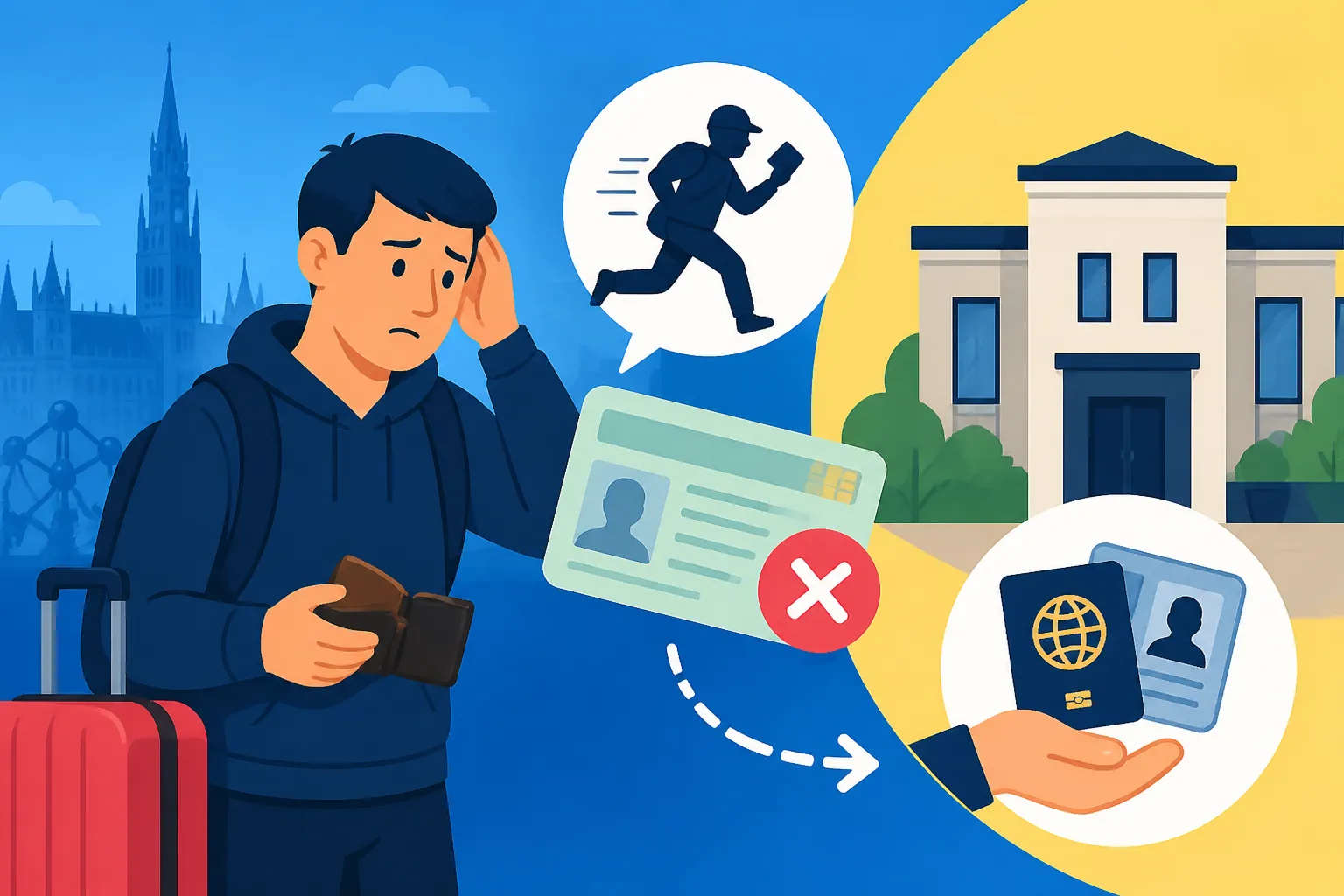
Requesting a Return Visa if Your Residence Card is Stolen Abroad
Imagine the sinking feeling of reaching into your bag at an airport in a foreign country, only to realize your Belgian residence card—your golden ticket home—is gone. Without it, airlines may refuse you boarding, and border guards will likely block your entry. This guide provides the exact roadmap to navigating the stressful process of requesting a return visa to get you back to Belgium safely.
The Immediate Panic: What to Do in the First 24 Hours
The moment you realize your Belgian eID or residence permit is missing, the clock starts ticking. It is easy to spiral into a state of panic, but your first priority must be administrative damage control. You are currently a person without a valid status in the eyes of transportation carriers, and you need a paper trail to prove that your residence in Belgium is legitimate.
First, you must contact DOCSTOP immediately. This is a centralized Belgian service available 24/7 that allows you to block your identity documents to prevent fraudulent use. While this doesn't help you cross the border, it protects your identity within the Belgian National Register. Once you have called them, your next stop is the local police station in the city where the theft or loss occurred. Do not skip this. A local police report is the foundational document for everything that follows. You will need this report to prove to the Belgian consulate that the card was actually lost or stolen.
If the police report is issued in a language other than French, Dutch, or German, you might encounter issues later at the Belgian embassy. This is where services like RushTranslate become invaluable. Having a sworn, certified translation of your police report ensures that the Belgian authorities can process your request without technical delays. Always ask the local police for multiple original copies or stamped photocopies, as you will likely need to submit one and keep one for your own travel records.
Understanding the Return Visa (Visa de Retour)
Many expats mistakenly believe they can simply fly back to Belgium on a standard Schengen tourist visa if they belong to a visa-exempt country, or that they can explain the situation at the border. This is a risky gamble that usually ends in a denied boarding at the departure gate. The correct legal instrument is the Return Visa (Visa de Retour), which is specifically designed for residents who have a valid right to stay in Belgium but lack the physical card to prove it.
The Return Visa is essentially a temporary Type D visa or a specific entry permit stamped into your passport. It signals to the airline and the federal police at Brussels Airport (Zaventem) or Charleroi that your residency has been verified in the Belgian National Register. Before you apply, it is helpful to know exactly which status you hold, as the requirements can vary slightly depending on The Belgian eID Card Types: A Card, B Card, F Card, and Others. For example, someone on an A card (temporary stay) may face more scrutiny than someone with an L card (long-term resident).
It is also worth noting that if you are currently in the middle of a renewal and only have a temporary document, you must be extremely careful. If you are traveling with What is an Annex 15 (Annexe 15/Bijlage 15) and Can You Work With It?, you should know that this document is generally not recognized for international travel outside the Schengen area. If you lose your eID while only possessing an Annex 15, the return visa process becomes significantly more complex because your "permanent" right to stay is technically still under review.
The Belgian Embassy Application Process
Once you have your police report and have blocked your card, you must find the nearest Belgian Embassy or Consulate General. Note that in some countries, Belgium outsources visa collections to centers like VFS Global or TLS Contact, but for a return visa, you often need direct communication with the consular staff. You will need to fill out a long-stay visa application form, even though you are already a resident.
The documentation required is usually extensive. You will typically need:
- Your valid passport (which must have at least two blank pages).
- The original police report of the loss or theft.
- A copy of the lost residence card (if you have a scan on your phone or email).
- Proof of your flight back to Belgium.
- Proof of residency, such as a recent utility bill or your Belgian work contract.
The embassy will then contact the Immigration Office (OE/DVZ) in Brussels to verify your status. This is the part that tests your patience. The consulate cannot issue the return visa until the authorities in Belgium give the green light. During this waiting period, ensure you have adequate international health coverage. If your Belgian mutuelle doesn't cover you extensively abroad, having a policy with a provider like Cigna Global can save you from massive out-of-pocket costs if a medical emergency happens while you are stranded.
| Document Needed | Purpose | Source |
|---|---|---|
| Local Police Report | Proves the loss/theft happened | Local Police Station |
| Certified Translation | Makes the report readable for Belgian officials | RushTranslate |
| Passport | Necessary for the visa sticker | Your home country |
| Proof of Status | Shows you have a right to live in Belgium | Work contract/Annex 15/Old Scans |
| DOCSTOP Confirmation | Proves you blocked the stolen card | Federal Public Service Interior |
Navigating the Waiting Period Abroad
Waiting for a return visa can take anywhere from a few days to several weeks, depending on how quickly the Immigration Office in Brussels responds to the consulate’s inquiry. This "limbo" period is one of the most frustrating aspects of expat life. You are stuck in a foreign country, often paying for unplanned hotel stays and meals, while your life in Belgium—your job, your rent, your pets—continues without you.
During this time, it is vital to stay in contact with your employer. If you are working on a Single Permit (Gecombineerde Vergunning) Process for Workers, your employer has a vested interest in your return. They might even be able to assist by reaching out to the regional employment office or providing additional documentation that proves your continued employment. Be transparent with them about the delay to avoid any "unjustified absence" issues that could complicate your contract.
If you find yourself struggling with the isolation or the financial stress of being stranded, look into local expat groups. Often, other people have gone through the exact same "stolen wallet" scenario and can recommend budget-friendly accommodation or even help you navigate the local bureaucracy. This is also a good time to double-check your insurance. Many high-level international plans, including those from Cigna Global, offer some level of travel assistance or emergency coordination that might help manage the logistics of your stay.
Returning to Belgium and Replacing the Card
Once the embassy grants your return visa, you can finally board your flight. When you land at the airport in Belgium, expect a bit of extra questioning at passport control. Show them the visa in your passport and the police report. Once you are through the gates and back in your apartment, the process isn't over. The return visa only gets you into the country; it does not replace your residence card.
Within 24 hours of arriving, you must begin the process of Replacing a Lost or Stolen Belgian Residence Card. This starts with a visit to your local commune. You will need to bring the return visa, your passport, and the original police report. The commune will issue you a temporary document (usually a new Annex 15) that allows you to stay and work legally while the new electronic card is being printed.
Depending on where you live, the speed of this process varies. For example, Changing Communes in Brussels: Which Wards Process IDs Fastest? is a common topic of discussion among expats because some communes like Ixelles or Etterbeek can be quite backed up. You will have to pay for the new card, which usually costs around 25 to 30 euros, though urgent procedures (which take 24 hours) can cost upwards of 120 euros.
Essential Administrative Follow-ups
While waiting for your new physical card to arrive at the commune, you might find that certain digital services are interrupted. Because you blocked your card via DOCSTOP, your digital certificates are revoked. This means you won't be able to log in to government portals using your eID card reader. If you haven't already set up the Itsme app, you might find yourself in a bind. We always recommend Setting Up Itsme While Waiting for Your Physical eID Card as soon as you have a temporary document with a national register number, as it allows you to handle taxes and health insurance or access Emergency Medical Care in Belgium: 112, Hospitals, and Pharmacies records without the physical card.
Don't forget to inform your bank and your insurance provider. If your wallet was stolen, your bank cards were likely taken too. Once you are back, you will need to re-verify your identity with your bank to regain full access to your accounts. Similarly, if you were using your residence card as a primary ID for any Belgian contracts, providing them with a copy of your new card once it arrives ensures there are no hiccups in your service.
Finally, keep a copy of your return visa and the police report in your permanent files. If you ever apply for Belgian citizenship in the future, you may need to explain any gaps or unusual stamps in your passport. Proving that a brief "overstay" or an unusual visa entry was due to a documented theft can prevent headaches during the naturalization process. Becoming a Belgian Citizen: Naturalization Rules and 2026 Updates are strict about continuous residency, and having your paperwork in order is the best way to protect your future in the country.
Summary Checklist for the Stranded Expat
To make this manageable, follow this specific order of operations:
- Call DOCSTOP to block the card immediately.
- Visit the Local Police and get a detailed theft/loss report.
- Get a Translation via RushTranslate if the report isn't in a Belgian national language.
- Email the Belgian Consulate to explain the situation and request an appointment for a "Visa de Retour."
- Gather Proof of Residency (work contracts, house deeds, or previous card scans).
- Apply for the Visa and wait for the Immigration Office to verify your status.
- Fly Back and head straight to the commune.
- Order the Replacement and consider the "Urgent Procedure" if you have upcoming travel.
Losing your identity documents in a foreign land is a rite of passage for many long-term expats, but it doesn't have to be the end of your Belgian journey. By following the legal steps for a return visa and keeping your documentation organized, you can navigate the "Administrative Labyrinth" and get back to your life in the heart of Europe.
Disclaimer
This guide is for informational purposes only and does not constitute legal advice. Immigration laws and consular procedures in Belgium are subject to change. Always consult the official website of the Belgian Immigration Office or a qualified legal professional for the most current regulations regarding return visas and residence permits.