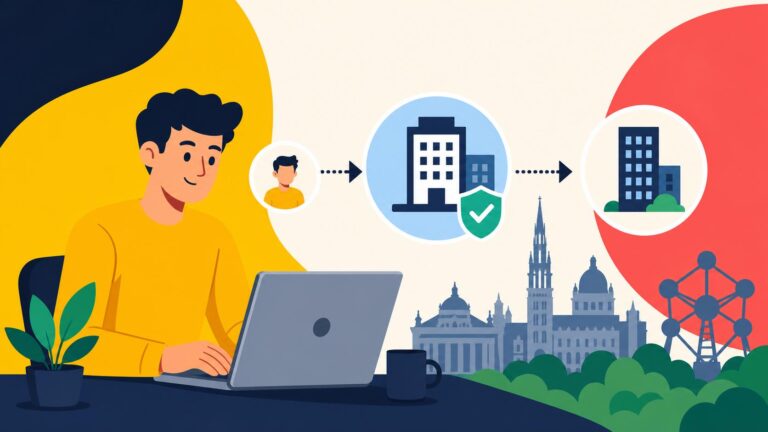
Applying for Public Sector Jobs (Selor) as an EU Citizen
Many EU expats in Belgium mistakenly believe that high-quality government jobs are reserved exclusively for Belgian nationals, leading them to overlook some of the most stable and well-compensated roles in the country. I remember sitting in a rainy café in Saint-Gilles, convinced my lack of a Belgian passport meant I was barred from anything other than private startups. This guide breaks down exactly how you, as an EU citizen, can successfully navigate the Selor platform to secure a public sector career.
Understanding Your Right to Work in the Belgian Public Sector
The first hurdle most of us face is purely psychological. We assume that "Public Service" equals "National Security" and thus requires citizenship. However, as an EU citizen, you have a legal right to work in almost any Belgian public institution. This is grounded in the principle of free movement of workers within the European Union. While there are a few exceptions—primarily roles involving the exercise of public authority or the safeguarding of general state interests (like high-level diplomacy, the judiciary, or certain police roles)—the vast majority of administrative, technical, and expert positions are fully open to you.
Working for the state is often managed by Selor, which is the recruitment office for the Belgian federal government, though it also handles selections for regional and local authorities. For those of us used to the more informal hiring processes of the private sector, Selor can feel like a cold, algorithmic gatekeeper. It is a centralized system designed to ensure "objectivity," which means your merit is measured by standardized tests rather than a charismatic cover letter.
When you begin looking at Working in Belgium as an Expat: Jobs, Culture, and Hiring (2027), you’ll notice that the public sector offers a unique level of job security. In Belgium, government roles are often divided into "statutory" (permanent, life-long tenure) and "contractual" (standard employment contracts). As an EU citizen, you are eligible for both. The selection process is identical for everyone, regardless of nationality, provided you have the right to reside in the country and meet the educational requirements.
Navigating the Selor Application Portal
The gateway to these roles is "MySelor," your personal online profile where you track every application. I found the registration process to be the first of many bureaucratic tests. You will need to upload your diplomas and provide proof of identity. If you haven't done so already, this is a great time to ensure your Itsme Authentication: How to Set Up Belgium's Vital Digital ID is fully functional, as it makes logging into government portals significantly less painful.
The most critical part of your profile is the diploma section. Selor is extremely strict about educational levels. If you have a Master’s degree from Italy or a Bachelor’s from Poland, you cannot simply upload a scan and hope for the best. You often need an official recognition of your degree's equivalence. Navigating the process of Getting Your Foreign Degree Recognized by NARIC Flanders/Wallonia is a prerequisite for many level A (university-level) government roles. Without this, the system may automatically filter you out before a human ever sees your name.
Once your profile is set up, you can search for "vacancies." Don't be discouraged by the heavy use of Dutch or French. While there are some English-Speaking Jobs in Brussels: EU Bubbles and NGOs, Selor roles almost always require a functional level of at least one national language. However, the testing itself is where many expats stumble. Selor uses "competency-based" testing, which involves abstract reasoning, situational judgment, and sometimes specific technical exams. These tests are timed and can be quite stressful if you aren't prepared for the specific Belgian "logic" they require.
Language Requirements and How to Prove Your Skills
In the Belgian public sector, your linguistic ability isn't just a "nice to have"—it’s a legal requirement. Depending on the role, you may need to prove your proficiency in French, Dutch, or German. For EU citizens, this is often the most significant barrier. If you are applying for a role in a federal institution, you might be required to pass a linguistic exam organized by Selor itself. These exams are separate from the job application and result in a language certificate that stays in your MySelor profile forever.
If your language skills are a bit rusty, I highly recommend investing time in structured learning before attempting the Selor exams. Platforms like Lingoda or Coursera offer intensive courses that can help you reach the B2 or C1 levels often required for administrative roles. For more focused, day-to-day practice, FrenchPod101 or DutchPod101 are excellent for familiarizing yourself with the specific vocabulary used in Belgian offices. Even Udemy has specialized courses on "Business French" or "Business Dutch" that can give you the edge in the interview phase.
It’s important to understand the Belgian Work Culture: Bilingual Workplaces, Meetings, and Hierarchy. In Brussels especially, being "bilingual" (French/Dutch) is a massive career booster. If you pass the Selor language tests for both languages, you are often entitled to a "bilingualism bonus"—a monthly supplement to your salary. This is a fantastic incentive that I’ve seen many expats use to boost their take-home pay by several hundred euros a month.
| Feature | Statutory (Statutaire) | Contractual (Contractuel) |
|---|---|---|
| Job Security | Extremely high; essentially for life. | High, but governed by standard labor law. |
| Pension | Specific public sector pension scheme. | Standard social security pension. |
| Promotion | Based on internal exams and seniority. | Based on performance and vacancies. |
| Eligibility | Open to all EU citizens. | Open to all EU citizens. |
| Salary Indexing | Automatic Indexation of Salaries in Belgium: How Inflation Adjustments Work. | Automatic Indexation of Salaries in Belgium: How Inflation Adjustments Work. |
The Selor Testing Phase: What to Really Expect
The Selor selection process usually happens in several stages. The first is almost always an "Abstract Reasoning" test. This involves identifying patterns in shapes and sequences. It sounds simple, but the time pressure is intense. I remember my first attempt; I spent too long on the first five questions and had to click randomly for the last ten. Practice is non-negotiable. There are numerous "Selor test prep" books available in Belgian bookstores, and I strongly suggest using them.
The second stage is often a "SJT" or Situational Judgment Test. You are presented with a workplace conflict or dilemma and asked to rank possible responses. This test is designed to see if your professional values align with the Belgian "Public Service" ethos—think compromise, neutrality, and following hierarchical procedures. It’s quite different from the "disruptor" mindset favored in the US or UK tech scenes. You need to answer like a reliable, stable civil servant.
If you pass these, you will move to the "Generic Competency" or "Specific Competency" screens. This is where your actual skills are tested. For an IT role, you’ll have a coding or systems architecture test; for a policy role, you might have to write a briefing note. Finally, there is the interview. Unlike private sector interviews, these are structured. Every candidate is asked the same set of questions to maintain "objectivity." This is where you should refer to your CVs and Cover Letters in Belgium: Formats and Interview Norms to ensure your presentation matches local expectations.
Why the Effort is Worth It for EU Expats
You might be wondering why anyone would jump through these hoops. The answer lies in the benefits. Beyond the salary, working for the Belgian public sector gives you incredible access to the social safety net. You will see exactly how Social Security Contributions: How Employers Deduct Health Costs are handled, and government employees often have access to superior "mutuelle" options and top-tier hospitalization insurance.
Furthermore, the work-life balance is often superior to the private sector. Most government roles follow strict 38-hour weeks with generous "recuperation" days if you work overtime. For parents, the flexibility is a godsend. You’ll also find that the public sector is a great way to truly integrate. You aren't just an expat in a bubble anymore; you are part of the machinery that keeps Belgium running. You'll gain a deep understanding of Healthcare in Belgium for Expats: Complete System Overview (2027) because you might be working in the very department that manages it.
Even if you only plan to stay in Belgium for a few years, a Selor-certified role on your CV is a mark of high competence and linguistic ability that private employers in Belgium respect immensely. It proves you can navigate the complex Belgian bureaucracy—a skill that is valuable in any sector. If you ever feel overwhelmed by the process, remember that many of us have been there, refreshing our MySelor pages with a mix of hope and dread. Persistence is the only way through.
Preparing for Your First Government Interview
When you finally get that invitation for an interview at the Selor offices (usually near Brussels North station), remember that they are looking for a specific type of candidate. They want someone who is "conventioned"—meaning they follow the rules and understand the legal framework of their role. If you are applying for a specialized role, perhaps in the health sector, you might even be asked about how the state interacts with Finding English-Speaking Doctors in Brussels, Antwerp, and Ghent or how the reimbursement system works.
Be prepared to talk about your "competencies" using the STAR method (Situation, Task, Action, Result). Selor interviewers love this structure. They aren't interested in vague stories; they want specific examples of how you handled a difficult colleague or managed a project under budget. Also, don't forget to mention your willingness to continue your language journey. Showing that you are using tools like Udemy to sharpen your technical skills or FrenchPod101 to improve your fluency shows a commitment to the Belgian state that interviewers find very appealing.
Finally, keep an eye on your emails. Selor moves at its own pace. Sometimes you’ll hear back in a week; sometimes it takes three months. Use that time to get your administrative life in order. Make sure you know where the nearest Emergency Medical Care in Belgium: 112, Hospitals, and Pharmacies are, and perhaps start looking into Healthcare Budgeting: Copays, DMG/GMD, and Reimbursements so you are fully prepared for your new Belgian life as a civil servant.
Important Disclaimer
The information provided in this guide is for informational purposes only and is based on personal experiences and the recruitment rules in place. Recruitment procedures, language requirements, and legal eligibility for EU citizens in the Belgian public sector are subject to change by federal and regional authorities. Always consult the official Selor (Workingfor.be) website or a qualified legal advisor before making significant career or immigration decisions. This article does not constitute legal or professional career advice.