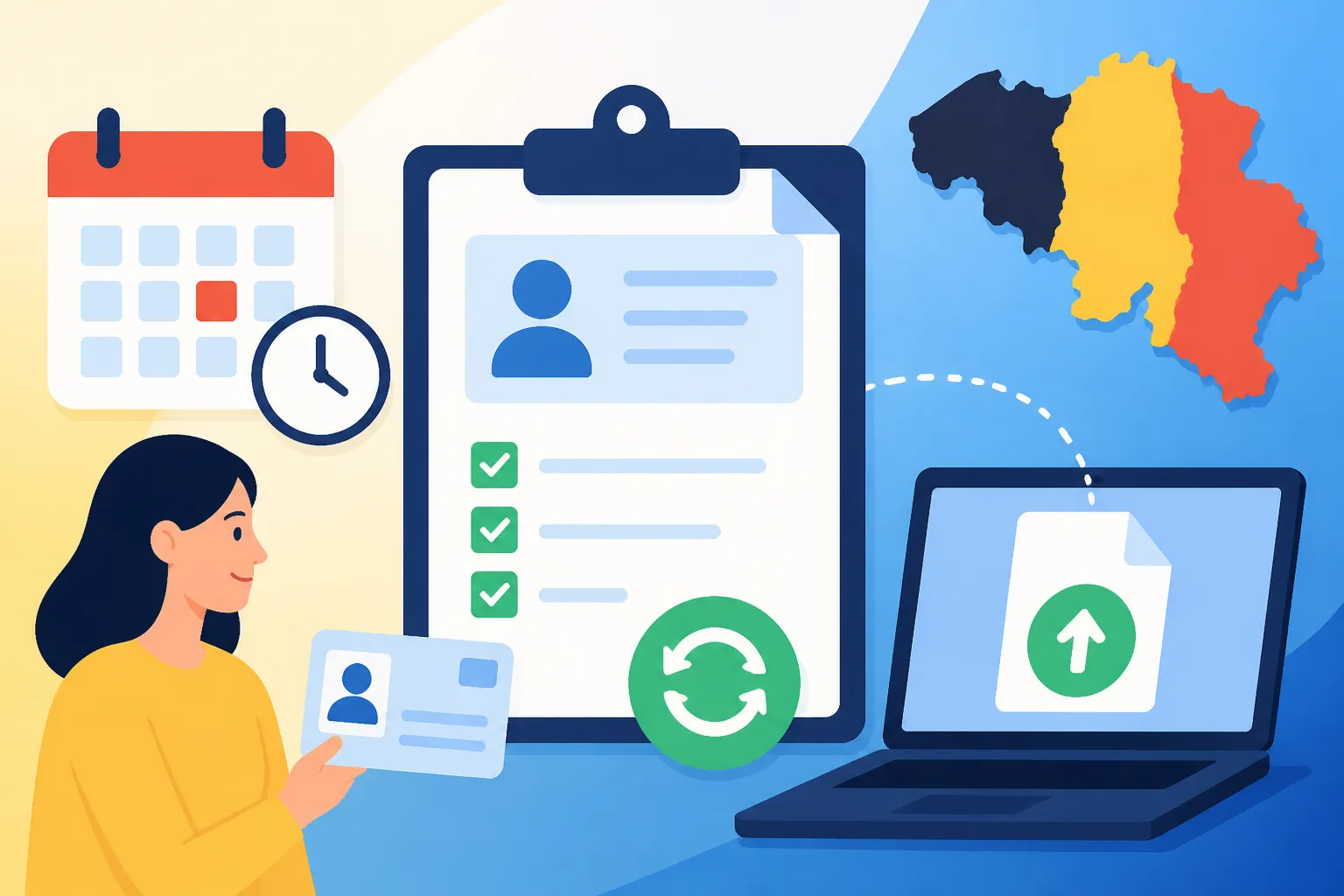
Renewing Your Single Permit: Deadlines and Digital Submission
Let's be real: that knot in your stomach when your residence permit expiry date looms large is a feeling most expats here in Belgium know all too well. It’s a bureaucracy-induced anxiety that’s almost universal! Don't worry, you're not alone. This guide is here to walk you through the often confusing, but entirely manageable, process of renewing your Belgian Single Permit, focusing on those crucial deadlines and the increasingly digital submission requirements.
Understanding the Single Permit Renewal Process in Belgium
So, you’ve successfully navigated the initial application, landed in Belgium, and settled into your job. Bravo! But the Belgian administrative journey, much like its cobblestone streets, requires ongoing attention. Your Single Permit, which combines your work authorization and residence permit, isn't a "set it and forget it" kind of deal. Renewing it is a distinct, though related, process that requires careful planning and execution. It's not just about updating your details; it's about re-proving your eligibility to continue living and working in this lovely, complex country.
Why Renewing is Different from Initial Application
While the core principle remains the same – proving you have a valid reason to be here and support yourself – the renewal process tends to be more about demonstrating continuity and adherence to your initial conditions. When you first applied, your employer likely took the lead, submitting piles of documents to secure that initial green light. For renewal, while your employer is still a critical partner, you often bear more responsibility in gathering and ensuring the accuracy of the required paperwork. The authorities are looking for proof that your circumstances haven't significantly changed for the worse, that your employment is stable, and that you haven't become a burden on the state. It's less about proving you can come, and more about proving you should stay. This means things like consistent salary payments, continued valid health insurance, and proof of your address become paramount.
One common difference is the level of scrutiny on your continued employment. They're not just looking for a job offer anymore; they're looking for payslips, employment contracts, and declarations from your employer confirming your ongoing role and salary that meets the regional thresholds. Furthermore, your first application might have been handled entirely by your employer's HR department or an immigration lawyer. For renewals, you might find yourself more directly involved in liaising with the commune and navigating the digital portals yourself, which can be a steep learning curve if you're not prepared.
Key Players in the Renewal Game
Successfully renewing your Single Permit requires coordination with several key administrative bodies. Think of it as a relay race, where each player passes the baton to the next.
Firstly, your employer is undeniably your primary partner. They are the ones who initially sponsored your permit, and they must confirm your continued employment. This means providing an updated employment contract, a salary declaration, and often proof that your salary still meets the regional thresholds for highly skilled workers. Without your employer's active participation and documentation, your renewal application simply won't proceed. They are the backbone of your professional integration here, so maintain open communication with them about these deadlines well in advance.
Next, the regional authorities (Flanders, Wallonia, or Brussels Capital Region) are responsible for the "work permit" part of your Single Permit. They will assess your employer's application for your continued work authorization based on the economic needs of the region and your specific profile. This is where the salary thresholds come into play, which are updated annually. You can find detailed information about these thresholds in articles like 2026 Salary Thresholds for Highly Skilled Workers in Brussels.
Then, there's the Immigration Office (Office des Étrangers/Dienst Vreemdelingenzaken – DOFI), which handles the "residence permit" aspect. Once the regional authority approves the work component, the Immigration Office makes the final decision on your right to reside in Belgium. They’ll check your overall compliance with immigration laws, your criminal record (or lack thereof), and other general residence conditions. They're the ones who give the ultimate "yes" or "no" for your continued stay. You can often track your application status on their website.
Finally, your local commune (gemeente/maison communale) is where the rubber meets the road. This is where you will physically submit some documents (if required), pick up your new eID card, and where your address registration is maintained. They act as the local point of contact for the Immigration Office and are crucial for the practical steps of getting your renewed residence card. Remember that vital 8-day rule for registering at the commune when you first arrived? Their role remains central throughout your time here. Understanding the different roles each entity plays can help demystify the process and allow you to anticipate where specific documents or approvals are needed.
Navigating the Renewal Deadlines: Don't Get Caught Off Guard
Missed deadlines in Belgium can lead to a bureaucratic nightmare, from temporary loss of residence status to even fines or difficulties travelling. With your Single Permit, timing is everything. Unlike some countries where you might get a grace period, Belgium tends to be quite strict. Knowing your deadlines and acting well in advance is not just recommended; it’s absolutely critical. This isn't a last-minute sprint; it's a carefully planned marathon.
The Critical Window for Submission
The golden rule for Single Permit renewal is to apply within the three-month window before your current permit expires. I cannot stress this enough. If your permit expires on October 1st, you should aim to submit your complete renewal application no later than July 1st. Many expats aim for even earlier, perhaps four or five months out, just to build in a buffer for any unforeseen issues or additional document requests.
Why is this window so critical? Because the processing times can vary wildly. While the aim is to process renewals efficiently, administrative delays are a fact of life. If you submit too late, your current permit might expire before your new one is approved. This puts you in a precarious position where you could temporarily lose your legal residence status.
When you submit your application within this window, the commune will typically issue you an Annex 15 (Annexe 15/Bijlage 15). This is a temporary residence document that proves your application is pending and allows you to continue residing and, crucially, working in Belgium while your renewal is being processed. It’s your lifeline during the waiting period. Without it, you could face severe complications with your employer, banking, and travel. Understanding what an Annex 15 is and what it allows you to do is essential during your renewal period.
If you don’t apply within this window, or if your permit expires before a decision is made, you risk having a gap in your legal status. This can have ripple effects on your employment, social security, and even your ability to travel in and out of the Schengen area without problems. Remember, the date on your permit is the final word; there's no implied extension.
Consequences of Late Submission or Expired Permits
Let’s talk about the cold, hard reality: what happens if you miss that critical window? The consequences of a late submission or, worse, an expired Single Permit, can range from inconvenient to truly disruptive.
Firstly, if your permit expires before your renewal is processed, you will lose your legal right to reside and work in Belgium. This isn't just a technicality; it can mean:
- Loss of Employment: Your employer is legally obliged to terminate your contract if you no longer have a valid work permit. No employer wants to deal with the legal ramifications of employing someone without proper authorization.
- Issues with Social Security and Health Insurance: Your access to the public health insurance system (mutuelle/ziekenfonds) is tied to your legal residence. An expired permit can lead to gaps in your coverage or even the suspension of your benefits. You can learn more about how this system works in Compulsory Coverage Basics: Who Must Enroll in Mutuelle/Ziekenfonds. While your private international insurance, perhaps from a provider like Cigna Global, might still cover you, you could lose access to the public system’s benefits and reimbursements.
- Travel Restrictions: Trying to travel outside Belgium, even within the Schengen area, with an expired permit and no valid Annex 15 can lead to serious problems at border control, including denial of re-entry.
- Legal Uncertainty: You would effectively be an undocumented resident, which can attract fines and complicate any future applications for residency or citizenship. The Immigration Office might also view a lapse in status negatively for future applications.
In some cases, if the delay is significant, the Immigration Office may require you to leave the country and apply for a new Single Permit from your home country, effectively starting the entire process from scratch. This is an outcome no expat wants, as it involves significant disruption, cost, and uncertainty. So, please, mark your calendar, set reminders, and start gathering documents months in advance. Proactivity is your best friend when it comes to Belgian immigration.
The Digital Submission Revolution: The 'Working in Belgium' Portal
Good news for those of us who dread paper pushing! Belgium has been steadily moving towards a more digital, streamlined approach for immigration processes. The "Working in Belgium" portal is a significant step in this direction, especially for Single Permit applications and renewals. While it might feel like another system to learn, it's designed to make things more efficient – once you get the hang of it, that is.
Step-by-Step Guide to the Online Portal
The 'Working in Belgium' portal is now the primary method for employers to submit new and renewal Single Permit applications for highly skilled workers. As an expat, you might not directly submit the application yourself, but you'll be heavily involved in providing your employer with the necessary documents and tracking the status.
Here’s a general overview of the steps involved, usually initiated by your employer:
- Employer Access: Your employer will log in to the 'Working in Belgium' portal using their company's digital identity (e.g., via their Itsme or eID for authorized personnel). If they are new to the system, they might need to obtain a Mahis Mandate, which grants them permission to submit applications on behalf of the company. You can find more details in The Mahis Digital Mandate: How Employers Submit Work Permits.
- Initiating the Renewal: They will select the option to renew an existing Single Permit, linking it to your previous application if possible.
- Filling Out the Application Form: The portal will guide them through various sections, requesting updated information about your employment, salary, and company details. Accuracy here is crucial.
- Uploading Required Documents: This is where your contribution comes in. Your employer will need to upload digital copies (PDFs are standard) of all supporting documents. We’ll delve into these in the next subsection, but anticipate providing your passport, existing residence permit, updated employment contract, and often proof of sufficient resources.
- Payment of Fees: There’s an administrative fee associated with the Single Permit application, which your employer typically pays directly through the portal.
- Submission and Tracking: Once all sections are complete and documents uploaded, the application is submitted. Both you and your employer should receive confirmation. You can then track the status of the application directly on the portal. This real-time tracking can alleviate a lot of anxiety during the waiting period. You can also track your overall visa status on the Immigration Office website.
It's vital to ensure all documents are clear, correctly named, and in the right format. Blurry scans or incorrect file types can cause delays or even rejection. Communication between you and your employer throughout this digital submission process is paramount to avoid errors.
Essential Documents for Digital Upload
Preparation is key. Before your employer even logs into the portal, you should have all your documents ready, scanned, and organized. Here's a comprehensive list of what you'll typically need for a Single Permit renewal. Remember, regional authorities can sometimes have specific additional requirements, so always check the official regional websites (VDAB for Flanders, Actiris for Brussels, Le Forem for Wallonia).
| Document Type | Description | Who Provides? | Important Notes |
|---|---|---|---|
| Passport | Valid passport, including pages with personal data and validity dates. | Expat | Ensure it's valid for at least 12 months beyond your intended permit expiry. If your passport is nearing expiry, renew it first! |
| Current Residence Permit | Your existing Belgian eID card (both front and back). | Expat | This proves your current status. |
| Employment Contract | An updated, signed employment contract confirming your continued employment in Belgium. | Employer | It must clearly state your position, salary, and working hours, and be for an indefinite period or a fixed-term contract aligning with permit duration. |
| Salary Slip/Declaration | Recent payslips (e.g., last 3-6 months) to prove consistent income, or a declaration from your employer stating your current gross annual salary. | Employer | Must meet the regional salary thresholds for highly skilled workers. This is crucial! |
| Employer's Declaration | A letter from your employer confirming your continued employment, role, and salary, and that the company is still active and solvent. | Employer | This often replaces a separate work permit application, as the Single Permit combines both. |
| Proof of Health Insurance | Evidence of your affiliation with a Belgian mutualiteit (mutuelle/ziekenfonds). | Expat | Your mutuelle membership card or a certificate of affiliation. Ensure continuous coverage. You can find more information about the public system in Mutuelle and Ziekenfonds: Public Health Insurance Registration Guide. For those using international private plans, like Cigna Global, a certificate of coverage is needed. |
| Proof of Accommodation | Your registered address in Belgium. This is usually checked via the commune, but a recent rental contract or property deed may be requested. | Expat | Ensures you have stable housing. Your commune registration automatically links to this. |
| Criminal Record Extract | A recent criminal record certificate (or equivalent) from your country of origin and any country you've resided in for over a year in the past five years. | Expat | This is generally required for renewals, especially if your initial permit was short-term or if there's any change in status. Should not be older than six months. May require authentication and translation by a sworn translator if not in French, Dutch, German, or English. RushTranslate can help here. |
| Medical Certificate | A certificate indicating you're free of diseases that could endanger public health. | Expat | May be required depending on the regional office or if there's a gap in residence. Usually obtained from a doctor approved by the Belgian embassy/consulate in your home country, or an approved doctor in Belgium. |
| Dependency Proof (if applicable) | For family reunification renewals, proof of continued dependency for children or spouse (e.g., school certificates, bank statements). | Expat/Family Member | Relevant if your initial permit included family members. For information on adding family members, see Adding Family Members: Enrolling Spouses and Children in Your Mutuelle. |
Remember, any documents not in French, Dutch, German, or English must be translated by a sworn translator in Belgium. Services like RushTranslate can be invaluable for this, as their sworn translators are recognized by Belgian authorities. Always keep original documents safe, even after digital submission.
Common Pitfalls and Troubleshooting Tips
Even with a detailed guide, the digital submission process can sometimes throw a curveball. Here are some common issues and how to tackle them:
- Technical Glitches on the Portal: Like any online system, the 'Working in Belgium' portal can experience downtime or bugs. If you encounter issues, try clearing your browser cache, using a different browser, or trying again later. If the problem persists, document it with screenshots and contact the portal’s technical support.
- Incorrect Document Format/Size: The system often has strict requirements for file types (usually PDF) and file sizes. Ensure your scans are clear, legible, and adhere to these specifications. Invest in good scanning software or use a professional scanning service if needed.
- Missing Information: Double-check every field in the application form and ensure all required documents are uploaded. A single missing piece of information can halt the entire process. Have your employer meticulously review the application before final submission.
- Conflicting Information: Ensure consistency across all documents. For example, your employment contract salary should align with the salary declaration. Any discrepancies will raise red flags and cause delays.
- Communication Gaps with Employer: This is a big one. Ensure regular communication with your employer's HR or the person responsible for your permit. Proactively provide them with requested documents and check in on the application status. Don’t assume they’re always on top of it; your permit is ultimately your responsibility.
- Language Barriers: If you're not fluent in French or Dutch, having a colleague or friend who is can be immensely helpful in navigating the portal or understanding official communications. Don't hesitate to use translation tools, but always verify critical information with a native speaker if possible.
By being aware of these potential pitfalls, you can often address them before they become significant roadblocks, making your renewal process much smoother.
Preparing Your Documents for a Smooth Renewal
Getting all your paperwork in order is perhaps the most time-consuming part of the renewal process. Belgian bureaucracy loves documents, and they need to be precise, up-to-date, and often authenticated. Don't underestimate the time it takes to gather everything, especially if you need documents from your home country or translations. Start early, really early.
Proof of Continued Employment and Sufficient Resources
This is arguably the most crucial aspect of your Single Permit renewal. The Belgian authorities need to be convinced that you continue to be a valuable economic contributor and can fully support yourself without relying on public funds.
Your updated employment contract is the cornerstone. This contract should be current and reflect your ongoing position, working hours, and most importantly, your salary. The salary mentioned must meet the minimum regional thresholds for highly skilled workers, which are indexed annually. These thresholds vary slightly depending on whether you're in Brussels, Flanders, or Wallonia, and for certain categories like management personnel. If your salary has changed, ensure the new contract reflects this. If you've received a promotion, include the new job title and responsibilities.
Beyond the contract, recent payslips (fiches de paie/loonfiches) are indispensable. Typically, the last three to six months are requested. These prove that you are actively employed and receiving a consistent income that meets the required threshold. These aren't just numbers on a page; they demonstrate your active integration into the Belgian economy. If your company provides a year-end salary declaration (fiche 281.10), that can also be a helpful supporting document.
Additionally, your employer will likely need to provide a declaration of continued employment. This is a formal letter on company letterhead confirming your ongoing role, the nature of your employment, and that the company intends to keep you on staff. This serves as an official endorsement of your continued work authorization request. This declaration will typically also confirm that the company is up-to-date with its social security contributions, an important aspect of Social Security in Belgium: Employer and Employee Contributions.
Proof of "sufficient resources" also extends to ensuring you haven't received specific social welfare benefits. While your employment income is the main focus, if there were any periods of unemployment or other situations, additional explanations or proof of self-sufficiency might be required.
Health Insurance and Accommodation Requirements
Beyond your job, your well-being and stability in Belgium are also key factors for renewal. The authorities want to ensure you are properly integrated into the healthcare system and have a stable place to live.
For health insurance, you are legally required to be affiliated with a Belgian mutuelle (mutualiteit/health insurance fund). For most employed expats, this happens automatically through your social security contributions. For your renewal, you'll need to provide proof of this affiliation, usually in the form of your mutuelle membership certificate or a printout of your online health insurance portal showing your active status. This confirms you have access to the public healthcare system, which reimburses a significant portion of your medical costs. For those who initially arrived with private international health insurance, such as Cigna Global, and then transitioned to a mutuelle, ensure your mutuelle registration is complete and active. For others, particularly those not in an employment contract, comprehensive private health insurance that meets Belgian standards might be required. Always keep your European Health Insurance Card (EHIC) if you're an EU citizen, as it can offer temporary cover during transitions, but it’s not a substitute for local registration when residing here.
When it comes to accommodation, your registration at the commune is the primary proof of your legal address in Belgium. When you first registered, the police did a neighborhood check. For renewals, they typically just check their internal records. However, if you've moved since your last permit was issued, it's absolutely vital that you have updated your address with your commune promptly. They might ask for a recent copy of your rental contract or proof of ownership if there's any ambiguity. A stable address is a fundamental requirement for residence. For guidance on informing the commune about your address changes, see Address Changes (Changement d'Adresse): Updating the Commune When Moving. Make sure your housing situation is settled and documented, as instability in accommodation can raise questions about your intention to reside long-term.
What Happens After You Submit? The Waiting Game and Beyond
Once your employer hits that "submit" button on the 'Working in Belgium' portal, or you've handed in all the physical documents at the commune, the hardest part for many begins: the waiting game. It can feel like your application disappears into a black hole, but there are ways to track its progress and prepare for the next steps. Patience is a virtue, but vigilance is also key.
Tracking Your Application Status
During the processing period, you'll want to keep an eye on your application's status. There are a couple of places to do this:
- The 'Working in Belgium' Portal: Your employer (and sometimes you, if granted access) can log in and view the real-time status of your Single Permit application. This portal should show you whether it's "submitted," "under review," "additional documents requested," or "approved/rejected."
- The Immigration Office Website: The DOFI (Office des Étrangers/Dienst Vreemdelingenzaken) has a general online tool where you can track the status of your visa or residence permit application using your file number. This is particularly useful once the work permit component has been approved by the region and the file moves to the federal level. You can use their online tool by inputting your file number (which starts with a series of numbers, followed by a forward slash and the year, e.g., 12345/2026). This can provide a broader overview of where your file stands. See Track Your Visa Status on the DOFI (Immigration Office) Website for more specific guidance.
- Contacting Your Commune: While not for daily checks, if you notice no movement on the online portals after a significant period (e.g., several weeks), your commune can sometimes provide an update, as they are the local liaison. They will be notified once the decision is made.
- Annex 15 Status: As mentioned earlier, if you submitted within the valid window, you should have received an Annex 15. This document itself serves as proof that your application is pending. Ensure you keep it safe, as it’s your legal proof of residence and work authorization during this interim period.
Remember that "no news is good news" often applies, but if you see a request for additional documents, respond immediately. Delays in providing requested information will only prolong the process.
Receiving Your New Residence Card and What to Do Next
Once your Single Permit renewal is approved, it’s a huge relief! The decision will be communicated to your local commune. Here’s what typically happens next:
- Notification from the Commune: Your commune will contact you, usually by mail or email, to inform you that your new residence card (eID card) is ready for issuance. This notification will include instructions on how to schedule an appointment for photo submission and fingerprinting, or simply to pick up your card.
- Appointment at the Commune: You’ll visit the commune to complete the necessary steps. This usually involves:
- Photo: Providing a recent passport-style photo that meets Belgian specifications.
- Fingerprints: Your fingerprints will be taken for the new card.
- Signature: You'll sign for the new card.
- Payment: There will be a fee for the production of the new eID card, which you'll pay at this time.
- Picking Up Your eID: After a few weeks (the exact timing can vary by commune), you’ll receive another notification that your card is ready for pickup. You'll often need to activate your card using the PIN/PUK codes provided. This activation is crucial for using Itsme and other digital government services.
- Activating Itsme: Your new eID card is linked to your Itsme digital identity, which is indispensable for Belgian online administration, banking, and many other services. If you haven't already, make sure to set up Itsme with your new card and its associated PIN/PUK codes. If you had Itsme set up with your old card, you might need to re-link it to the new one. You can find detailed instructions in Itsme Authentication: How to Set Up Belgium's Vital Digital ID.
Once you have your new eID in hand, take a moment to celebrate! You’ve successfully navigated another layer of Belgian bureaucracy. Just remember to keep an eye on the expiry date of this new card for future renewals.
Seeking Expert Assistance and Avoiding Complications
Let's face it, Belgian administration can be a labyrinth, even for seasoned expats. While this guide aims to be comprehensive, there are always unique situations, unexpected hurdles, or moments when you just need a professional to cut through the red tape. Don't be afraid to seek help; it can save you time, stress, and potential headaches.
When to Consult an Immigration Lawyer
Deciding whether to hire an immigration lawyer is a personal choice, but there are certain scenarios where their expertise becomes almost invaluable:
- Complex Cases: If your employment situation is unusual (e.g., you're moving from a freelance status to an employed one, or you're an intra-company transferee), if you've had periods of unemployment, or if your salary is borderline for the highly skilled threshold, a lawyer can navigate the nuances.
- Previous Rejections or Issues: If your initial Single Permit application faced any issues, or if you've had a previous renewal rejected, a lawyer can help understand the reasons and build a stronger case for your renewal. Similarly, if you're dealing with a revocation of residence status, legal counsel is paramount.
- Late Submission/Expired Permit: If you find yourself in the unfortunate situation of having missed the renewal deadline or your permit has expired, an immigration lawyer is your best bet for damage control. They can advise on the best course of action, which might include regularization requests or appeals.
- Family Reunification Complications: If you're renewing your permit along with family members, especially if there are any changes in their dependency status or if they are non-EU citizens, a lawyer can ensure all family reunification requirements are met. You can find more information about these complex processes in Family Reunification for Non-EU Citizens Married to Non-EU Workers.
- Language Barriers: While many officials speak English, official communication can be exclusively in French or Dutch. If you struggle with these languages and need to understand legal jargon or complex requests, a lawyer can act as your advocate and interpreter.
- Employer Reluctance or Lack of Expertise: Some smaller companies might not have an in-house HR department familiar with expat immigration processes. In such cases, an immigration lawyer can guide your employer through their responsibilities, ensuring they submit everything correctly.
When choosing a lawyer, look for one specializing in immigration law in Belgium. Recommendations from other expats or professional expat networks can be a good starting point. While it’s an added expense, the peace of mind and successful outcome can be well worth the investment.
Support for Language Barriers and Document Translations
One of the most persistent challenges for expats in Belgium is the language barrier. Official documents, forms, and even conversations at the commune or with the Immigration Office can be exclusively in French, Dutch, or occasionally German. This is where professional support can make a world of difference.
For document translations, it’s not enough to use an online translator. Belgian authorities require official translations by a sworn translator (traducteur juré/beëdigd vertaler). These translators are accredited by Belgian courts and their translations carry legal weight. This is especially true for documents like criminal record extracts, marriage certificates, or birth certificates (if required for family members). Services like RushTranslate specialize in these types of certified translations and can connect you with qualified sworn translators who understand the specific requirements for Belgian immigration. Trying to submit unofficial translations will inevitably lead to delays or rejection.
For navigating official appointments or understanding complex correspondence, consider hiring an interpreter if you don't have a trusted, fluent friend or colleague. While some commune staff may speak English, it's not guaranteed, and for legal matters, precise communication is vital.
Additionally, don’t forget the wealth of resources available through expat groups and online forums. While not legal advice, these communities often share practical tips, recommend specific services, and offer emotional support for navigating the often-frustrating administrative landscape. Many expat organizations also offer help desks or informational sessions specifically for immigration topics. Take advantage of these networks; they’re often born from shared experiences of overcoming Belgian bureaucracy.
By being proactive about language and translation needs, and knowing when to call in legal experts, you can significantly ease the stress of your Single Permit renewal and ensure your continued, happy residence in Belgium.
Disclaimer
The information provided in this guide is intended for general informational purposes only and does not constitute legal advice. While we strive to provide accurate and up-to-date information, immigration laws and procedures in Belgium can change frequently. It is always recommended to consult with the official Belgian Immigration Office (DOFI), regional authorities, or a qualified immigration lawyer for advice tailored to your specific situation. We are not responsible for any actions taken or not taken based on the information presented herein.