Garbage Sorting Rules: Blue, Yellow, White, and Green Bags Explained
Staring at a pile of mismatched trash with five different colored bags is the ultimate Belgian "welcome" moment. I remember my first week in a drafty apartment in Ixelles, nearly in tears because I didn't know if a greasy pizza box was "paper" or "residual." This guide solves the mystery of the Belgian bag system so you can avoid the dreaded orange fine stickers.
The Complexity of Belgian Waste Management
If you have just arrived and are browsing HousingAnywhere for a long-term flat, you might be surprised to learn that garbage is one of the most discussed topics in local neighborhood groups. In Belgium, waste management is not just a utility; it is a civic duty governed by strict regional laws. The system is designed around the "polluter pays" principle, which is why the bags themselves often cost a significant amount of money at the supermarket. You aren't just buying plastic; you are pre-paying for the collection and processing of that specific type of waste.
Why Region Matters
The first thing you need to realize is that Belgium is a federal state with three distinct regions: Flanders, Wallonia, and the Brussels-Capital Region. Each has its own waste management agency—Net Brussel in the capital, IVAGO or Limburg.net in parts of Flanders, and various inter-communal organizations in Wallonia. While the bag colors are mostly standardized, the specific rules of what goes inside and the frequency of collection can vary by just crossing a street.
When you are Living in Brussels: Top Expat Neighborhoods (Ixelles, Etterbeek), you will notice that the rules are incredibly granular. One side of the street might have a Tuesday morning collection, while the other side is Thursday night. If you get this wrong, your bag stays on the pavement, and you might receive a visit from a waste inspector who will sift through your trash to find a stray envelope with your name on it to issue a fine.
The Psychology of the Pay-per-Bag System
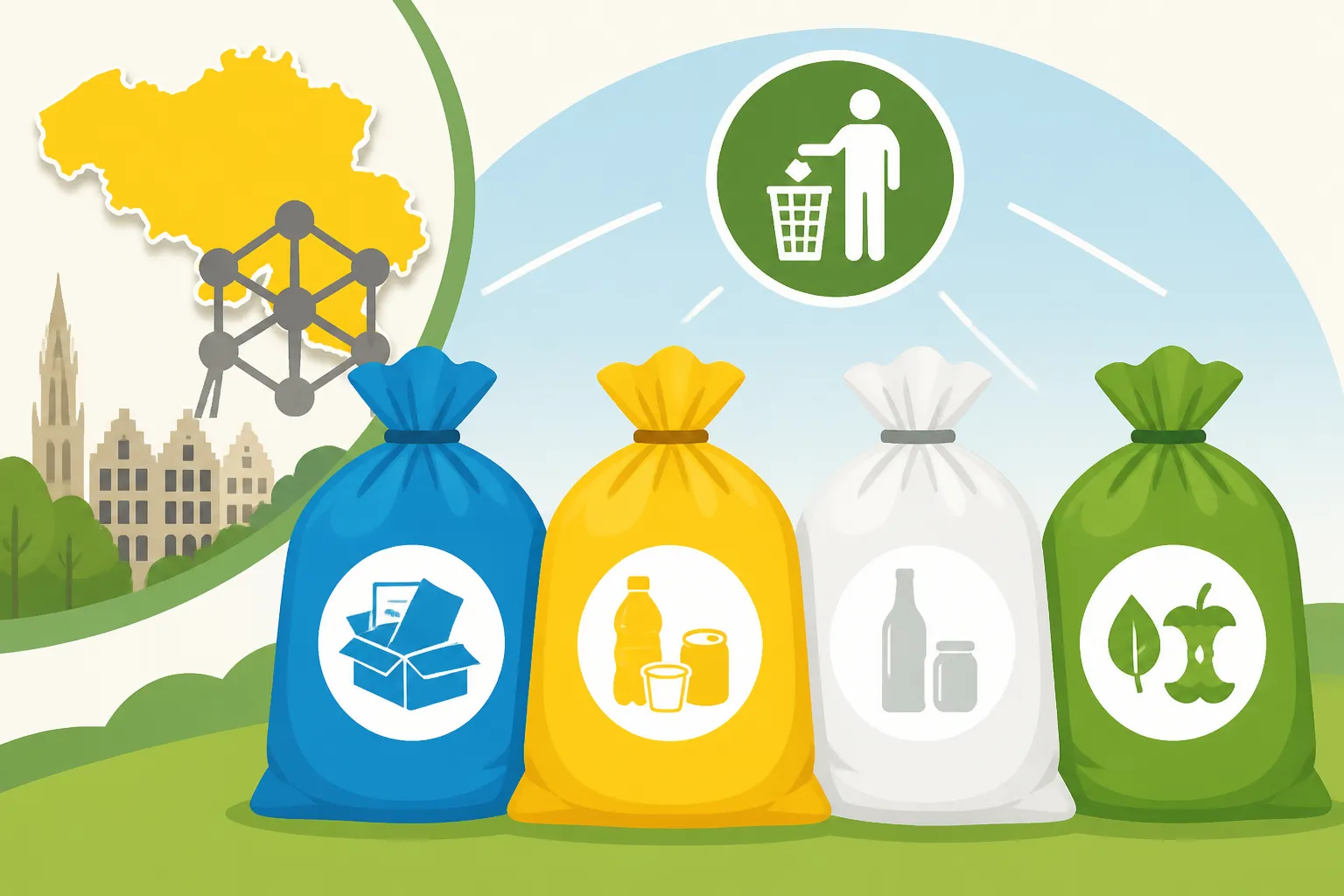
For many expats, the idea of paying nearly 2 euros for a single large white bag feels like a scam. However, this is the primary way the government incentivizes recycling. The "residual" bags (white) are the most expensive, while the recycling bags (blue, yellow, orange) are heavily subsidized and much cheaper. The goal is simple: make it expensive for you to throw away things that could be recycled.
This creates a unique Belgian habit of meticulously cleaning yogurt pots and flattening cardboard boxes to fit as much as possible into the cheaper bags. It is a fundamental part of the Everyday Rules in Belgium: Garbage Sorting, Noise, and Etiquette that every resident must master to integrate successfully.
The Holy Trinity: White, Blue, and Yellow Bags
These three colors form the backbone of the Belgian recycling system. Even in the most basic studio apartment, you will need to find space for at least these three streams. If you are struggling to find bins that fit into small Belgian kitchens, I highly recommend checking Amazon Belgium for slim-profile stacking bins that help keep the different bags organized.
The White Bag: Your Most Expensive Trash
The white bag is for "residual waste"—anything that cannot be recycled, composted, or taken to a specialized center. Because this waste is usually incinerated, it is the most ecologically damaging and, therefore, the most expensive stream. You should aim to put as little as possible in here.
Items that belong in the white bag include:
- Dust from your vacuum cleaner.
- Cigarette butts and cold ashes.
- Dirty or greasy food packaging (like that aforementioned pizza box).
- Cat litter and pet waste.
- Used diapers/nappies.
- Broken ceramics or mirrors (though large mirrors need the container park).
What never goes in the white bag is glass, chemicals, or electronics. I’ve seen neighbors get slapped with 150-euro fines because they threw a wine bottle in a white bag. The clink of glass is a dead giveaway for inspectors.
The Blue Bag (PMC): The Expat's Best Friend
The blue bag is for PMC, which stands for Plastic, Metal, and Cartons. In recent years, the rules for the blue bag have expanded significantly. It used to be very restrictive, but now, almost all plastic packaging is accepted. This is the bag that will fill up the fastest.
According to the Brussels Garbage Bags Color Guide: White (General) vs Blue (PMC), you can now include:
- Plastic bottles, tubs, and trays (margarine tubs, yogurt pots).
- Plastic film and bags (the wrap around your pack of water or bread bags).
- Metal packaging, including beverage cans, tins, and even aluminum trays.
- Drinks cartons (Tetra Pak for milk, juice, etc.).
Pro-tip: You do not need to scrub these items with soap, but they must be emptied. If you leave half a liter of spoiled milk in a carton, the bag becomes too heavy and messy, and the collectors might refuse to take it. Also, do not nest plastic tubs inside each other; the sorting machines at the plant need to be able to identify each item individually.
The Yellow Bag: Paper and Cardboard Rules
The yellow bag is specifically for clean, dry paper and cardboard. This is a "dry" stream, meaning if the paper is wet or contaminated with food, it must go into the white bag. Belgium takes its paper recycling seriously, and this is one of the easiest streams to manage.
You should include:
- Newspapers, magazines, and flyers.
- Cardboard boxes (flattened!).
- Envelopes (even those with plastic windows are usually okay).
- Office paper and paper bags.
One major mistake expats make is putting "fake" paper in here. Wallpaper, thermal fax paper, and greaseproof paper are not recyclable in the yellow stream. If you are ordering a lot of deliveries while setting up your home, the yellow bag will be your best friend. Just remember to remove all plastic tape and shipping labels from the boxes before putting them in the bag.
The Organic Revolution: Orange and Green Bags
In the last two years, organic waste collection has become mandatory in many parts of Belgium, including the entire Brussels-Capital Region. This was a massive shift for many residents who were used to throwing food scraps into the white bag.
The Orange Bag: Mandatory Food Waste
The orange bag is for food scraps and organic kitchen waste. If you are Food Waste (Orange Bags): Rules for Composting in the City, you know that these bags are quite small and made of a breathable or biodegradable material. Because they can smell, many communes provide a small orange plastic pre-bin with a lid to keep the bag secure inside your kitchen.
Items for the orange bag:
- Fruit and vegetable peels.
- Leftover cooked food (meat, pasta, rice).
- Coffee grounds and paper filters.
- Tissues and paper towels (as long as they aren't soaked in chemicals).
- Eggshells.
The orange bag is collected once a week. Because it contains organic matter, it is vital to keep it tightly closed. If you have a balcony, keep the orange bin there to avoid fruit flies in the summer. If you have a large garden, you might even consider skipping the orange bag and starting your own compost pile, though you still need to follow local ordinances regarding smell and pests.
The Green Bag: Garden Waste and Flanders Specifics
In Flanders and suburban areas of Brussels/Wallonia, you will see the green bag. This is specifically for "green waste" like grass clippings, leaves, and small branches. In some areas, this isn't a bag but a rigid green bin that you pay a yearly subscription for.
If you are Renting in Belgium: Apartments, Contracts, and Tenant Rights (2027) and your rental includes a small garden, check your contract to see who is responsible for the green waste disposal. Often, if a gardener is provided by the landlord, they take the waste with them. If not, you will need to buy the specific green bags from your local commune or supermarket.
Beyond the Bag: Glass, Textiles, and Chemicals
Not everything can be picked up from your doorstep. Some waste streams require you to walk a few blocks or drive to a specialized center.
Glass Recycling: The "Bulle à Verre" System
Belgium does not collect glass from your house. Instead, you must take it to a "Bulle à Verre" (glass bulb). These are large containers located on street corners. They are almost always color-coded: one for white (clear) glass and one for colored (green/brown) glass.
When using the Glass Recycling: Finding the Bulles à Verre in Your Neighborhood, keep these rules in mind:
- Empty and Rinse: You don't want to attract wasps to the containers.
- Remove Caps: Lids and corks belong in the blue or white bag, not the glass bulb.
- Respect the Hours: It is strictly forbidden (and quite rude) to dump glass between 10:00 PM and 7:00 AM. The sound of clinking glass in a quiet neighborhood is a major noise violation.
- No Pyrex or Mirrors: These have different melting points and will ruin the recycling batch.
Disposing of Hazardous Waste (Small Chemicals)
Small hazardous waste, known as KGA in Dutch or "Proxy Chimik" in French, includes batteries, lightbulbs, paint, oils, and cleaning chemicals. You cannot throw these in any bag.
For batteries, look for the "Bebat" boxes at the entrance of almost every supermarket. For other chemicals, most communes have a mobile collection van that parks at specific locations once or twice a month. Alternatively, you must take them to the container park. If you have just moved in and are overwhelmed, I recommend using Airalo to ensure you have a data connection to check the "Recycle!" app, which shows the exact GPS locations of these mobile vans in real-time.
| Bag Color | Purpose | Common Items | What to Avoid |
|---|---|---|---|
| White | Residual | Diapers, pet litter, cigarette butts | Glass, electronics, food |
| Blue | PMC | Plastic tubs, soda cans, cartons | Hard plastics (toys), batteries |
| Yellow | Paper | Magazines, clean cardboard | Greasy pizza boxes, wallpaper |
| Orange | Organic | Peels, leftovers, coffee grounds | Plastic bags, bones (sometimes) |
| Green | Garden | Grass, leaves, hedge trimmings | Soil, stones, thick branches |
Practical Logistics for Expats
Understanding what goes in the bag is only half the battle. You also need to know the "when" and the "where" of Belgian waste.
Where to Buy Your Bags (And Why They’re Not Generic)
You cannot use generic black bin bags from your home country. You must buy the official bags sanctioned by your local waste agency. You can find these at the checkout or the "Kiosk" section of supermarkets like Delhaize, Carrefour, or Colruyt.
When you ask for them, you usually specify the size (e.g., "White bags, 60 liters"). Note that the price of these bags includes the tax for waste collection. This is why a roll of 10 bags might cost 20 euros. If you are budgeting, remember that waste costs are a significant part of the Cost of Living in Belgium 2026: Singles, Couples, and Families.
The Collection Calendar and Avoiding Fines
Every year, the commune publishes a "Waste Calendar." This tells you exactly which day each bag is collected. In many cities, bags must be placed on the sidewalk either the evening before (after 6:00 PM) or early the morning of (before 6:00 AM).
If you put your bags out on the wrong day, or if they contain the wrong items, the collectors will leave them there and stick a large, colorful "refusal" sticker on them. This is a signal to the waste police to investigate. If you live in a communal building, this can also lead to friction with your landlord or neighbors. To avoid this, always check the digital calendar or the "Recycle!" app.
Using Container Parks (Recyparks)
For everything that doesn't fit in a bag—broken furniture, old electronics, piles of renovation rubble—you need to visit a "Recypark" or container park.
To enter, you generally need:
- Your Belgian eID: The gates only open for residents of that specific commune or region.
- To be within your quota: Most residents get a certain number of free cubic meters per year, after which you have to pay.
- To sort on-site: You will drive to different large bins for wood, metal, rigid plastic, and "everything else."
If you don't have a car, you can look into Oversized Waste (Encombrants): Booking a Pickup or Using Recypark. Most communes offer one or two free "on-demand" pickups per year for large items, but you usually have to book these several weeks in advance.
Setting Up Your Home for Success
The key to surviving the Belgian garbage system is organization. Don't wait until the bag is full to realize you've mixed up your plastics and papers.
Managing Space in Small Apartments
Belgian apartments, especially in historic parts of Brussels or Antwerp, aren't always designed with five different trash cans in mind. Use the vertical space in your kitchen. Many expats use the balcony for the "smelly" bags (white and orange) and keep the "dry" bags (blue and yellow) in a closet or under the sink.
If you are still in the process of moving, make sure you keep The Police Check (Contrôle de Quartier) for Address Verification in mind. The police officer who visits your home to verify your residency will notice if you are following the local rules. It sounds minor, but being a "good neighbor" starts with not letting your garbage pile up in the hallway.
Must-Have Tools for Sorting
- A Box Cutter: You will be doing a lot of cardboard flattening.
- The "Recycle!" App: The absolute gold standard for knowing which bag goes out tonight.
- A Small Crate for Glass: So you can easily carry it to the glass bulb once a week.
- Sturdy Bin Liners: Even though you use the official bags, some people put a cheaper generic bag inside the official white bag to prevent leaks, though this is technically frowned upon if the inner bag is too thick.
Mastering the bags is a rite of passage. Once you can accurately distinguish between a PMC-eligible plastic film and a residual-only candy wrapper, you can truly call yourself a Belgian resident.
Legal and Administrative Disclaimer
The information provided in this guide is for informational purposes only and is based on the general waste management regulations in Belgium. Garbage sorting rules, collection schedules, and bag prices are subject to frequent changes by local communal and regional authorities (Net Brussel, IVAGO, etc.). Residents are strongly advised to consult their specific commune's official website or the "Recycle!" mobile app for the most current and localized regulations. Failure to comply with local waste ordinances can result in significant administrative fines. This guide does not constitute legal advice.