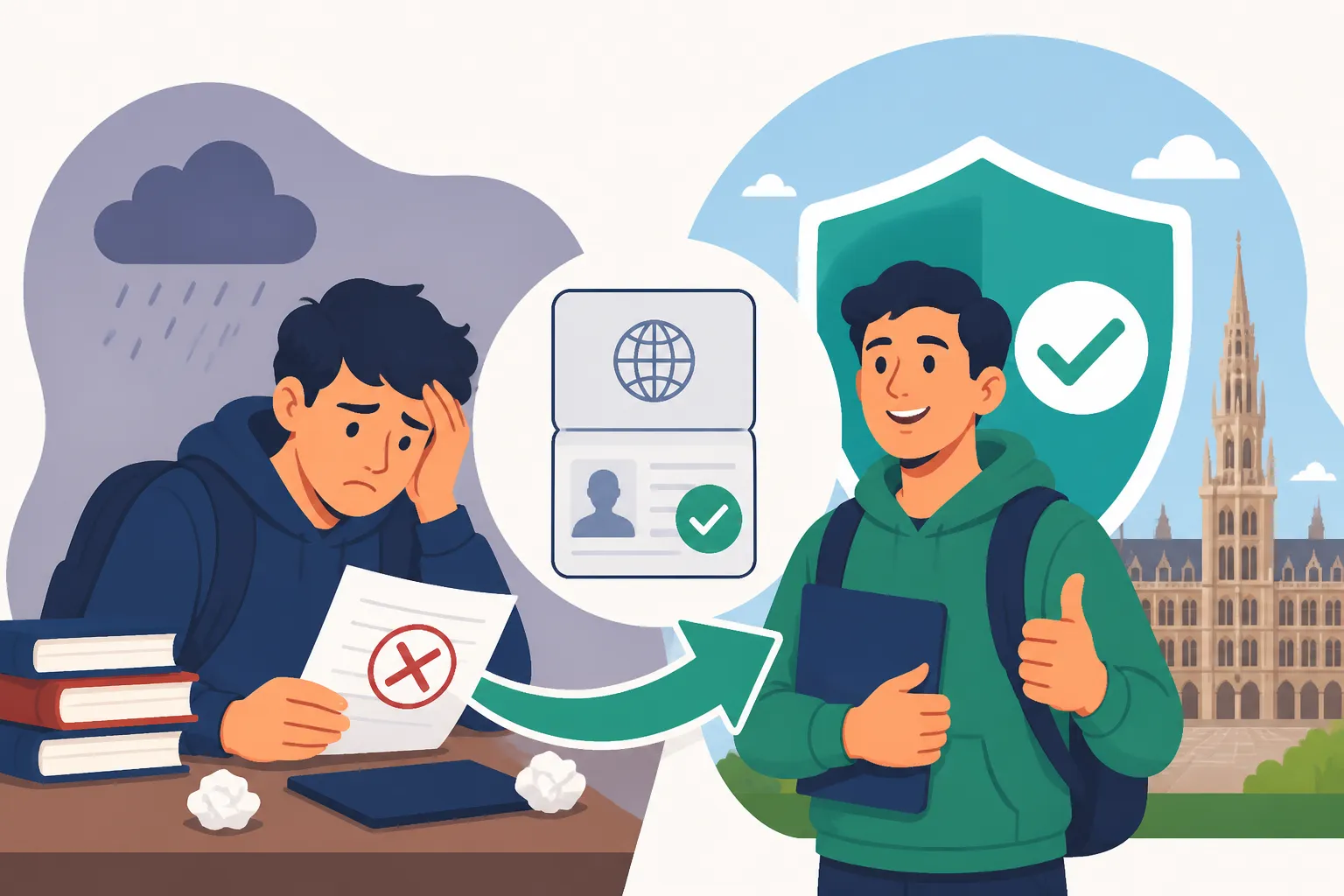
Extending a Student Visa if You Fail a University Year
That sinking feeling when the exam results roll in, and it's not what you hoped for – we've all been there, or at least imagined the gut punch. But when you're an international student in Belgium, a failed university year isn't just about disappointment; it brings a whole new layer of anxiety: "What about my student visa?" This guide is here to walk you through the often-stressful, but entirely manageable, process of extending your Belgian student visa, even when your academic journey hits an unexpected bump.
The Reality of Academic Progress and Your Student Visa in Belgium
When you first arrived in Belgium on your student visa, the Immigration Office granted it based on the premise that you'd be pursuing serious and regular studies. They're not expecting you to be a straight-A student, but they do expect you to show genuine effort and progress. This fundamental expectation is what underpins all visa renewals for students. If you've found yourself in a situation where you haven't accumulated enough credits, or you need to re-sit an entire year's worth of courses, it can feel like your entire future in Belgium is hanging by a thread.
Understanding "Serious and Regular Studies"
The Immigration Office defines "serious and regular studies" as being actively enrolled in a full-time study program and demonstrating consistent participation and effort towards completing that program. This typically means you're attending classes, participating in exams, and generally following the academic calendar. It doesn't necessarily mean you have to pass every single course on your first try. However, if you consistently fail to obtain a significant number of credits, or if your academic progress grinds to a halt for multiple semesters, that's when you might raise a red flag.
For example, if you enrolled for 60 ECTS credits and only managed to validate 15, that's a much harder sell to the immigration authorities than if you validated 40 and have a clear plan to re-sit the remaining few. They look at the overall picture, your active engagement, and whether you're genuinely committed to your education here. The Belgian system offers various pathways for students who need to retake courses or even an entire academic year, and the visa framework is generally designed to accommodate these realities, provided you can demonstrate that commitment. To get a broader understanding of how all these pieces fit together, I highly recommend checking out our comprehensive guide on Belgian Visas and Residence Permits: The Complete 2027 Guide.
Initial Visa Conditions and Academic Expectations
Remember those stacks of documents you submitted for your initial student visa? The proof of enrollment, the financial solvency, the medical certificates? Those weren't just hurdles to clear for entry; they set the baseline expectations for your stay. You declared an intention to study, and you proved you could support yourself. Now, as you consider an extension after a difficult academic year, you'll effectively need to re-affirm those commitments. Your university, in particular, becomes a crucial ally. They need to officially re-enroll you and confirm your study plan, even if it's to repeat courses or a full year.
It's also worth revisiting the topic of financial proof. Just as you provided evidence of sufficient funds initially, you’ll need to do so again for your extension. The amount required often gets adjusted annually, so it's vital to have up-to-date information. If you're unsure about the specifics, our guide on Student Visa Proof of Solvency: How Much Money Must Be Blocked? can provide valuable insights. Your health insurance, whether it's through a local mutuelle or an international provider like Cigna Global, also remains a mandatory requirement throughout your stay.
Step-by-Step Guide to Extending Your Student Visa After an Unsuccessful Academic Year
This is where the rubber meets the road. Navigating the administrative maze of visa extensions after a failed year can feel daunting, but a structured approach can make all the difference. The key is to be proactive, transparent, and have all your ducks in a row.
Immediate Action: Engage Your University
The very first step, even before you think about immigration paperwork, is to communicate openly and immediately with your university. Don't shy away from their academic advisors or the international student office. These individuals are not just there to help with course registration; they are often your strongest advocates and navigators within the Belgian system. Explain your situation, discuss your options for re-enrollment, and ask for their guidance. They can often provide a crucial "attestation" or official letter confirming your re-enrollment for the upcoming academic year, outlining your revised study plan, and, crucially, validating your ongoing commitment to your studies. This document is golden for your visa application.
The university staff can also advise you on whether you're eligible to re-enroll, what the maximum duration of your study program is, and if there are any specific internal university processes you need to follow. Sometimes, a university might have internal limits on how many times you can repeat a year or specific courses. Understanding these nuances before you apply for your visa extension is vital.
Gathering Your Documents: The Visa Extension Checklist
Once you have a clear academic plan from your university, it's time to compile your visa extension application. The list might seem familiar from your initial visa application, but pay close attention to the details specific to your current situation.
Here's a breakdown of the typical documents you'll need:
- Valid Passport: Ensure it has at least six months of validity remaining beyond your intended stay.
- Current Belgian Residence Permit (eID): This will be your existing A-card.
- New Enrollment Certificate (Attestation d'inscription / Inschrijvingsattest): This is from your university, confirming your enrollment for the upcoming academic year, even if it's to repeat a year. It should clearly state the number of ECTS credits you are taking.
- Academic Transcripts: Provide official transcripts showing your academic performance to date, including the failed year. While it might feel counterintuitive to present "bad" results, transparency is key. You can often get these from your university's student administration office.
- Proof of Sufficient Funds: You'll need to demonstrate, again, that you have the financial means to support yourself without becoming a burden on the Belgian state. This could be a blocked account, a scholarship letter, or an Annex 32 (proof of sponsorship) from a guarantor. The amount required is indexed annually, so verify the current threshold.
- Proof of Health Insurance: Ensure your health insurance coverage is continuous and valid for the entire duration of your requested extension. This could be your registration with a Belgian mutuelle (like Partenamut or Solidaris) or an international private health insurance plan such as Cigna Global.
- Motivation Letter: This is perhaps the most crucial document for an extension after a failed year. Don't just submit a generic letter. Use this as your opportunity to explain why you had a difficult academic year (e.g., adaptation issues, personal struggles, health problems – be honest but professional). Crucially, outline your concrete plan for academic success in the upcoming year. Show that you've learned from the experience and are committed to getting back on track. This is where your voice truly matters.
- Proof of Accommodation: Your rental contract or a declaration of residence.
- Police Records (if requested): For certain renewals, or if there's a gap in your stay, the commune might request an extract from your criminal record.
Any documents not originally in French, Dutch, German, or English will need to be translated by a sworn translator. Services like RushTranslate can be invaluable for ensuring official documents meet Belgian legal requirements for translation and, if necessary, apostille or legalization. For more details on the general process of registering your residence and obtaining your eID, check out Residence Registration: Annexes, Communes, and the eID Card.
Submitting Your Application to the Commune
With all your documents meticulously prepared, you will submit your application to the foreign residents' department (service des étrangers / dienst vreemdelingen) at your local Commune/Stadhuis. Remember, the deadline for submitting your extension is typically no later than 15 days before your current residence permit (eID) expires. Missing this deadline can lead to complications, including fines or even an order to leave the territory. If you're concerned about your eID's expiry, our article on Renewing Your eID: How Early Should You Apply Before Expiry? can help you plan.
The commune will review your application and forward it to the Immigration Office (Office des Étrangers / Dienst Vreemdelingenzaken – DVZ) in Brussels. They are the ultimate decision-makers regarding your visa extension. They will evaluate your academic progress, your motivation letter, and your overall situation to determine if you still meet the conditions for a student visa.
Here's a helpful table summarizing the key documents:
| Document Category | Specific Document | Purpose | Notes |
|---|---|---|---|
| Identity & Residency | Valid Passport | Proof of identity and nationality | Minimum 6 months validity |
| Current Belgian eID Card | Proof of current residence status | ||
| Academic Proof | New Enrollment Certificate (University) | Confirms re-enrollment for the upcoming year, number of ECTS credits | Must specify full-time enrollment, even if repeating a year. |
| Official Academic Transcripts | Shows previous academic performance and current standing | Transparency is crucial; include all results. | |
| Financial Solvency | Proof of Sufficient Funds | Bank statements, scholarship letter, Annex 32 (sponsorship) | Check updated required amounts annually. |
| Health Coverage | Health Insurance Certificate | Proof of comprehensive medical coverage for the duration of stay | Mutuelle affiliation or private insurance (e.g., Cigna Global) |
| Personal Statement | Detailed Motivation Letter | Explains academic difficulties, commitment to studies, plan for future success | Personalized and honest explanation is vital. |
| Accommodation | Rental Agreement / Declaration of Residence | Proof of stable housing in Belgium | |
| Translations | Sworn Translations of Foreign Documents (if applicable) | Ensures all non-official language documents are legally recognized | Services like RushTranslate specialize in these for Belgian authorities. |
What to Expect: Challenges and Potential Outcomes
Once your application is submitted, you enter the dreaded "waiting game." This period can be filled with anxiety, but understanding the possibilities can help you prepare emotionally and practically.
The Waiting Game and Temporary Annexes
After you submit your application to the commune, they will provide you with a temporary residence document, usually an Annex 15 (Annexe 15 / Bijlage 15). This document proves that your application is pending and allows you to continue residing in Belgium legally while your file is being processed by the Immigration Office. It's essential to understand its limitations; while it allows you to stay, it may not grant you the same rights as your eID, especially regarding international travel. Our guide on What is an Annex 15 (Annexe 15/Bijlage 15) and Can You Work With It? delves into the specifics of this crucial temporary document. Processing times can vary greatly, from a few weeks to several months, depending on the volume of applications and the complexity of your case.
During this period, avoid traveling outside the Schengen Area if possible, as re-entry might be complicated with just an Annex 15. Your commune will contact you when a decision is made or if additional information is required.
Possible Outcomes and How to React
There are generally three main outcomes for a student visa extension request after an unsuccessful academic year:
- Approval: This is, of course, the best-case scenario. The Immigration Office acknowledges your efforts and grants you an extension, usually for another academic year. You'll be notified by your commune, who will then process your new A-card. Congratulations, you're back on track!
- Request for More Information (Annex 32): The Immigration Office might send you an official letter, an Annex 32, requesting further clarification or additional documents. This is not a rejection, but a signal that they need more details to make a decision. Do not ignore this! Respond promptly, thoroughly, and provide all requested information, possibly with a new, updated motivation letter. This is your chance to fill any gaps or strengthen your case.
- Rejection: In some cases, especially if there's a history of poor academic progress, insufficient proof of funds, or a poorly presented motivation, your application might be rejected. A rejection will typically come with an order to leave the Belgian territory (an OQTF – Ordre de Quitter le Territoire / Bevel om het grondgebied te verlaten). This is a serious situation, but it's not necessarily the end of the road.
Appealing a Rejection and Alternative Paths
If your student visa extension is rejected, you do have the right to appeal the decision. This appeal is typically lodged with the Council for Alien Law Litigation (CALEA/RvV – Conseil du Contentieux des Étrangers / Raad voor Vreemdelingenbetwistingen). The appeal process is complex and time-sensitive, so this is where professional legal advice becomes absolutely critical. You will want to consult an immigration lawyer experienced in Belgian alien law. They can assess the grounds for your rejection, help you prepare a robust appeal, and represent you. Don't delay, as there are strict deadlines. Our article on Appeals and Rejections: What to Do if the Immigration Office Denies You provides more in-depth information on this challenging process, and if you find yourself in this situation, consider reading Hiring an Immigration Lawyer: When Do You Need Professional Help? to understand your options.
If an appeal is unsuccessful or if you decide not to pursue it, you might need to consider alternative options for your stay in Belgium, such as exploring work visa categories (if you find an employer and meet the criteria) or, regrettably, making arrangements to leave the country.
Personal Advice and Proactive Steps
As an expat who's seen it all, I can tell you that the best way to navigate these waters is to be proactive and understand that you're not alone. Many international students face academic challenges, and the system does have provisions for it, provided you meet them halfway.
Don't Suffer in Silence: Seek University Support
One of the biggest mistakes you can make is to isolate yourself and struggle alone. Universities in Belgium have extensive support systems for international students. If you're struggling academically, seek out tutoring services, academic coaching, or even mental health support. Academic stress and culture shock are very real factors, and addressing them can make a huge difference in your studies. Consider reaching out to an English-Speaking Psychologists in Belgium: Therapy Access if the pressure feels overwhelming. Your well-being is paramount.
Additionally, if language is proving to be a barrier in your studies, investing in language courses can significantly improve your academic performance. There are many excellent options for Language Learning: French and Dutch Courses for Professional Growth that can help you integrate better and excel in your studies.
Maintain Impeccable Records and Communication
Treat every interaction with your university and the commune as a part of your visa journey. Keep copies of every email, every official letter, every transcript, and every submitted document. When you're dealing with bureaucracy, having a clear, organized paper trail can save you immense headaches down the line. When communicating, always be polite, clear, and persistent. Don't assume anything; if you're unsure about a requirement, ask for clarification in writing.
Remember, the Immigration Office is looking for evidence of your genuine intent to study seriously and regularly. By being transparent about your struggles, demonstrating a clear plan for recovery, and actively engaging with your university, you significantly improve your chances of a successful visa extension. It might be a challenging chapter, but with the right steps, you can turn it around.
Disclaimer
Please note that while this guide provides comprehensive information based on current regulations and common experiences, immigration laws in Belgium (and globally) are subject to change. This content is for informational purposes only and does not constitute legal advice. Always consult with the relevant official authorities, such as the Belgian Immigration Office or a qualified immigration lawyer, for personalized advice regarding your specific situation.