How to Submit Medical Receipts for Reimbursement in Belgium
Navigating the Belgian healthcare system often feels like you have stepped into a confusing maze of paperwork, tiny white stickers, and mysterious metal mailboxes on street corners. I remember my first week in Brussels, staring at a green slip of paper from a GP in Etterbeek, wondering if I was supposed to mail it, scan it, or keep it as a souvenir. This guide solves the mystery of the reimbursement process, ensuring you get your money back quickly and correctly.
Understanding the Belgian Healthcare Refund System
In Belgium, the healthcare system operates on a "fee-for-service" basis with a compulsory insurance layer. Most residents pay the doctor upfront and then request a partial refund from their public health insurance provider, known as a mutuelle in French or ziekenfonds in Dutch. If you are still setting up your life here, it is vital to understand the Healthcare in Belgium for Expats: Complete System Overview (2027) to see how these pieces fit together.
Generally, the public system covers about 50% to 75% of your medical costs. The remaining portion, which you pay out of pocket, is called the "ticket modérateur." For many expats, especially those used to fully subsidized systems, this can be a shock. This is why many international professionals also carry private insurance, such as Cigna Global, to cover that remaining gap and provide more comprehensive global coverage. While your mutuelle handles the basics, a provider like Cigna Global can be a lifesaver for private hospital rooms or specialized treatments that fall outside the standard public tariff.
To begin the reimbursement process, you must be properly registered with a fund. If you haven't done this yet, you should follow the Mutuelle and Ziekenfonds: Public Health Insurance Registration Guide immediately. Once you are registered, you will receive a sheet of small white stickers—vignettes—which are the "currency" of your administrative health life in Belgium. These stickers contain your national registry number and your specific mutuelle code, and you will need them for almost every physical interaction with the system.
The Traditional Way: Submitting Physical Receipts
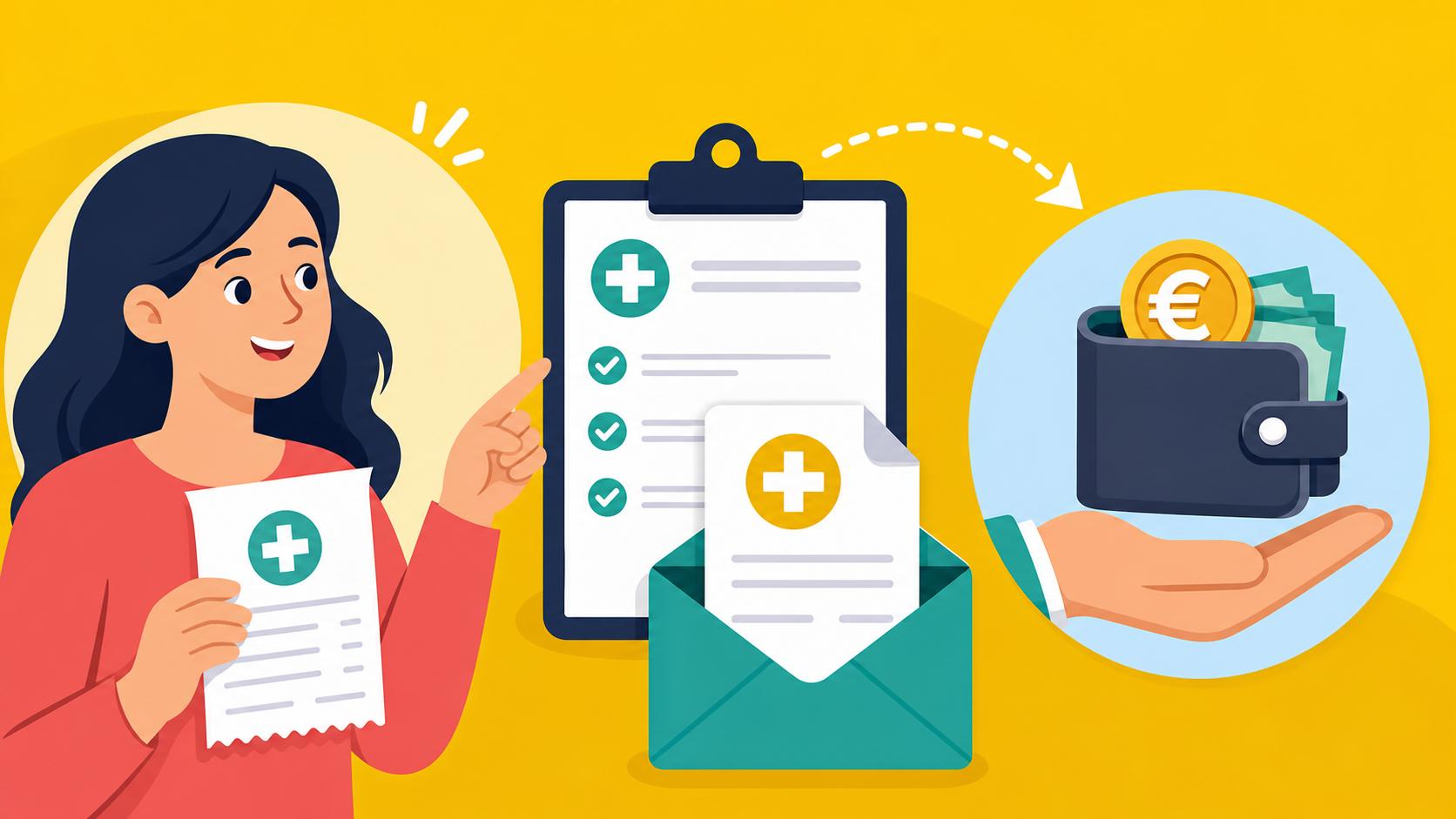
While Belgium is rapidly digitizing, you will still frequently encounter the "Attestation de Soins Donnés" (French) or "Getuigschrift voor verstrekte hulp" (Dutch). This is a small, often green or white, rectangular slip of paper that the doctor or specialist hands you after you pay your bill. For years, I kept these in a kitchen drawer, terrified I would lose the one that cost 100 Euros.
The first thing you must do with this receipt is check that all the fields are filled out. The doctor must sign it, date it, and include their "INAMI" number (their professional registration code). On the right-hand side of this slip, there is a dedicated space for your vignette. You must stick one of your white stickers firmly in that box. If you forget this, the mutuelle won't know which account to deposit the money into. If you are unsure about these stickers, read more about What Are Mutuelle Stickers Used For and Where to Put Them to avoid a rejection.
Once the sticker is on, you need to "post" it. Most mutuelles have their own dedicated mailboxes. They are usually located outside their local branch offices. For example, if you are with Partenamut, look for the blue boxes; if you are with CM, look for the yellow or red ones. You do not need an envelope or a stamp if you use these specific boxes. You simply drop the slips inside. Within a week or two, the money magically appears in your bank account. However, if you are new and still waiting for your initial paperwork, you might wonder How Long Does It Take to Get Your Mutuelle Stickers (Vignettes)? before you can actually drop those receipts off.
The Modern Way: eAttest and Digital Reimbursements
The good news for those of us who hate paper is that the "eAttest" system is becoming the standard. If your doctor uses eAttest, you don't have to do anything. After you pay via Bancontact or the Payconiq app, the doctor sends the claim digitally to your mutuelle. In my experience, the refund often hits my bank account before I even get home from the appointment.
When you are Choosing Your First GP (General Practitioner) in Belgium, it is always worth asking if they use eAttest. It saves you the hassle of keeping track of paper slips and finding mailboxes. You can track all these digital claims through the federal portal. I highly recommend bookmarking the MyHealth.belgium.be Guide: Accessing Your Medical Records Online so you can verify that your doctor actually submitted the claim.
There is also a system called "Tiers-payant" (third-party payer). In this scenario, you only pay the "ticket modérateur" (your share) at the time of the visit, and the doctor bills the mutuelle directly for the rest. This is common at hospitals and large medical centers in Brussels or Antwerp. To understand how this works in depth, you should look at eAttest Explained: How Doctors Automatically Claim Your Refund. It is the smoothest way to interact with the system, though not every independent specialist offers it yet.
Pharmacy Reimbursements and Medication
Pharmacies in Belgium operate differently than you might expect. When you go to a "Pharmacie" or "Apotheek" with a digital prescription (which is now linked to your eID card), the reimbursement is usually applied instantly at the counter. You only pay the reduced price. However, this only applies to medicines that are "remboursable."
Many things you might need for daily health—like high-quality vitamins, supplements, or specific skincare for chronic conditions—are often not covered by the mutuelle. I’ve found that even with the discount, Belgian pharmacy prices for non-prescription items can be quite high. This is where many expats turn to iHerb. I personally use iHerb for my specialized probiotics and magnesium because even after shipping, it is often significantly cheaper than the local pharmacy price in Brussels. While you won't get a mutuelle refund for an iHerb order, the savings often exceed what a refund would have been anyway.
For prescriptions, make sure you understand the Pharmacies and Medication in Belgium: Prescriptions and OTC Rules. If you have private insurance like Cigna Global, you can often submit the pharmacy receipts (even for non-reimbursable items) to them for a full or partial refund, depending on your plan. Always ask the pharmacist for a "quittance" (a detailed receipt) if you intend to claim through private insurance.
Maximizing Your Refunds and Avoiding Pitfalls
One of the biggest mistakes expats make is not opening a Global Medical Record, or DMG (Dossier Médical Global). If you don't have one, you will pay more for every doctor's visit, and your reimbursement will be lower. By asking your GP to open a DMG, you get a higher percentage of your money back and better coordination of care. This is a critical step, so make sure you read The Global Medical Record (DMG/GMD): Why You Need It for Better Refunds.
Another common frustration involves specialist visits. In some countries, you go straight to a specialist. In Belgium, if you go to a specialist without a referral from your GP, your reimbursement might be lower, or the "conventioned" status of the doctor might change. To save money, always check Seeing Specialists in Belgium: Do You Need a GP Referral First? before booking that dermatologist or cardiologist appointment.
| Reimbursement Method | Speed | Action Required | Best For |
|---|---|---|---|
| Physical (Green Slip) | 1-3 Weeks | Attach Vignette & Drop in Box | Older GPs & Specialists |
| eAttest (Digital) | 2-5 Days | None (Automatic) | Modern GPs & Clinics |
| Tiers-Payant | Instant | Pay only the co-pay | Hospitals & Large Centers |
| Pharmacy Digital | Instant | Show eID | Prescription Meds |
| Private (Cigna Global) | Varies | Upload Scan/Photo to App | Hospitalization & Gaps |
What to Do If Your Reimbursement Is Rejected
Sometimes, a receipt comes back to you in the mail with a red stamp or a letter of explanation. This usually happens because the vignette fell off, the doctor’s stamp was illegible, or the date of service was more than two years ago (the legal limit for claims). Don't panic; it is usually a simple fix.
If the vignette fell off, simply put a new one on and drop it back in the box. If the doctor's info is missing, you will need to return to their office and ask them to re-stamp and sign it. I have had to do this once when a specialist in Ixelles forgot to sign the bottom of the form. It was a 20-minute detour, but it saved me 60 Euros.
Lastly, keep a folder for your medical records. Even today, the Belgian system relies on you being the ultimate curator of your health history. Whether you are using a public mutuelle, a private gap-filler like Cigna Global, or simply ordering your vitamins from iHerb, staying organized is the only way to survive the bureaucracy without losing your mind.
Disclaimer
This guide is intended for informational purposes only and represents the personal experiences of an expat living in Belgium. Healthcare regulations, reimbursement rates, and digital systems are subject to change by the Belgian federal government and the INAMI/RIZIV. Always consult with your specific mutuelle provider or a legal professional for the most current advice regarding your personal situation.