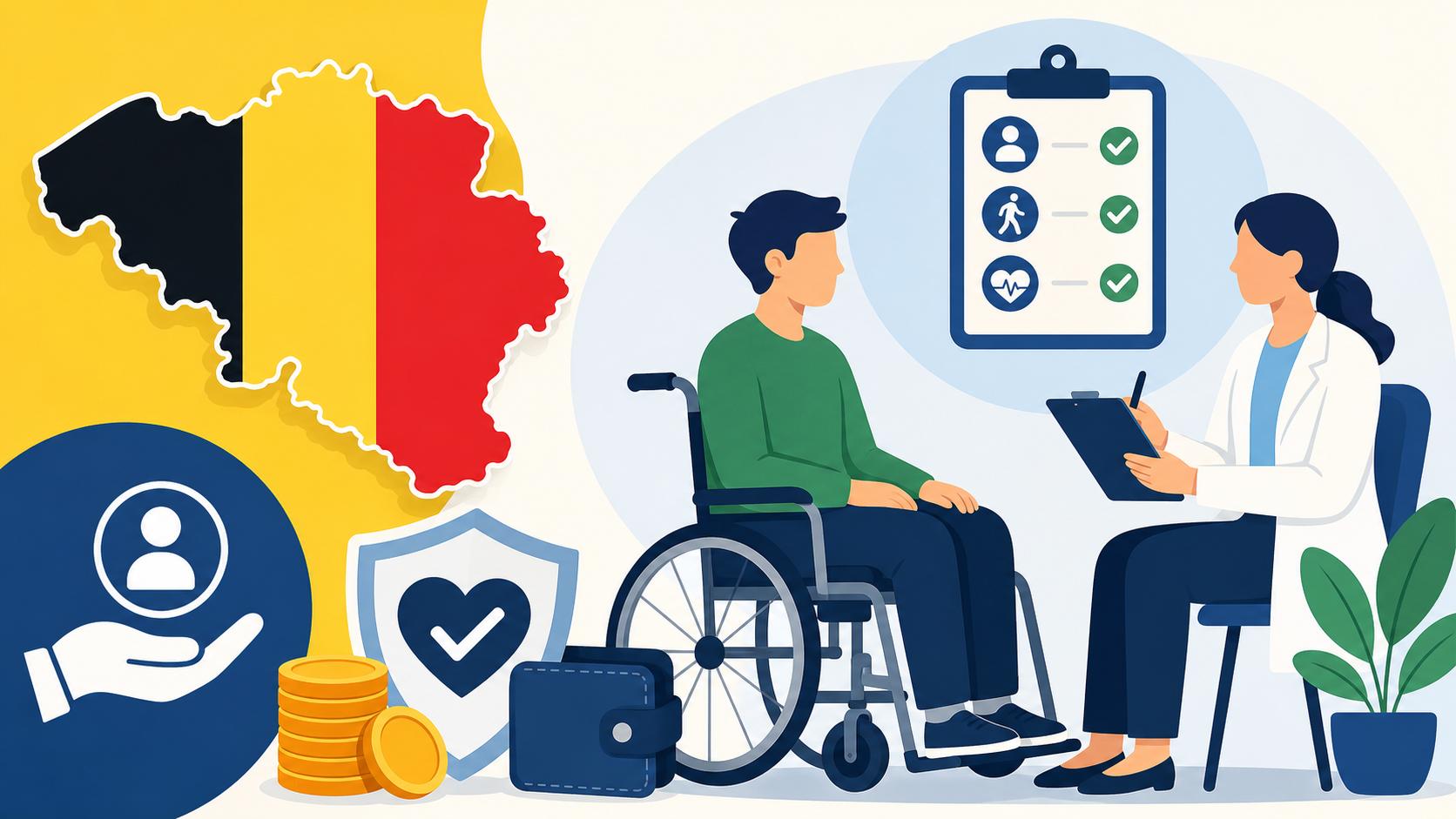
Disability Allowances in Belgium: Medical Assessments and Criteria
Navigating the Belgian social security system while managing a long-term illness or disability can feel like trying to solve a Rubik’s cube in the dark. I remember sitting in my local commune office, clutching a stack of medical records and feeling completely overwhelmed by the complex terminology used by the staff. This guide simplifies the disability allowance system in Belgium, helping you understand medical assessments, eligibility, and how to secure the support you deserve.
Understanding the Types of Disability Allowances in Belgium
Belgium offers two primary federal allowances for adults with disabilities, managed by the DG Persons with Disabilities (part of the Federal Public Service Social Security). It is important to distinguish between these two because their goals and eligibility criteria differ significantly. While Healthcare in Belgium for Expats: Complete System Overview (2027) provides a broad look at the medical landscape, disability benefits are a specialized niche within that system.
Income Replacement Allowance (ARR/IVT)
The Income Replacement Allowance, known as ARR in French (Allocation de Remplacement de Revenus) or IVT in Dutch (Inkomensvervangende tegemoetkoming), is designed for individuals whose earning capacity is reduced to one-third or less of what an able-bodied person could earn on the general labor market. This is essentially a safety net for those who cannot work or can only work very limited hours due to their physical or mental condition.
When I first looked into this, I was surprised to learn that the calculation isn't just about your health; it’s deeply tied to your household's financial situation. The authorities look at your "catégorie" (household composition) and your taxable income. If you are living with a partner who earns a high salary, your ARR might be reduced or even zeroed out, which can be a point of major frustration for expats used to individualized benefit systems. If you are struggling with costs before your allowance is approved, looking into Healthcare Budgeting: Copays, DMG/GMD, and Reimbursements can help you manage day-to-day medical expenses.
Integration Allowance (AI/IT)
The Integration Allowance, or AI (Allocation d’Intégration) / IT (Integratietegemoetkoming), is quite different. It isn't meant to replace a salary; instead, it's intended to cover the "hidden" costs of living with a disability. This could include specialized transport, home adaptations, or the extra time and help needed for daily tasks. Unlike the ARR, the AI is based primarily on your loss of autonomy.
The beauty of the Integration Allowance is that you can often receive it even if you are working. It recognizes that even a high-earning professional with a disability faces costs that their peers do not. Many expats maintain private coverage through providers like Cigna Global to handle international medical needs, but the federal AI remains a vital local resource for long-term integration support. If you find yourself needing specific health aids or supplements to manage your condition while waiting for these bureaucratic wheels to turn, many residents find that iHerb offers a reliable way to source international wellness products delivered directly to Belgium.
The Medical Assessment Process: What to Expect
The medical assessment is the part most people dread. It involves a "medical expert" from the FPS Social Security reviewing your case to determine your level of disability or loss of autonomy. It’s not just a chat with your GP; it’s a formal evaluation that follows very specific Belgian legal grids.
The 6-Point Scale of Autonomy
To determine the Integration Allowance, the doctor evaluates your ability to perform daily activities. They use a scale of 0 to 3 across six specific categories. A score of 0 means no difficulty, while 3 means you cannot perform the task at all without help. The categories usually include:
- Moving around (walking, stairs, navigating the environment).
- Preparing and eating food.
- Personal hygiene and dressing.
- Maintaining a household (cleaning, laundry, shopping).
- Living without supervision and awareness of danger.
- Communicating and social contact.
To qualify for an allowance, you generally need a total of at least 7 points across these categories. I’ve seen many people fail to get the points they deserve because they were "too brave" during the assessment. When the doctor asks if you can cook, and you say "yes" because you can microwave a meal despite being in pain, they might mark you down. It is essential to describe your "worst day" or the effort and pain involved in these tasks. Having a clear record in the system, as described in the MyHealth.belgium.be Guide: Accessing Your Medical Records Online, is incredibly helpful here.
Preparing for the Doctor’s Appointment
Once you apply, you will eventually be called for a physical or video consultation. You should bring every piece of evidence you have. This includes recent reports from specialists, X-rays, and psychological evaluations. Do not assume the FPS doctor has seen your files from Finding Medical Care in Belgium: GPs, Specialists, and Hospitals.
In my experience, it helps to bring a "diary of limitations" for a week prior to the appointment. List exactly what you couldn't do or where you needed help. If your spouse has to help you tie your shoes every morning, that needs to be mentioned. The doctor isn't there to treat you; they are there to "score" you. It’s a cold process, but being prepared with facts makes it smoother. If your condition was caused by a workplace incident, you should also ensure you understand Social Security Contributions: How Employers Deduct Health Costs to see how insurance at work might overlap with federal aid.
| Allowance Type | Focus | Work Compatibility | Income Impact |
|---|---|---|---|
| ARR / IVT | Earning Capacity | Very Limited | Household income affects amount |
| AI / IT | Autonomy/Daily Life | Fully Compatible | Own income affects amount |
| MAFS | Out-of-pocket costs | Compatible | Based on medical spending |
Eligibility Criteria for Expats and Foreign Residents
One of the most common questions I get from the international community is: "Am I even eligible if I’m not Belgian?" The answer is usually yes, but there are hoops to jump through regarding residency and nationality.
Residency and Nationality Requirements
Generally, you must be "effectively and permanently" residing in Belgium. This means your primary home is here and you are registered in the National Register. For nationality, the rules are:
- Belgian citizens.
- EU, EEA, or Swiss citizens.
- UK citizens (subject to specific Withdrawal Agreement protections).
- Refugees, stateless persons, or those with subsidiary protection.
- Non-EU citizens from countries with a social security treaty with Belgium (like Morocco, Turkey, or Tunisia).
If you don't fall into these categories, you might still qualify if you are the spouse or dependent of someone who does. The administrative side of this requires a valid eID. If you’re still in the early stages of your move, you might find Registering for Public Health Insurance: Step-by-Step at Your Commune a necessary first step before even approaching the disability office.
Income Thresholds and Household Composition
The Belgian system is heavily "socialized," meaning they look at your household as a unit. For the ARR, if your partner earns a significant income, the government assumes they can support you, and your allowance will be tapered. There are specific exemptions—for instance, a certain portion of your partner's income is "protected" and not counted against you—but the calculation is notoriously opaque.
For the AI, the income of your partner is usually not taken into account, but your own income is. If you are working while disabled, your Integration Allowance might decrease once your salary hits a certain threshold. It is always worth consulting a social worker at your Mutuelle and Ziekenfonds: Public Health Insurance Registration Guide office. They have specialized software that can run simulations of what you might actually receive in your pocket every month.
How to Apply and Navigate the Digital Portal
The days of paper forms are mostly gone. Today, everything happens through the "MyHandicap" portal. This is where your digital literacy—and your Belgian digital ID—becomes vital.
Using MyHandicap.belgium.be
To log in, you will need Itsme Authentication: How to Set Up Belgium's Vital Digital ID or a card reader for your eID. Once inside, the application is a series of questionnaires. You don't need to choose which allowance you want; the system evaluates you for all of them based on your answers.
The questionnaire will ask for the name of your "treating physician." This is usually your GP. It is critical that you talk to your GP before you submit the application. The DG Persons with Disabilities will send a digital request to your doctor for medical data. If your GP isn't aware of the depth of your daily struggles, they might provide a standard medical summary that doesn't help your case. If you are struggling with low income and can't afford the initial doctor visits to gather this data, the CPAS/OCMW Medical Aid: Healthcare for Those in Financial Need can sometimes assist with medical costs for those in precarious situations.
Support from Your Mutuelle and Local Commune
You don't have to do this alone. In fact, I highly recommend you don't. Almost every Mutuelle has a "Service Social" (Social Service) department. These professionals spend all day helping people fill out these forms. They know the "keywords" the government doctors are looking for and can help you frame your struggles accurately.
Your local commune also has a "Handicap" desk. They can help you with the digital login if you don't have a card reader at home. Remember that the process is slow. It can take six to nine months from the day you click "submit" to the day you receive your first payment. During this waiting period, ensuring you have robust health coverage is essential. While the state system processes your claim, having a policy with Cigna Global can provide peace of mind for specialized treatments not immediately covered by the Belgian state. For those who find that local pharmacies don't always stock the specific allergen-free or high-dosage supplements they need during recovery, iHerb is a frequent go-to for the expat community.
Additional Benefits and the European Disability Card
Beyond the monthly allowance, a recognized disability in Belgium opens doors to several other "social advantages." Once your medical percentage or point score is high enough, you can request the European Disability Card (EDC). This card is increasingly recognized across EU countries and provides discounts or easier access to museums, theaters, and public transport.
In Belgium specifically, you might also qualify for:
- Social tariffs for electricity and gas (a lifesaver given Belgian energy prices).
- A special parking permit if your mobility is severely limited.
- Tax reductions on your vehicle or property.
- Reduced prices for trains and buses via The Mobib Card: How to Load Tickets for All Belgian Transport system.
Living with a disability is challenging enough without the added stress of Belgian "paperwork mountains." By understanding the criteria, preparing for the medical assessment with brutal honesty, and using the resources provided by your mutuelle, you can navigate this system effectively. Stay persistent—the system is slow, but it is there to support those who call Belgium home.
Disclaimer
This guide is for informational purposes only and does not constitute legal or medical advice. Belgian social security laws and allowance amounts are subject to annual indexation and legislative changes. Always consult with the Federal Public Service Social Security (DG Persons with Disabilities) or your mutuelle for the most current and personalized information.