Getting a Sick Note (Certificat Médical) for a 1-Day Absence
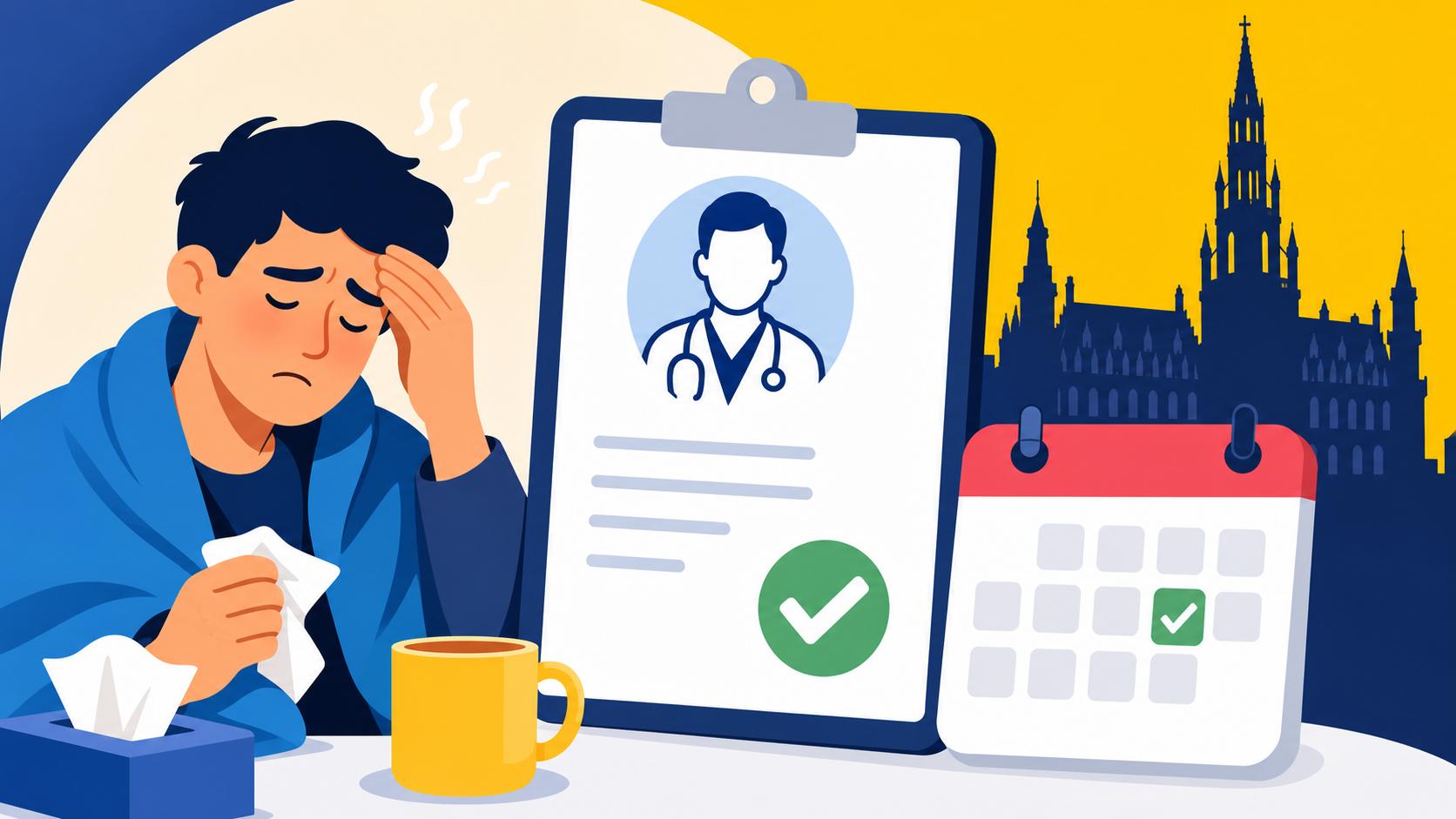
You’re lying in bed with a splitting headache and a fever, staring at your phone, wondering if you really have to drag yourself to a GP just for a 24-hour absence. I remember my first Belgian winter, shivering in a cold waiting room for two hours just for a single-day slip. This guide clarifies exactly when you need a sick note for a 1-day absence and how to get one without the stress.
Understanding the 1-Day Sick Note Rule in Belgium
The administrative landscape of Belgian labor law underwent a significant shift recently, and as an expat, it is easy to get caught between old habits and new regulations. For decades, the "first day" rule was absolute: if you missed even four hours of work due to illness, you needed a signed piece of paper from a doctor. However, the Belgian government introduced a law to unburden general practitioners from what they called "paperwork medicine."
Currently, employees working in companies that employ at least 50 people are legally entitled to stay home for one day due to illness without providing a medical certificate. This exemption is not infinite; you are allowed to use this "free pass" up to three times per calendar year. If you fall ill for a fourth single-day instance, or if your illness extends into a second day, the traditional requirement for a Sick Leave in Belgium: Medical Certificates and Informing Employers kicks back in immediately. It is vital to check your specific work contract or the internal labor regulations of your firm, as some companies may have negotiated specific "Joint Committee" rules that slightly alter these rights.
For those of us working in smaller startups or local businesses with fewer than 50 employees, the situation is different. Small employers have the right to derogate from this law. This means they can still demand a medical certificate for the very first day of absence, provided they have explicitly stated this in the company’s labor regulations or a collective labor agreement. When I first moved to Brussels and worked for a small non-profit, I made the mistake of assuming the "no-note" rule applied to everyone. I quickly learned that small-business owners often prefer the security of a certificate to maintain strict attendance records. Always verify your status before assuming you can stay under the duvet without a doctor’s visit.
How to Get a Certificat Médical for a Short Absence
If you find yourself in a situation where a note is required—either because you’ve used up your three annual exemptions, you work for a small company, or you are simply too ill to work the following day—the process of obtaining a Certificat de Maladie (French) or Medisch Attest (Dutch) is your top priority. You generally have 48 hours to provide this document to your employer, though many contracts stipulate that you must notify them of your "incapacity" within the first few hours of your working day.
Booking Your Appointment Quickly
In Belgium, the medical system is highly efficient but can be daunting when you are unwell. Your first point of contact should always be your Médecin de Famille or Huisarts. If you have already gone through the process of Choosing Your First GP (General Practitioner) in Belgium, you likely have their phone number or a link to their online booking portal. Most Belgian doctors use platforms like the Rosa App: Booking Medical Consultations Online or Doctena. These apps are lifesavers because they allow you to see real-time availability without having to struggle through a phone conversation in French or Dutch while you have a sore throat.
If your regular GP is fully booked, do not panic. You can visit any "Medical House" (Maison Médicale) or a walk-in clinic, though these are less common in residential areas and more frequent in city centers like Brussels or Antwerp. Many expats find that having a secondary private insurance option like Cigna Global helps if they need to access private clinics that offer faster turnaround times for diagnostic checks, especially if the 1-day absence is related to a more complex recurring issue.
The Rise of Telemedicine for Minor Ailments
One of the best developments for the "I just need a note" scenario is the acceptance of Telemedicine in Belgium: Consulting Doctors via Apps and Video. During a video consultation, a doctor can assess your symptoms and, if they deem it appropriate, send a digital medical certificate directly to your email or via the "MyHealth" portal. This is particularly useful for a 1-day absence caused by something straightforward like a migraine or food poisoning, where the physical act of traveling to a clinic might actually worsen your condition.
Be aware, however, that the doctor must be registered in Belgium for the note to be legally binding for your employer. While you might be tempted to use a service from your home country, Belgian employers and the Social Security Contributions: How Employers Deduct Health Costs system generally require a practitioner recognized by the INAMI/RIZIV. During your recovery, if you're looking for over-the-counter support to bounce back quickly, many expats use iHerb to stock up on high-quality vitamins and supplements that aren't always readily available at the local apotheek.
Employer Communication and Your Legal Obligations
Even if you do not need a physical note for that one day off, your legal obligation to communicate with your employer remains strict. Under Belgian law, you must inform your employer "immediately" of your inability to work. "Immediately" usually means before your shift starts or within the first hour of the workday. A quick email or a message via the company’s preferred communication channel (like Slack or Teams) is usually sufficient, but always follow up with an official notification if your company uses an HR portal.
The Content of Your Sick Note
When the doctor hands you that small piece of paper, check it carefully. A Belgian medical certificate for an employer typically contains three pieces of information: the fact that you are unfit for work, the expected duration of the illness (start and end date), and whether or not you are allowed to leave your home. This last point is crucial. If the doctor ticks "No" for "Authorized to leave the house," you are legally expected to be at your registered address if a Control Doctors (Médecin Contrôle) in Belgium: Employer Checks on Sick Leave decides to visit.
You do not have to disclose your specific medical diagnosis to your employer. Privacy laws in Belgium are very strong; the "reason" for your illness is a matter of medical professional secrecy. The certificate serves as the legal proof of your incapacity to work, nothing more. If you are worried about the costs of frequent doctor visits for short-term illnesses, remember that the Maximum Billing System (MAF): Capping Out-of-Pocket Health Costs protects you from excessive out-of-pocket expenses once you reach a certain threshold of medical spending.
Dealing with the Control Doctor
It sounds like something out of a spy novel, but the Médecin Contrôle is a very real part of Belgian professional life. An employer has the right to send an independent doctor to your home on the very first day of your absence to verify that you are indeed ill. This usually only happens if there is a pattern of absences (like every Monday after a football match), but it can happen to anyone.
If you are not at home when the control doctor knocks, and your certificate says "No" to leaving the house, you could face disciplinary action or a loss of "guaranteed salary" for that day. This is why having your Mutuelle and Ziekenfonds: Public Health Insurance Registration Guide paperwork in order is so important; the mutual insurance office and your employer's insurance work together to handle your salary during sick leave. If you are managing a chronic condition that causes frequent 1-day absences, having a policy like Cigna Global can provide additional layers of support and specialists who can help document your condition more thoroughly than a standard GP.
Comparison of Sick Note Requirements by Company Size
| Company Size | 1-Day Note Required? | Annual Limit for No-Note | Notification Deadline |
|---|---|---|---|
| 50+ Employees | No (Usually) | 3 times per year | Start of workday |
| <50 Employees | Yes (If in regulations) | 0 (Unless specified) | Start of workday |
| Public Sector | Varies by Department | Often required from Day 1 | Immediate |
| Self-Employed | No (For self) | N/A | Inform clients |
Managing Your Health Records and Recovery
Staying organized is the best way to handle the "1-day flu" without it becoming an administrative nightmare. I always recommend keeping a digital folder of all your certificates. Even if you don't submit a physical copy, having a scan can save you if there is a dispute during your annual review or if the HR department loses your email. Most doctors now use e-attestations, which link directly to your eID, but the paper certificate for the employer is still the gold standard for "proof of life" in the Belgian corporate world.
Utilizing Digital Tools
Belgium is surprisingly digital when it comes to health. By logging into the federal health portal, you can see your history of certificates and vaccinations. This is helpful if you forget how many of your "free" days you have used. If you find yourself falling ill frequently due to the damp Belgian climate, focusing on preventative care is essential. I personally order high-dose Vitamin D and Zinc from iHerb every October to prepare for the "grey months" and avoid the dreaded 1-day fever.
Costs and Reimbursements
The cost of a GP visit in Belgium is regulated, usually hovering around 30 euros for a consultation. If you have your Mutuelle and Ziekenfonds: Public Health Insurance Registration Guide set up, the vast majority of this is reimbursed. However, for a 1-day absence, you aren't looking for "sick pay" from the government; you are looking for "guaranteed salary" from your employer. To ensure there are no hiccups in your paycheck, the medical certificate is your insurance policy. If you ever find yourself in a dispute about whether a 1-day absence was justified, having a comprehensive health record—supported by a provider like Cigna Global—can give you the leverage needed to prove your case.
Common Pitfalls to Avoid
The most common mistake expats make is thinking that a "1-day absence" doesn't count if they work from home. In Belgium, if you are too ill to work, you are too ill to work, regardless of your location. If you try to "power through" while sick but then realize at 2:00 PM that you need to stop, that technically counts as a day of illness. In this case, you might still need a note if you work for a small company, even though you worked half the day.
Another pitfall is the "Friday-Monday" trap. If you fall ill on a Friday and are still sick on Monday, this is not two 1-day absences. This is a continuous period of illness including the weekend. In this scenario, you must get a certificate that covers the entire duration. Employers are notoriously skeptical of Friday or Monday absences, so even if you aren't legally required to provide a note, sometimes getting one anyway is a good "political" move to maintain trust with your manager.
Lastly, never forget the power of the vignette. These are the little yellow stickers provided by your health fund. While they are being phased out in favor of digital eID reading, having one handy at the doctor’s office still makes the process of documenting your Social Security Contributions: How Employers Deduct Health Costs much smoother. It’s a small detail, but in the Belgian bureaucracy, small details are what keep the wheels turning.
Medical Certificate Disclaimer
This guide is for informational purposes only and does not constitute legal or professional medical advice. Belgian labor laws and "Joint Committee" agreements are subject to frequent changes and may vary significantly depending on your specific employment contract and sector. Always consult with your HR department, a qualified legal professional, or your union representative to confirm the current regulations applicable to your situation. If you are experiencing a medical emergency, please contact the Belgian emergency services immediately by dialing 112.