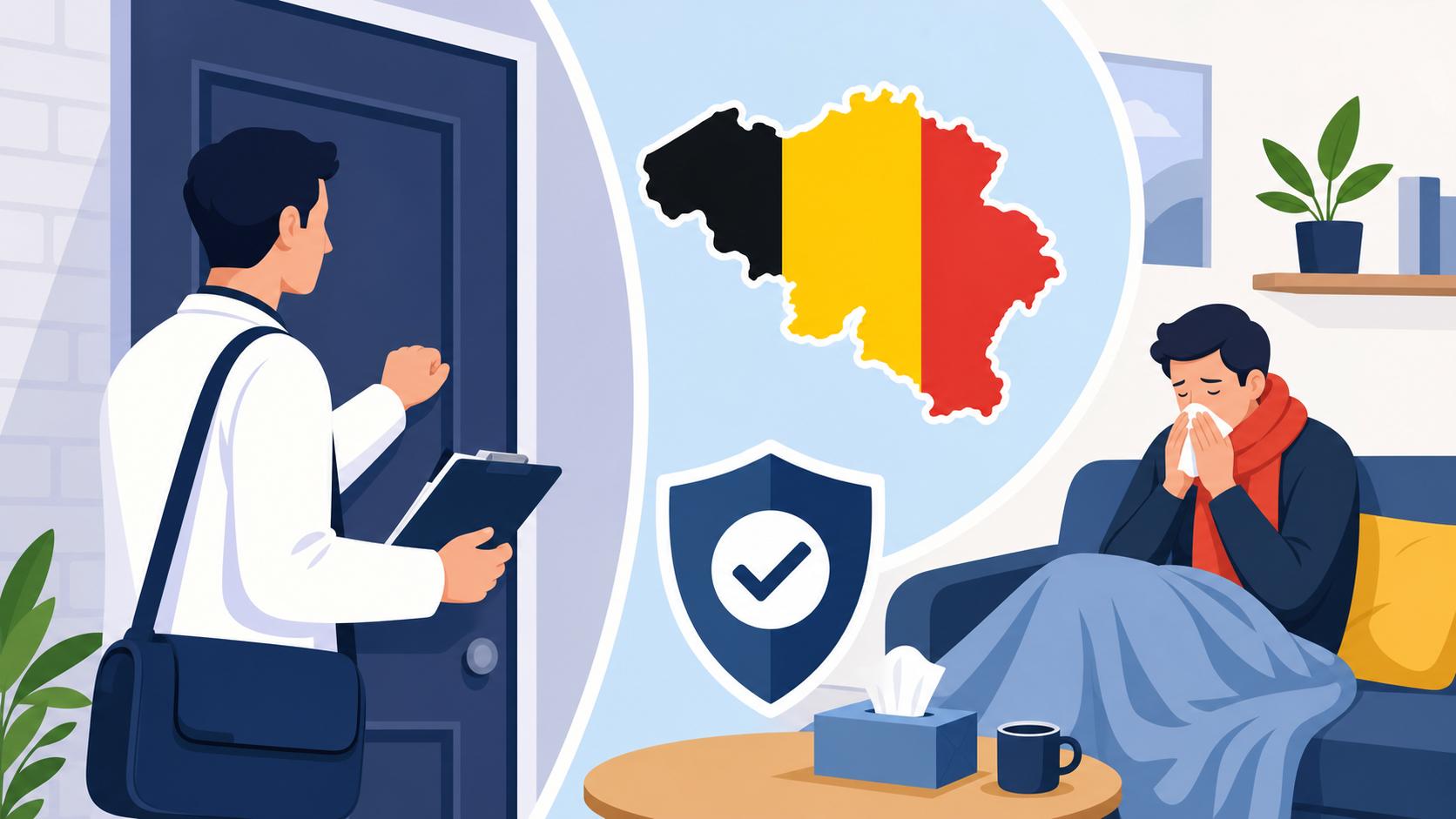
Control Doctors (Médecin Contrôle) in Belgium: Employer Checks on Sick Leave
Imagine you are lying in bed with a splitting headache and a fever, having finally navigated the stress of notifying your boss and securing a medical certificate. Suddenly, your doorbell rings, and a stranger stands there claiming to be a doctor sent by your employer to verify your illness. I remember the sheer panic I felt the first time this happened to me in my drafty Ixelles apartment; I felt untrusted and violated. This guide explains exactly how the control doctor system works in Belgium so you can protect your rights and your paycheck without the added stress.
Understanding the Role of the Control Doctor in the Belgian Workplace
The concept of a Médecin Contrôle (in French) or Controlearts (in Dutch) is often one of the biggest culture shocks for expats coming from the UK, the US, or Southern Europe. In many countries, a note from your GP is the final word. In Belgium, however, your employer has a legal right to verify that you are actually unfit for work. This isn't necessarily a sign that they suspect you are lying; for many large Belgian companies, it is simply a standard administrative protocol triggered automatically by the HR system.
The control doctor is a neutral third party. They do not work directly for your company, but rather for an external medical agency that the company hires. Their job is not to treat you, provide a diagnosis, or give you a prescription. Their sole mission is to determine three things: is the employee truly ill, does the illness justify an absence from work, and is the duration of the sick leave prescribed by the GP appropriate? When you are navigating Sick Leave in Belgium: Medical Certificates and Informing Employers, you must realize that the control doctor’s assessment can technically override your own doctor's note regarding your ability to work.
It is also important to note that the control doctor is bound by professional secrecy. They cannot tell your boss what specific illness you have. They will only report back whether you are "fit" or "unfit" to perform your duties. This distinction is vital for your privacy. If you are struggling with Mental Health in Belgium: Therapy, Psychiatry, and Expat Support, for example, the control doctor will evaluate your capacity to work without disclosing the details of your therapy or diagnosis to your manager.
Your Obligations and Rights During Sick Leave
When you are sick in Belgium, your primary obligation is to stay reachable. This is where most expats get into trouble. Most employment contracts or collective labor agreements (CBAs) specify a window of time—typically a block of four hours, such as 10:00 AM to 2:00 PM—during which you must be at your place of residence to receive a potential visit from a control doctor. If your contract doesn't specify a window, the law generally requires you to be available throughout the day, unless your medical certificate explicitly states that you have "freedom of movement."
The "freedom of movement" clause is a checkbox your doctor marks on the Finding Medical Care in Belgium: GPs, Specialists, and Hospitals paperwork. Even if you have this freedom, you cannot just disappear. If you decide to recover at a partner's house or your parents' home, you must inform your employer of your temporary address immediately. If a control doctor knocks on your door and you aren't there, and you haven't provided a valid reason (like being at the pharmacy or the hospital), your employer can legally refuse to pay your "guaranteed salary" for the days you were absent.
If you are at home and the doorbell rings, you are legally required to let the doctor in and submit to the examination. Refusing entry is considered an "obstruction of control," which carries the same financial penalties as being absent. I’ve seen expats ignore the door because they were sleeping or in the shower; if this happens, the doctor will usually leave a note in your mailbox. You must then contact the agency immediately to explain. To keep your immune system strong and potentially avoid these visits altogether, many expats rely on supplements from iHerb to manage the Vitamin D deficiency that often comes with Belgian winters.
| Feature | Your GP (General Practitioner) | Control Doctor (Médecin Contrôle) |
|---|---|---|
| Goal | To diagnose and treat your illness. | To verify if you are fit/unfit for work. |
| Confidentiality | Full medical secrecy regarding diagnosis. | Can only tell employer if you are "fit" or "unfit." |
| Prescriptions | Can issue prescriptions and referrals. | Cannot issue prescriptions or treatment. |
| Who Pays? | You pay (partially reimbursed by Mutuelle). | Your employer pays the agency fees. |
| Authority | Decides how long you should stay home. | Can theoretically cut your sick leave short. |
What Happens During the Medical Examination
The actual visit from a control doctor is usually quite brief—often less than fifteen minutes. The doctor will ask about your symptoms and may perform a basic physical check, such as taking your temperature or listening to your lungs. They will ask to see the medical certificate provided by your GP. This is why Choosing Your First GP (General Practitioner) in Belgium is so important; you need a doctor who provides clear, professional documentation that stands up to scrutiny.
If the control doctor agrees with your GP, they will sign off on the report, and you can go back to resting. However, if they believe you are fit to return to work sooner than your GP suggested, a disagreement occurs. At this point, the control doctor will inform you of their decision in writing. You have the right to disagree. If you feel you are truly too ill to work, you must tell the control doctor immediately that you do not accept their conclusion.
In the event of a stalemate, an arbitration process is triggered. A third "arbitrator doctor" is chosen to make a final, binding decision. This process is rare but can be stressful. To avoid the financial burden of such disputes, some expats opt for supplemental coverage from providers like Cigna Global, which can offer more robust support for long-term health issues that might fall outside the standard public system. Remember, even during a dispute, you should keep track of your Healthcare Budgeting: Copays, DMG/GMD, and Reimbursements to ensure you aren't losing out on the money you are owed.
Navigating the Financial and Administrative Aftermath
The consequences of a control doctor's visit can impact your bank account quickly. If you are found "fit" to work and you choose not to return the next day, those subsequent days of absence will be unpaid. Furthermore, if you missed the visit without a valid excuse, you lose your right to the guaranteed salary paid by your employer for the entire period of that specific sick leave. This is why understanding Mutuelle and Ziekenfonds: Public Health Insurance Registration Guide is so important; if your illness lasts longer than a month, the responsibility for your income shifts from your employer to your health insurance fund.
Administratively, you should always keep a copy of every document the control doctor gives you. If you were at the pharmacy when they called, keep your receipt from the Pharmacies and Medication in Belgium: Prescriptions and OTC Rules visit as proof of your whereabouts. Belgian bureaucracy thrives on paper trails. I always recommend that expats also maintain The Global Medical Record (DMG/GMD): Why You Need It for Better Refunds with their regular doctor, as having a consistent medical history makes it much harder for a control doctor to argue that you are "faking" an illness or exaggerating symptoms.
If you are a frequent traveler or have complex health needs, having Private Health Insurance in Belgium: When Do Expats Really Need It? can provide peace of mind. While it won't stop a control doctor from visiting, it can provide better access to specialists who can provide the detailed documentation needed to justify longer absences for chronic conditions. Staying healthy is a full-time job in a new country, and while we often use iHerb for our basic wellness needs, the Belgian medical system requires a high level of compliance and awareness to navigate successfully.
Essential Tips for Expats to Avoid Sick Leave Penalties
To make sure you don't fall into the common traps of the Médecin Contrôle system, follow these practical steps every time you call in sick:
- Check Your Contract: Know your "availability window" by heart. If it says you must be home between 2 PM and 6 PM, do not go to the supermarket during those hours, even if you feel slightly better.
- Update Your Address: If you aren't staying at the address listed on your ID card, email HR immediately with the address where you will be recovering.
- Keep Your Phone On: While the doctor usually just knocks, sometimes the agency calls first to confirm you are home.
- Be Professional: You don't need to be "performing" illness, but don't meet the doctor at the door while you're clearly in the middle of a home workout or a loud video game session.
- Request a Copy: Always ask for a copy of the control report before the doctor leaves your house.
- Stock Up Early: Use iHerb or local delivery services to keep your pantry and medicine cabinet full so you don't have to leave the house during your "stay-at-home" hours.
The Belgian system is built on a foundation of "trust but verify." While it feels invasive, the control doctor is just another cog in the machine of the social security system. If you stay organized, keep your Understanding the 75% Reimbursement System for Medical Consultations documents in order, and remain available during your designated hours, the visit will be nothing more than a minor interruption in your recovery. If you ever feel that your employer is using control doctors to harass you specifically, consider reaching out to a union or a legal advisor, as the law protects employees from the "abusive use" of medical checks.
Disclaimer
This guide is intended for informational purposes only and does not constitute legal or professional medical advice. Belgian labor laws and medical control regulations can vary based on specific joint committees (Commissions Paritaires) and individual employment contracts. Always consult with your HR department, a qualified legal professional, or your trade union representative regarding your specific situation and obligations. Any health-related decisions should be made in consultation with a licensed medical practitioner. Be aware that non-compliance with sick leave regulations in Belgium can lead to the loss of salary or other disciplinary actions by your employer.