Health Checkups for Driving Licenses: Vision and Medical Forms
Most expats arriving in Belgium assume that once they have their residence permit, the administrative battle is won. Then you try to swap your home license or apply for a professional permit, and the commune hands you a cryptic medical form. I remember staring at a Dutch-language medical questionnaire in a cold waiting room, realizing my eyesight wasn't the only thing being tested—my patience was too. This guide explains exactly how to navigate health checkups for Belgian driving licenses without losing your mind.
Why You Might Need a Health Checkup for Your Belgian License
In Belgium, the need for a medical examination or a vision test isn't universal for every driver, but it becomes a mandatory hurdle under specific circumstances. For most people driving a standard Category B vehicle (a passenger car), the process is relatively light. However, the moment you step into the world of professional driving, heavy vehicles, or if you have a pre-existing medical condition, the bureaucracy thickens.
The most common reason a newcomer faces this is during the process of Exchanging a Foreign Driver’s License for a Belgian One. If your original license is from a non-EU country, the commune may require proof that you meet Belgian physical standards, especially if your license has expired or if you are over a certain age. Additionally, if you are applying for a Group 2 license—which covers categories C (trucks) and D (buses)—a medical certificate is non-negotiable. This is often called the "Selection Médicale" or "Medische Schifting."
Validation of your fitness to drive is also required if you suffer from certain chronic illnesses. Conditions like epilepsy, severe diabetes, or cardiac issues must be declared. Failing to do so can invalidate your insurance in the event of an accident. While standard public insurance covers the basics of health, some expats prefer Private Health Insurance in Belgium: When Do Expats Really Need It? to ensure they can see specialists quickly for these mandatory evaluations. Cigna Global is frequently used by internationals here to bridge the gap when waiting times for "conventioned" specialists become too long.
Navigating the Vision Requirements and Ophthalmologist Visits
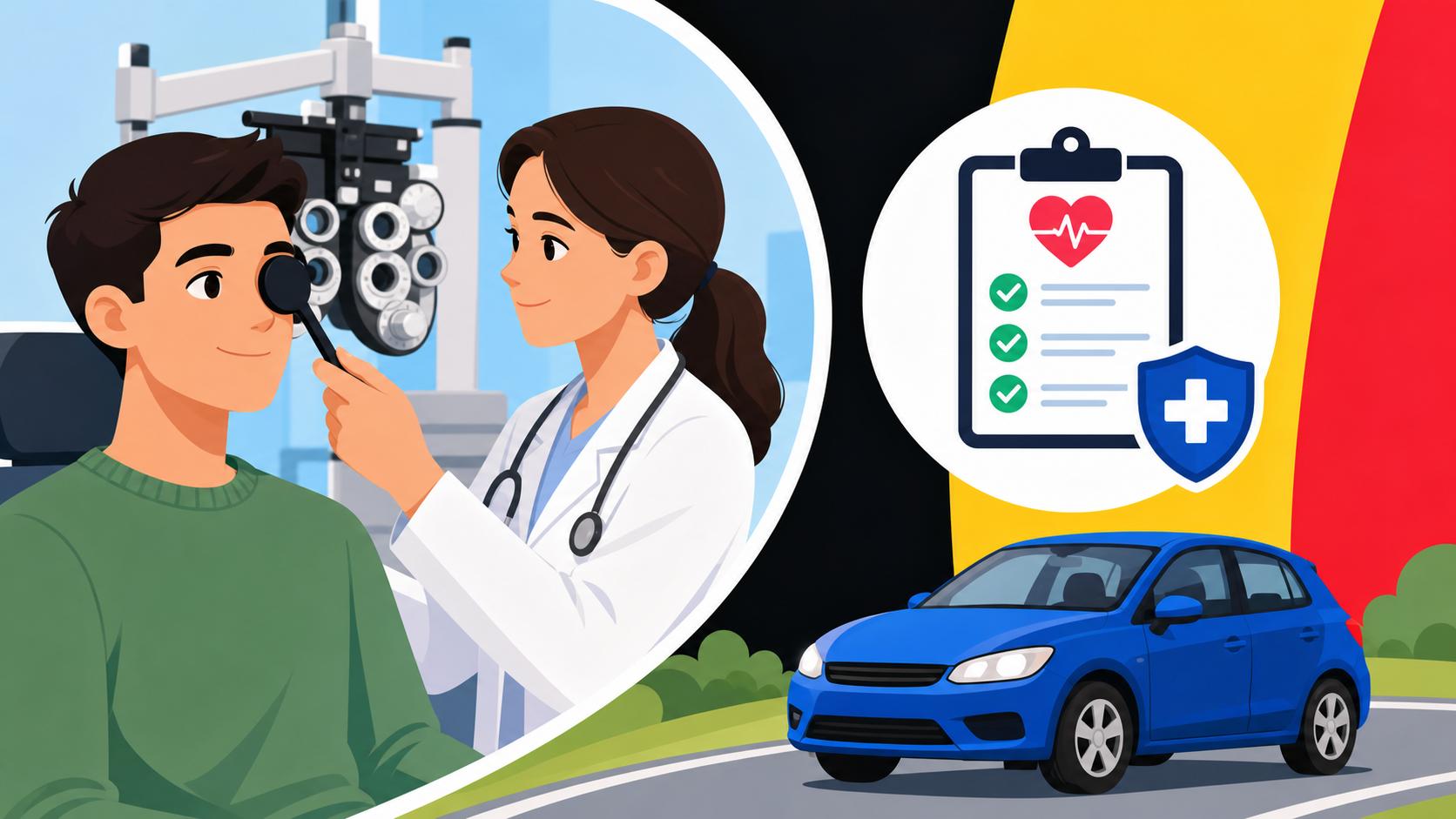
Vision is the most scrutinized part of the Belgian driving medical. The standards are divided into Group 1 (cars and motorcycles) and Group 2 (professional drivers). For Group 1, you generally need a binocular visual acuity of at least 0.5 (6/12). If you wear glasses or contact lenses, this requirement applies to your corrected vision.
If the person at the commune office suspects your vision isn't up to par during your Registering at the Commune: The 8-Day Rule After Arrival or license exchange, they will refer you to an ophthalmologist. You cannot simply go to an optician at a glasses shop for this specific legal form; it must be a certified medical doctor specializing in eye care. They will test your visual field, night vision, and glare sensitivity.
For those in Group 2, the rules are significantly stricter. You need 0.8 in your best eye and 0.1 in the other. Many expats find that the screen time associated with corporate life in Brussels takes a toll on their eyes. While you can find various eye-health supplements on iHerb to support general wellness, a professional medical evaluation is the only way to clear the administrative bar. If you find yourself needing an urgent appointment, Using the Doctena App to Book Doctor Appointments in Belgium is the most efficient way to find an eye doctor who speaks English and has an immediate opening.
The Medical Examination Process for Group 2 and Professional Drivers
If you are looking to drive a taxi, an ambulance, or a heavy goods vehicle, you enter the realm of the Group 2 medical. This is a comprehensive checkup that goes beyond a simple eye test. The doctor will look at your hearing, your nervous system, and your cardiovascular health.
During the appointment, the physician will perform several checks:
- Blood Pressure: Persistent hypertension can lead to a temporary rejection until it is controlled.
- Neurological Function: Checking for tremors, coordination issues, or signs of sleep apnea, which is a major concern for long-haul drivers.
- Urine Test: This is often done to check for glucose levels (indicating undiagnosed diabetes) or traces of controlled substances.
- Hearing: You must be able to hear a conversation at a distance of 3 meters.
The doctor will then fill out the official "Attest van medische geschiktheid" or "Certificat d'aptitude médicale." This certificate is usually valid for five years, though the doctor can shorten this period if they believe your condition requires more frequent monitoring. If you are preparing for this exam, staying on top of your general health is key; many expats use iHerb to source specific vitamins or magnesium to help manage the stress levels that can sometimes spike blood pressure during these formal "test" environments.
Choosing the Right Doctor for Your Driving Forms
One of the most confusing aspects of Belgian healthcare is knowing which doctor is authorized to sign which form. For a standard car license (Group 1) where a medical issue has been flagged, your regular GP can often handle the initial assessment. If you haven't settled on a doctor yet, you should look into Choosing Your First GP (General Practitioner) in Belgium to find someone who understands the local administrative requirements.
However, for Group 2 (Professional) licenses, the rules changed slightly a few years ago. You must visit an accredited occupational health center or a specialized medical service like Medex (for civil servants) or an approved private physician who specifically handles "permis de conduire" examinations.
| Driver Category | Type of Vehicle | Medical Authority Required | Validity of Certificate |
|---|---|---|---|
| Group 1 | Cars, Motorcycles (A, B, B+E) | GP or Ophthalmologist | Life (unless medical change) |
| Group 2 | Trucks, Buses (C, D, C1, D1) | Occupational Health / Accredited MD | Usually 5 Years |
| Professional | Taxis, Limo Services | Accredited Medical Center | Usually 5 Years |
It is worth noting that while your Mutuelle and Ziekenfonds: Public Health Insurance Registration Guide setup is vital for most medical costs, the "Selection Médicale" for a professional license is often considered a non-reimbursable administrative act. This means you might have to pay the full fee out of pocket, which typically ranges from 60 to 120 Euros depending on the complexity of the tests.
CARA: Dealing with Reduced Mobility or Complex Conditions
If you have a physical disability or a complex medical history, the standard GP or ophthalmologist might refer you to CARA (Center for Driving Ability and Vehicle Adaptation), which is part of the VIAS Institute. This can feel like a daunting step, but it is actually a very supportive process designed to keep you on the road safely.
CARA evaluates whether you need specific vehicle adaptations—like hand-controlled accelerators or specialized steering wheels. They also assess drivers who have suffered strokes or have early-stage dementia. The evaluation at CARA involves both a medical exam and a practical driving test in a specially equipped vehicle.
If you are referred here, do not panic. The goal is "fitness to drive," not "finding a reason to ban you." The wait times for CARA can be long, so if this applies to you, start the process at least six months before you need your license. Many international residents with complex health needs maintain a policy with Cigna Global to ensure that any diagnostic tests required by CARA—like an MRI or a detailed neurological workup—can be done privately and quickly to avoid delaying their license application.
Administrative Next Steps: Submitting Your Forms to the Commune
Once you have that precious signed and stamped medical form in your hand, the battle isn't quite over. You must take the document to your local Commune Registration: Annexes, Communes, and the eID Card office. In cities like Brussels or Antwerp, you will almost certainly need an appointment.
Bring the following to your appointment:
- The original medical certificate (keep a photocopy for yourself!).
- Your current driver's license (or your foreign one if exchanging).
- Your Belgian eID card.
- A recent passport-sized photo (though many communes now use the photo from your eID).
- Payment (usually around 25-30 Euros for the physical card).
The commune will then process your request and issue a new license that includes specific "codes" on the back. For example, Code 01 means you must wear glasses or contacts while driving. Code 05.01 means you are restricted to driving only during daylight hours. Understanding these codes is essential; if you are caught driving without your glasses and have Code 01 on your license, you face heavy fines and your insurance may refuse to pay out in an accident. If you find the terminology confusing, check out Healthcare in Belgium for Expats: Complete System Overview (2027) to get a better handle on the medical vocabulary you might encounter on these forms.
Staying Compliant and Avoiding Common Pitfalls
The biggest mistake expats make is waiting until the last minute. If your professional license expires, you are legally not allowed to drive those vehicles until the new medical certificate is processed and the new license is in your pocket. This can take two to three weeks at the commune after your doctor's visit.
Another pitfall is the "language barrier." While many doctors in major cities speak English, the official forms are in French, Dutch, or German. If your doctor doesn't speak English well, they might struggle to explain why they are marking a certain restriction. It is perfectly legal to bring a friend to translate or use Finding English-Speaking Doctors in Brussels, Antwerp, and Ghent to ensure there are no misunderstandings during your exam.
For those managing chronic conditions while driving, it is wise to keep a small "health kit" in the car. This might include your prescription medications, a copy of your medical certificate, and perhaps some glucose tabs or supplements from iHerb if you are prone to energy dips. Being proactive about your health doesn't just help with the driving test; it ensures you are safe on the Belgian E40 or the Ring of Brussels, which can be challenging environments even for the healthiest drivers.
Finally, always check if your employer covers the cost of these checkups. Many Belgian companies that require employees to drive as part of their job will pay for the "Selection Médicale" through their own occupational health provider. This can save you the out-of-pocket expense and the hassle of finding an accredited doctor on your own. If you are self-employed, these costs are generally tax-deductible as a professional expense, so keep your receipts.
Disclaimer
The information provided in this guide is for informational purposes only and does not constitute legal or medical advice. Belgian driving regulations and medical requirements are subject to change. Always consult with the official Belgian Federal Public Service for Mobility and Transport (FPS Mobility) or your local commune for the most current requirements. Health-related decisions should be made in consultation with a qualified medical professional. This site may receive commissions for purchases made through links to brands like Cigna Global or iHerb.