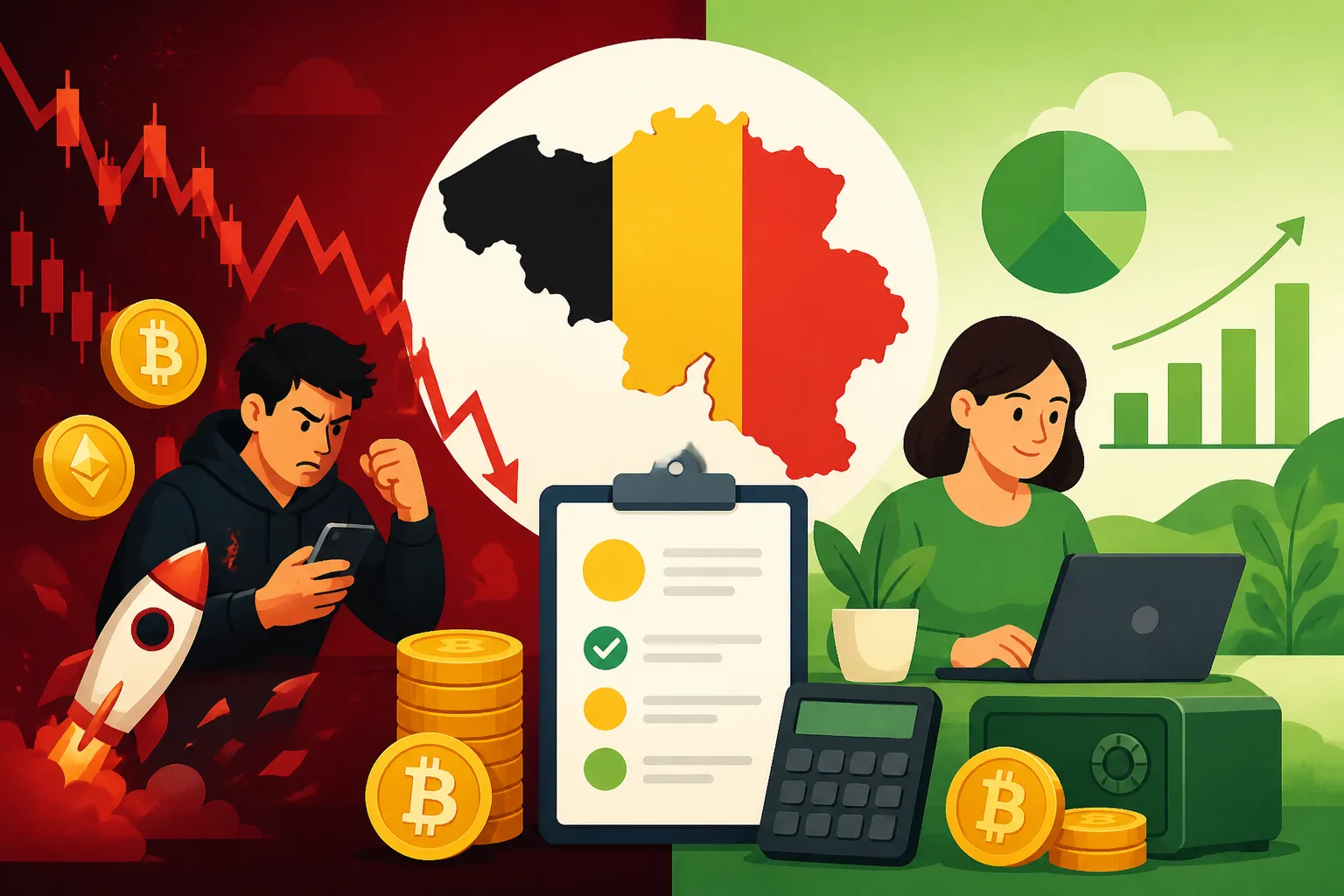
Crypto Taxes in Belgium: Speculative vs Normal Management
Belgium’s tax office is notoriously opaque when it comes to the "Bon Père de Famille" rule for crypto, leaving many of us staring at our portfolios in a cold sweat. I remember the panic of filing my first Belgian tax return after selling some ETH, not knowing if the state viewed me as a "good father" or a reckless speculator. This guide demystifies Crypto Taxes in Belgium: Speculative vs Normal Management so you can trade with confidence and keep the taxman at bay.
Understanding the Three Tax Tiers for Crypto in Belgium
Navigating the Belgian tax system is often like trying to find a specific brand of beer in a supermarket with no labels; you know what you want is there, but the categories seem to overlap. For crypto enthusiasts, the FPS Finance (Federal Public Service Finance) essentially looks at your activity through three distinct lenses. These lenses determine whether you pay nothing, a flat rate, or a significant portion of your hard-earned gains.
Normal Management of Private Estate
The "holy grail" of Belgian taxation is the concept of normal management, often referred to as the "Good Father of the Family" (Goede Huisvader / Bon Père de Famille) rule. Under this classification, your capital gains on crypto are 100% tax-free. To qualify, your investment behavior must mirror that of a prudent person managing their personal wealth. This typically involves long-term holding (HODLing), using your own savings rather than borrowed money, and avoiding high-risk maneuvers like frequent day trading or heavy leverage.
When I first arrived, I assumed there was a specific time limit, like the one-year rule in Germany. However, Belgium doesn't have a hard-coded timeline. It is entirely subjective. If you bought Bitcoin three years ago and sold a small portion to help with a down payment on a house, you are likely in this "Normal Management" zone. The key is that the investment was a "diversification" of your existing wealth rather than a primary pursuit of profit through active market participation. For a broader look at how this fits into your life, check out our guide on Banking and Finance in Belgium: Complete Expat Guide (2027).
Speculative Management and the 33 Percent Rule
If your trading activity crosses the line from "prudent" to "risky," the tax authorities will categorize your gains as "diverse income." This is the "Speculative Management" tier. In this scenario, you are hit with a flat tax rate of 33% on your capital gains, plus municipal taxes which can add another 6% to 9% on top of that 33%.
What triggers this? Usually, it’s a combination of frequency and risk. If you are swing trading every week, using complex technical analysis, or investing a massive percentage of your total net worth into a single volatile altcoin, the state will argue you aren't acting like a "Good Father." You are speculating. While you can deduct legitimate expenses related to these trades, the 33% bite is significant. It’s vital to understand the Taxes in Belgium for Expats: Personal Income Tax System 2026 to see how this sits alongside your salary.
Professional Activity and Progressive Tax Rates
The third tier is the most expensive: Professional Income. If the tax office decides that your crypto activity is actually your "job" or a professional occupation, your gains are no longer taxed at a flat rate. Instead, they are added to your other income and taxed at the standard Belgian Tax Brackets 2026 (Assessment Year 2027): 25% to 50%.
This classification usually applies if you have a professional setup, such as high-end mining rigs, or if you spend forty hours a week trading. It also applies if your crypto income is your primary source of funds for living expenses. Furthermore, you will be liable for Social Security in Belgium: Employer and Employee Contributions, which can eat another 20.5% of your earnings. If you find yourself in this category, it’s often more tax-efficient to set up a company, but that comes with its own administrative hurdles.
Decoding the Good Father of the Family Rule
The "Good Father" rule is the most discussed yet least understood part of the Belgian tax code. It is an "open" legal concept, meaning it evolves based on court rulings and the specific facts of each case. For an expat, this ambiguity can be incredibly frustrating because we often prefer clear, black-and-white rules.
The Seventeen Questions of the Ruling Commission
The Belgian Ruling Commission (DVB/SDA) often uses a list of roughly seventeen questions to determine if a taxpayer is a "Good Father." They look at the "share" of your crypto compared to your total assets. If you have €10,000 in crypto and €200,000 in a savings account or property, you’re likely safe. If those numbers are reversed, you have a problem.
They also ask about the origin of the funds. Using your monthly salary is fine. Using a bank loan to buy a "moonshot" coin is a massive red flag. They will even look at your professional background. If you are a high-frequency trader for a bank by day and a crypto trader by night, the tax office will find it very hard to believe you are just "managing your estate" in your off-hours. This is where Is Crypto Tax-Free in Belgium? The 'Good Father of the Family' Rule becomes a central theme for your annual filing.
The Role of Risk and Technical Knowledge
In the eyes of the Belgian state, a "Good Father" doesn't usually use automated trading bots or complex "DeFi" (Decentralized Finance) strategies like flash loans or yield farming. While simply holding a coin and "staking" it for a small return is generally considered normal management, moving assets through five different bridges to chase 1,000% APY is viewed as speculative.
If you use platforms like Binance to trade, ensure you are pulling your trade history regularly. The tax authorities focus heavily on the "knowledge" aspect. If you can prove you aren't a technical expert and are just following a "buy and hold" strategy, you have a much stronger case. This is one reason many expats prefer using a more regulated, traditional-style broker like Trade Republic for their broader portfolio, as it separates "normal" investments from more "speculative" crypto plays.
Frequency and Holding Periods
While there is no "12-month rule," the duration you hold an asset is a major indicator. Selling a coin two weeks after buying it because the price spiked is speculation. Holding it for two years through market volatility is management. Most tax experts in Belgium suggest that a holding period of at least one year significantly reduces the risk of being taxed at the 33% rate.
If you are transferring funds between your crypto wallet and your Belgian bank account, using a service like Wise can help keep your records clean, but remember that Belgian banks are increasingly cautious. They may ask for the "Source of Wealth" if they see large incoming transfers from exchanges. Having a clear timeline of your holding period is your best defense.
How to Calculate and File Your Crypto Taxes
Filing taxes in Belgium often feels like an endurance sport. Between the paper forms and the digital portals, it’s easy to miss a box that could cost you thousands. For crypto, the reporting requirements depend entirely on which of the three tiers you fall into.
Reporting Gains on Tax-on-Web
For most of us, tax season happens in May and June. You will likely use the digital portal, and you’ll need to know How to File Your Income Tax via Tax-on-web (MyMinfin). If you believe your gains fall under "Normal Management," you don't actually have to declare them. Yes, you read that right. In Belgium, if an income is tax-exempt, it generally doesn't go on the form.
However, if you are in the "Speculative" category, you must report your net capital gains (profits minus losses and costs) in Part II of the tax return under "Diverse Income." If you are "Professional," it goes under your professional earnings. Using Itsme Authentication: How to Set Up Belgium's Vital Digital ID is the easiest way to access these forms securely. I highly recommend setting this up as soon as you get your residence card.
Keeping Meticulous Records
The burden of proof in Belgium often rests on the taxpayer if the authorities decide to investigate. This means you need a trail of every Euro that went into crypto and every Euro that came out. You should maintain a spreadsheet or use specialized tax software that tracks your cost basis (the price you paid) and your exit price.
You need to track:
- The date of every purchase and sale.
- The exchange rate at the time of the transaction.
- The platform used (e.g., Binance, Trade Republic).
- The purpose of the transaction (investment, payment, staking).
For more on managing your documentation, see our guide on How to Track Crypto Trades to Avoid 33% Speculation Tax.
Declaring Foreign Accounts
This is the "trap" that catches most expats. If you hold crypto on an exchange that provides you with an IBAN or a "cash account" (like some features on Binance or Wise), you must declare these accounts to the National Bank of Belgium. This is a separate process from your tax return.
Failure to declare a foreign account can lead to hefty fines and will certainly trigger a red flag during a tax audit. You can find the step-by-step process in our article on Declaring Foreign Bank Accounts to the Belgian National Bank (NBB). Even if you have zero balance, the "existence" of the account must be reported.
Comparative Analysis: Which Tax Status Are You?
It helps to see the differences side-by-side. The following table summarizes the key factors the Belgian tax authorities use to distinguish between the three statuses for a typical expat resident.
| Feature | Normal Management | Speculative Management | Professional Activity |
|---|---|---|---|
| Tax Rate | 0% (Tax-Free) | 33% + Municipal Tax | 25% – 50% + Social Security |
| Risk Level | Low (Defensive) | Moderate to High | High (Business-like) |
| Origin of Funds | Own Savings | Borrowed or Huge % of Wealth | Working Capital |
| Frequency | Rare (HODL) | Frequent (Swing Trading) | Constant (Day Trading) |
| Deductibility | No (Not applicable) | Only Direct Costs | All Professional Expenses |
| Complexity | Simple Assets | Leverage, Futures, Bots | Mining, Staking Nodes |
Risks, Audits, and Common Expat Pitfalls
The Belgian tax authorities are increasingly using automated tools to track large transfers from crypto exchanges. If you suddenly transfer €50,000 from an exchange to your Belgian bank account, expect a phone call or a letter.
The Danger of Reclassification
The biggest risk is "Reclassification." You might think you are a "Good Father," but the tax office might decide you are a "Speculator." If they reclassify you, they can go back several years, adding late payment interest and administrative penalties on top of the 33% tax. This is why many people who have significant gains choose to request a "Private Ruling" before they sell.
A ruling is a formal document from the tax office that tells you exactly how they will tax a specific transaction. It provides 100% legal certainty, but it takes months to process and usually requires the help of a tax lawyer. For those with smaller portfolios, the cost of the lawyer often outweighs the tax savings, making it a difficult balancing act.
Bank Freezes and Anti-Money Laundering (AML)
Belgian banks (like KBC, ING, or BNP Paribas) are notoriously crypto-phobic. They are terrified of AML fines. If you move money from an exchange, even if you’ve paid your taxes, the bank might freeze your account and ask for proof of the "Source of Funds."
This is where your meticulous records come in. If you can show them that the money came from your taxed Belgian salary, went into an exchange, grew over three years, and is now coming back, they will usually unfreeze it. Using a middle-man like Wise can sometimes smooth the process, but the bank will eventually want to see the original exchange records.
The "Good Father" Strategy for Expats
If you want to stay in the 0% tax bracket, follow these "Expats in Belgium" golden rules:
- Never invest more than 5-10% of your total net worth in crypto.
- Hold your assets for at least one year.
- Only use your own savings (never credit).
- Avoid complex derivatives like futures or 10x leverage.
- Keep your crypto activity separate from your professional life.
Navigating the Ruling Commission and Strategy
If your crypto portfolio has grown to a life-changing amount, you shouldn't guess. You need a strategy. Belgium is a beautiful place to live, but its bureaucracy can be a nightmare if you find yourself on the wrong side of an audit.
When to Seek Professional Help
If you are sitting on gains exceeding €50,000, it is time to talk to a tax advisor who specializes in "Digital Assets." They can help you prepare a "Ruling Request" or at least a "Defensive File." A defensive file is a collection of documents prepared before an audit, proving why you qualify as a "Good Father."
This file should include your bank statements showing the initial investment, your transaction history from Binance or other exchanges, and a written explanation of your investment "philosophy." Proving that you are a long-term investor is much easier when you have the data ready to go.
Integrating Crypto into Your Wealth Plan
Don't look at crypto in a vacuum. It should be part of your broader strategy, which might include Building Wealth: Investing, Savings Accounts, and Pensions in Belgium. By balancing crypto with Belgian "Category A" savings accounts or regulated ETFs on platforms like Trade Republic, you reinforce the image of a "Good Father" who is managing a diversified estate.
If the state sees that you have a stable job, a pension plan, and a small, long-held crypto position, they are much less likely to bother you than if your entire financial life revolves around Discord groups and "to the moon" memes. Being a "Good Father" isn't just about the tax; it's about a holistic approach to your financial security in your new home.
Important Disclaimer
The information provided in this guide is for educational and informational purposes only and does not constitute professional tax, legal, or financial advice. Belgian tax laws and the interpretations of the "Good Father of the Family" rule are subject to change and are highly dependent on individual circumstances. Always consult with a qualified tax professional or accountant specializing in Belgian law before making significant financial decisions or filing your tax returns. Neither the author nor this publication assumes any liability for actions taken based on the content of this article.