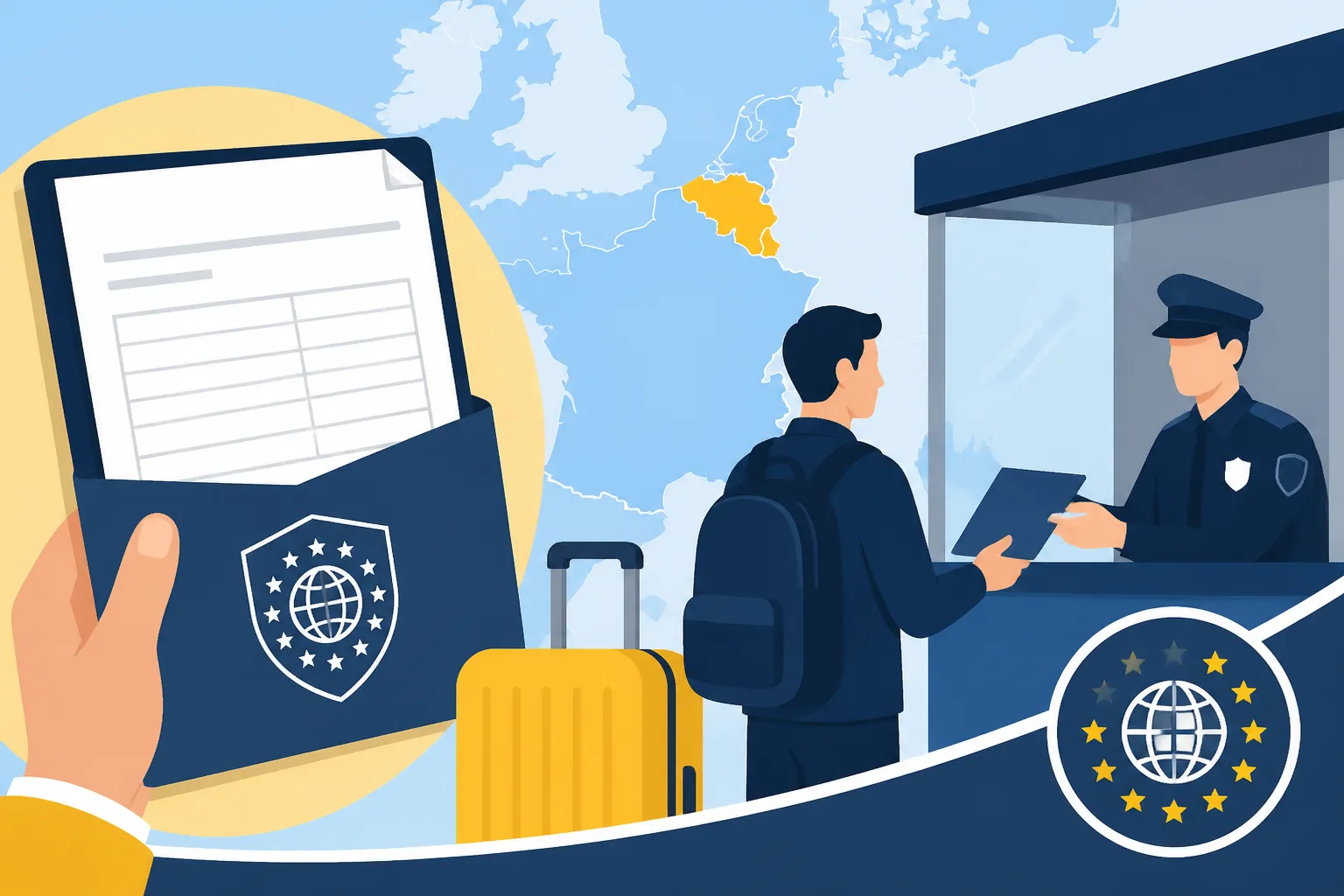
Schengen Border Controls: Traveling Outside Belgium with an Annex 15
Ah, the infamous Annex 15! When you first arrive in Belgium, or even when you're just navigating a renewal, getting this particular piece of paper from your commune can feel like a small victory. You’ve officially got proof you’re here legally, at least for now. But then the travel bug bites, or you need to visit family, and suddenly that innocent-looking document sparks a whole new wave of questions and anxieties, particularly when it comes to those elusive Schengen border controls. Don't worry, you're not alone in this particular expat predicament. This guide is going to walk you through everything you need to know about traveling outside Belgium with an Annex 15, cutting through the confusion so you can plan your next adventure or necessary trip with peace of mind.
Decoding Your Annex 15: Your Temporary Welcome to Belgium
Let's face it, Belgian administration loves its paperwork, and the Annex 15 is one of those quintessential documents you'll encounter early on. It's often the first tangible proof you receive that you're officially on the system, bridging the gap between your initial arrival and the coveted electronic identity card (eID).
What Exactly is an Annex 15?
Think of the Annex 15 (or Bijlage 15 in Dutch) as your temporary residence certificate. It's an attestation d'immatriculation – essentially a registration certificate – issued by your local commune. This document confirms that your application for a residence permit (like a work permit, student visa, or family reunification permit) is currently being processed by the Immigration Office (Office des Étrangers/Dienst Vreemdelingenzaken) and that you are legally residing in Belgium while you wait for your final decision or the issuance of your eID card. It replaces your initial Annex 8 or Annex 49, indicating a more advanced stage in your registration process.
Typically, when you first register at your commune, you might receive an Annex 8 (attestation of submission) or if you're an EU citizen, an Annex 19. The Annex 15 comes later, usually after a positive decision on your residence application or while your long-stay visa (Visa D) is converted into a residence permit. It's proof that you're legitimately waiting for your shiny new ID card. For a deeper dive into these various documents, you might find our guide on Understanding Immigration Annexes: Annex 8, Annex 15, and Annex 49 quite helpful.
Validity and Legal Status of the Annex 15
The Annex 15 isn't just a placeholder; it carries significant legal weight, albeit temporary. Its validity period is clearly stated on the document itself, usually for a few months, and it can be renewed if the processing of your eID takes longer. During its validity, it confirms your legal status as a resident whose application is under review. This means you have the right to reside in Belgium, and crucially, if your underlying permit (like a Single Permit for work) has been approved, it also grants you the right to work.
Without a valid Annex 15 or an eID, your legal stay in Belgium would be uncertain, potentially leading to complications with everything from employment to healthcare access. It truly is the unsung hero of temporary expat life. It's your official 'receipt' that says, "Yes, I belong here, I'm just waiting for the plastic proof!"
Why You Get an Annex 15 and Its Purpose
You typically receive an Annex 15 after your initial registration at the commune and after the police check confirms your address. Once the Immigration Office gives a green light, or at least acknowledges your application is complete, the commune will issue this document. For instance, if you arrived on a long-stay D-visa for work, after your employer has secured your work permit, your commune will process your residence application. While they wait for the physical eID to be manufactured (which can take weeks, sometimes months!), they issue the Annex 15. This document serves a critical purpose: it ensures you're not in a legal limbo. It allows you to continue living your life, working, opening bank accounts, and accessing services while the wheels of Belgian bureaucracy slowly turn to produce your permanent residence card. It’s a bridge, a temporary pass, ensuring continuity of your legal status. For a clearer picture of the final ID types, take a look at our article on The Belgian eID Card Types: A Card, B Card, F Card, and Others.
Navigating the Schengen Area with Your Annex 15
This is usually where the primary concern lies for many expats. Can you pop over to Paris for the weekend? What about a quick business trip to Germany? The good news is, generally, yes, within the Schengen Area, your Annex 15, combined with your passport, usually does the trick.
The Schengen Area: What It Means for You
The Schengen Area comprises 27 European countries that have abolished internal border controls, allowing for free movement of people. Once you're legally inside one Schengen country, you can typically travel to others without showing your passport at every border. Belgium is a full member of the Schengen Area.
For expats, this means that once your residence in Belgium is established (even temporarily by an Annex 15 linked to a valid permit application), you gain the right to travel freely within this zone. This is a huge relief, enabling spontaneous trips and easing logistics for work or leisure. However, "no border checks" doesn't mean "no documents." You must always carry valid identification.
Required Documents for Schengen Travel
When traveling within the Schengen Area, even though there are typically no routine border checks, you absolutely must carry two essential documents:
- Your valid passport: This is your primary identity document and proof of your nationality.
- Your valid Annex 15: This document proves your legal residence in Belgium and, by extension, your right to be in the Schengen Area.
It's crucial to understand that neither document is fully sufficient on its own. Your passport alone, especially if your initial D-visa has expired, won't prove your ongoing legal right to reside in the Schengen zone. Your Annex 15 alone isn't an international travel document; it's specific to your Belgian residence application and needs to be supported by your national identity (passport).
Why Both? Imagine a scenario where you're on a train from Brussels to Amsterdam. There's no formal border control, but police might conduct random checks for identity and immigration status. If you only show your passport, and your initial 90-day tourist visa (if you had one before your D-visa) or D-visa has expired, you could be questioned about your legal status. The Annex 15 explicitly states that you are legally awaiting a residence permit in Belgium, which covers your stay. Similarly, without your passport, the Annex 15 is just a piece of paper without the corresponding national identity proof.
Practical Travel Tips and Potential Scenarios
Traveling within Schengen with an Annex 15 is generally smooth, but here are some scenarios and tips:
- Random Checks on Trains or Roads: Don't be surprised if you encounter police or transport security personnel conducting random ID checks. This is normal. Present both your passport and your Annex 15 calmly. Explain, if asked, that you are a resident in Belgium awaiting your eID. Most officers will recognize the document.
- Airline Travel Within Schengen: If you're flying between Schengen countries (e.g., Brussels to Rome), your airline might ask for your ID at check-in or boarding. Again, present both documents. While internal Schengen flights have eased checks, some airlines might still be cautious, so being prepared is key.
- Always be polite and clear: If an officer seems unfamiliar with the Annex 15, point to the French/Dutch text that states "attestation d'immatriculation" or "attest van immatriculatie" and perhaps where it indicates your right of residence and often, if applicable, your right to work (e.g., "détenteur d'un permis de travail" or similar). Having a basic grasp of French or Dutch for these terms can be very helpful.
- Keep supporting documents handy: While not strictly necessary for Schengen internal travel, having a copy of your work contract, university enrollment letter, or marriage certificate (if on family reunification) on your phone can offer extra reassurance in rare, complex situations.
Here’s a quick overview of what to keep in mind:
| Document Type | Purpose | For Schengen Travel? | For Non-Schengen Travel? |
|---|---|---|---|
| Passport | Primary National ID & Travel Document | Yes (Always) | Yes (Always) |
| Annex 15 | Proof of Legal Residence Application in Belgium | Yes (With Passport) | Limited/No |
| eID Card | Permanent Belgian Residence Permit | Yes | Yes (with Passport for non-EU) |
| Visa D (Long-Stay) | Entry Visa for Belgium, specific validity | No (if expired) | No (if expired) |
Traveling Outside the Schengen Area: The Big Caveat
This is where things get significantly trickier, and it's a point of frequent misunderstanding and anxiety for new arrivals. The general rule of thumb: an Annex 15 is not a standalone travel document for re-entering the Schengen Area once you've left it for a non-Schengen country.
Why an Annex 15 Isn't a Travel Document for Non-Schengen Countries
Your Annex 15 is a national Belgian document. It certifies your legal residence application status within Belgium. It is not a uniform Schengen visa, nor is it a fully recognized international travel document like an eID or a passport. When you cross an external Schengen border (e.g., flying from Brussels to London or New York), the border control officers are primarily looking for a valid travel document (your passport) and a valid visa or residence permit that grants you entry into the entire Schengen zone.
If your initial long-stay D-visa in your passport has expired, and all you have is your Annex 15, external border officials in non-Schengen countries, or even at the Schengen re-entry point, may not recognize it as sufficient proof for re-entry. This can lead to serious delays, denied boarding, or even being refused entry back into Belgium/Schengen. This is a common pitfall, and one you absolutely want to avoid. Our article on Visa D (Long-Stay Visa) vs Residence Permit: What’s the Difference? further clarifies these distinctions.
Re-Entry to Belgium/Schengen with an Annex 15
This is the most critical and nuanced point. While the official stance from the Belgian Immigration Office (DOFI) is that a valid Annex 15, issued in connection with a pending residence permit application (e.g., for work, study, family reunification) does allow re-entry to the Schengen area, the reality at external borders can be challenging.
Here's the breakdown:
- The Theory: If your Annex 15 is properly issued after your D-visa expired but before your eID is ready, and it is explicitly linked to an approved or pending residence permit (like a Single Permit or student status), then it should theoretically allow you to re-enter Schengen. It acts as proof that you have a right to reside in a Schengen country.
- The Reality: External border guards (especially at airports in other Schengen countries like Germany, France, or the Netherlands) might not be familiar with the specifics of a Belgian Annex 15. They are trained to look for a physical residence card or a valid visa in your passport. Explaining the intricacies of Belgian temporary documents to an overworked border agent at 3 AM can be a nightmare. They might see an expired D-visa in your passport and an unfamiliar piece of paper and refuse boarding or entry.
What to do if you MUST travel outside Schengen:
Ideally, do not travel outside the Schengen Area if you only have an Annex 15 and your D-visa has expired. Wait for your eID card. However, if circumstances force your hand, you must take extra precautions:
- Contact the Belgian Immigration Office: Get written confirmation (if possible) of your right to re-entry with your Annex 15.
- Contact the embassy/consulate of your destination country: Check their specific requirements for entry from Belgium, especially regarding temporary residence documents.
- Contact your airline: Ask about their policy on boarding passengers with an Annex 15 for re-entry to Schengen. Many airline staff are unaware and might refuse you boarding.
- Carry extensive supporting documentation: This includes your original D-visa, the Annex 15, your work contract, university acceptance letter, police check confirmation, any letter from the commune or Immigration Office about your pending eID, and proof of your continued residence in Belgium (e.g., lease agreement, utility bills). Have everything translated into French/Dutch (and English if traveling to an English-speaking country) by a sworn translator if possible. Brands like RushTranslate can assist with sworn translations, which can be invaluable in these situations.
This is a high-risk situation, and waiting for your eID is by far the safest option. If your Single Permit is awaiting renewal, for instance, waiting for the updated permit or eID before exiting Schengen is critical. You can learn more about renewal processes in our guide on Renewing Your Single Permit: Deadlines and Digital Submission.
Countries That Might Have Issues or Require Additional Documents
Any country outside the Schengen Area can be problematic. This includes the UK, Ireland, the USA, Canada, your home country (if it's non-EU/Schengen), and other destinations. Even within Europe but outside Schengen (like Romania or Bulgaria, which are partially in Schengen but not fully for land borders), you might face scrutiny.
- Airlines: As mentioned, airline policies can be stricter than official immigration rules. They often err on the side of caution to avoid fines for transporting inadmissible passengers. If they deny you boarding, there's little you can do at the last minute.
- Border Guards: The level of understanding among border officials varies greatly. While Belgian border police are generally familiar with the Annex 15, an officer in, say, Lisbon or Rome's international airport might not be.
Always prepare for the worst-case scenario: being asked for more documents than you anticipate. This isn't about distrust; it's about the administrative fragmentation of temporary documents across national borders within the larger Schengen framework.
The Evolving Landscape: Annex 15 and Digitalization in Belgium
Belgium, like many countries, is slowly but surely moving towards more digital administrative processes. However, the Annex 15 remains a stubbornly physical piece of paper.
The Shift Towards Digital Processes
While you might use Itsme to log into various government portals like MyMinfin or MyHealth.be, and the Single Permit application process is increasingly digital via platforms like 'Working in Belgium', the Annex 15 itself is still a paper printout. You collect it from your commune, and it’s valid only as a physical document. This can feel a bit anachronistic in our increasingly digital world, but it's the reality for now. When you finally receive your eID, you'll be able to link it with Itsme Authentication: How to Set Up Belgium's Vital Digital ID, making many administrative tasks much smoother.
When Your eID Arrives: Say Goodbye to Annex 15 (Mostly)
The moment your eID card arrives, you can breathe a huge sigh of relief. This plastic card is your official Belgian residence permit, recognized across the Schengen Area and often beyond. With your eID, you can generally travel throughout the Schengen zone without needing your passport for ID, though carrying both is always recommended for non-EU nationals. For non-Schengen travel, your eID serves as robust proof of your legal residence in Belgium when presented with your valid national passport.
When you get your eID, the Annex 15 effectively becomes obsolete for travel purposes. You might keep it for your records, but its function as your temporary travel document ceases. The eID is truly your ticket to smoother travel and daily life. It’s the concrete evidence that you've successfully navigated a significant chunk of the Belgian immigration process. While waiting for it, your National Register Number (Numéro National/Rijksregisternummer) is vital; our guide on Getting Your National Register Number (Numéro National) Fast can help you understand its importance.
Practical Advice and Avoiding Common Pitfalls
Navigating the nuances of immigration documents can be incredibly stressful. Here’s some veteran expat advice to keep things as smooth as possible.
Always Carry Your Passport
Seriously, always. Even if you have your eID, and especially if you only have an Annex 15, your passport is your ultimate proof of identity and nationality. The Annex 15 merely grants you residence status; it does not replace your national passport as an international travel document. Many airlines and even some hotels might ask for your passport, regardless of your Belgian residence card. This applies even more rigorously when traveling internationally.
Keep Copies and Digital Backups
This is a golden rule for any important document while living abroad. Make photocopies of your passport, D-visa, Annex 15, and any other relevant immigration documents. Store them separately from the originals. Take clear photos of all pages and save them to a cloud service (Google Drive, Dropbox, etc.) and your phone. If you ever lose your documents, having readily accessible copies can significantly speed up the replacement process, especially if you need to contact your home country's embassy or the Belgian authorities. Losing your residence card can be a nightmare, so knowing what to do is crucial. We cover this in depth in Replacing a Lost or Stolen Belgian Residence Card.
Consulting Embassies and Airlines
Before any international trip outside the Schengen area (or even within if you’re particularly anxious), take the time to:
- Check with the embassy/consulate of your destination country: Verify their specific entry requirements for foreign residents of Belgium. Do they recognize the Annex 15? Will you need a separate visa? This is paramount.
- Contact your airline: Call their customer service or check their website for their policy on passengers traveling with an Annex 15. If they refuse to board you, you won't get far. Get any confirmations in writing if possible.
These steps can save you immense stress and potential financial loss at the airport. Better safe than sorry when it comes to international travel documents.
What to Do If Stopped or Questioned
Remain calm and polite. Border officials have a job to do, and sometimes they encounter documents they are unfamiliar with.
- Present both documents: Hand over your passport and your Annex 15 together.
- Explain your situation clearly and concisely: "I am a resident in Belgium, and this [point to Annex 15] is my temporary residence certificate while I await my permanent eID card. My application for a [work/student/family] permit has been accepted."
- Have supporting documents ready (especially for non-Schengen re-entry): If you followed the earlier advice for non-Schengen travel, you’ll have your work contract, university letter, or other supporting documents. Present them if the officer seems to require more information.
- Do not argue or get agitated: This can escalate the situation negatively. If there's a serious issue, ask to speak to a supervisor.
Remember, the goal is to provide clear, factual information to facilitate your journey. Most times, if you're prepared, these encounters are brief and uneventful. For EU citizens, the rules might be different even with temporary documents. For those wondering about what to do with an expired eID, our guide Can I Travel Within the Schengen Area with an Expired eID and Annex 8? offers further insight.
Final Thoughts on Your Expat Journey and Travel
Living in Belgium as an expat means navigating a unique blend of cultures, languages, and, yes, administrative hurdles. The Annex 15 is just one of those quirks you’ll encounter. While it might feel like an obstacle, it’s actually a vital step in your journey to fully integrate and enjoy your life here. Understanding its purpose and limitations for travel is key to avoiding unnecessary stress and ensuring your adventures remain joyful.
Always err on the side of caution, especially for international trips. Waiting for your eID before embarking on major travel outside the Schengen zone is the safest, most stress-free approach. But if you must travel, arm yourself with information and all possible supporting documents. Safe travels, fellow expat!
Disclaimer
The information provided in this guide is for general informational purposes only and does not constitute legal advice. Immigration laws and regulations in Belgium are subject to change. While we strive to provide accurate and up-to-date information, it is essential to consult with official sources such as the Belgian Immigration Office (Office des Étrangers/Dienst Vreemdelingenzaken), your local commune, or a qualified immigration lawyer for personalized advice regarding your specific situation. Travel requirements can also vary based on your nationality and destination. Always confirm travel document requirements with relevant embassies, consulates, and airlines before making any travel plans.