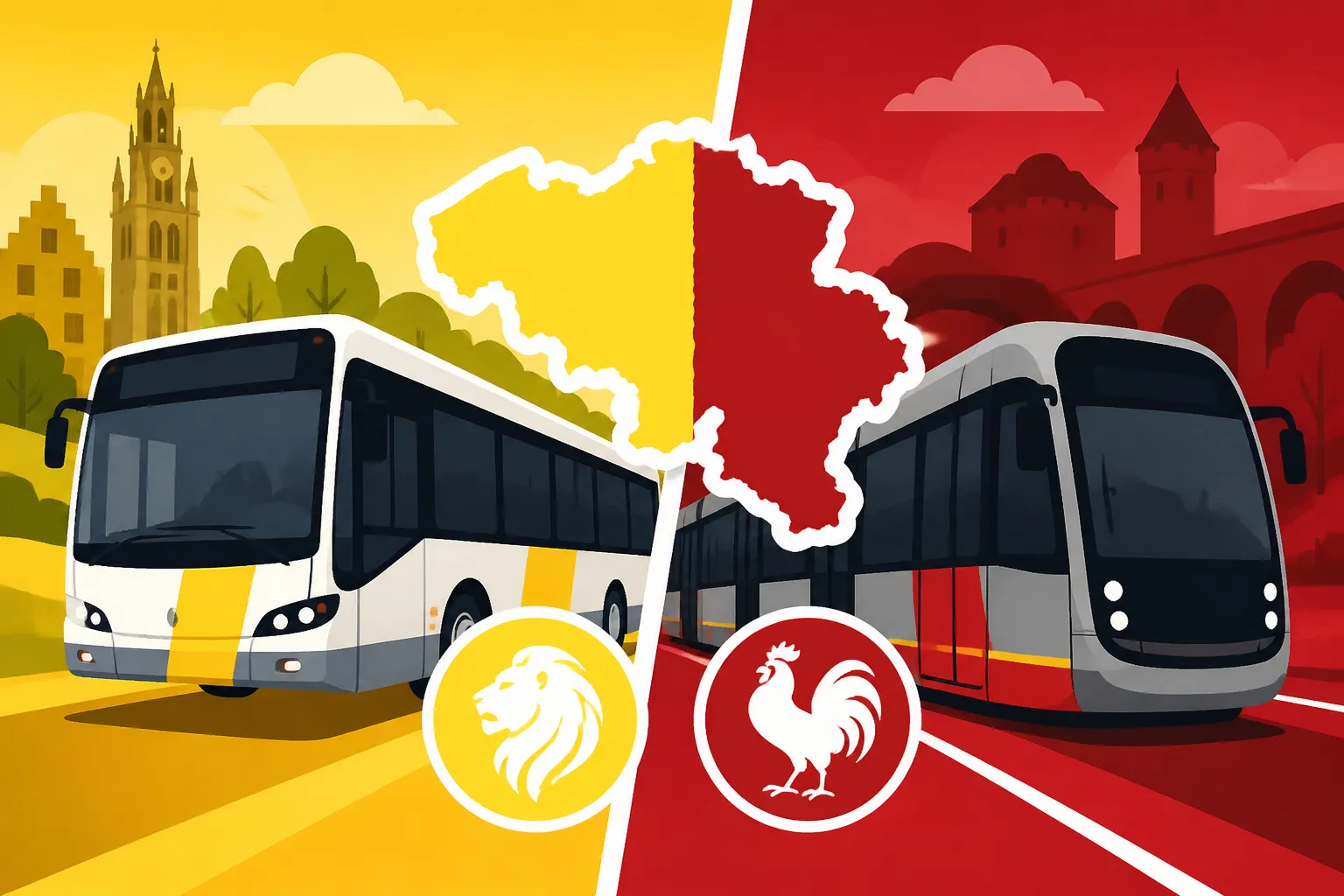
Flanders Transport (De Lijn) and Wallonia Transport (TEC) Basics
You are standing at a bus stop in a charming Flemish village, watching a bright yellow bus fly past despite you waving like a maniac. I have been there, stranded in the rain because I did not realize Belgian bus etiquette is basically a secret handshake. This guide decodes the regional transport maze to ensure you actually reach your destination.
Navigating the Regional Divide: Why Belgium Has Different Transport Operators
One of the first things you will learn as an expat is that Belgium loves its regional autonomy. This is not just a political quirk; it fundamentally changes how you get from point A to point B. Unlike some countries with a single national bus operator, Belgium splits its ground transport (excluding the national trains) into three distinct entities: De Lijn for Flanders, TEC for Wallonia, and STIB/MIVB for the Brussels-Capital Region. Understanding this split is the first step toward sanity.
I remember my first week in Leuven, trying to use a ticket I’d bought in Charleroi. The driver looked at me like I was trying to pay with Monopoly money. The systems do not "talk" to each other in the way you might expect. While the Transportation in Belgium: SNCB Trains, Trams, and Mobib Cards system provides a backbone for the whole country, once you step off that train, you are entering a specific regional jurisdiction with its own apps, rules, and pricing.
If you are moving for work, you will likely find yourself living in one region and perhaps commuting to another. This is where the complexity peaks. For instance, if you are looking for a rental via HousingAnywhere, you should check which regional line serves your potential neighborhood. A house just 500 meters across the regional border could mean a completely different transport pass and a significantly different monthly budget.
Flanders and the De Lijn Network
De Lijn is the operator for the Flemish region. You will recognize their vehicles by their distinctive white and yellow branding. They operate an extensive network of buses and trams, covering everything from the dense urban centers of Antwerp and Ghent to the most remote corners of the Limburg countryside. In Flanders, the bus is often the primary way to reach smaller towns that the SNCB train lines don't touch.
The network is surprisingly efficient, but it relies heavily on "knopen" or hubs. Most routes will funnel you through a central station (usually the local train station). One thing to keep in mind is that Flemish bus drivers are sticklers for the rules. You must enter through the front door, and you must have your ticket ready to scan immediately. If you're coming from a country where you can board through any door, this will be your first "culture shock" moment on the road.
Wallonia and the TEC (Transport En Commun)
Across the linguistic border in the south, the TEC (Transport En Commun) takes over. Their buses are usually yellow and red (though older models might still be grey). Wallonia’s geography is much more rugged than the flat plains of Flanders, which means the TEC network often feels like an adventure through the hills. Because the population density is lower in the Ardennes, buses are less frequent but absolutely vital for the local communities.
The TEC is divided into five geographical sub-entities: Charleroi, Liège-Verviers, Namur-Luxembourg, Hainaut, and Brabant Wallon. While your ticket is generally valid across all of them, the schedules and frequencies vary wildly. If you are living in a city like Liège, the service is frequent and reliable. However, if you've chosen a rustic farmhouse in the deep south, you might only see two buses a day—one for the school run and one in the evening.
The Overlap in Brussels
Brussels is the "neutral" zone where everything meets. While the Brussels Transport (STIB/MIVB): Metros, Trams, and Bus Networks system is the king of the city, you will see De Lijn and TEC buses everywhere. They usually serve as "express" lines bringing people from the suburbs (the Flemish "Rand" or the Walloon Brabant) into the city center.
The most important thing to know here is that a standard STIB ticket will not work on a De Lijn bus, even if you are only traveling three stops within the Brussels city limits. However, if you have a "Brupass" or "Brupass XL" loaded onto your card, you can use any of the three operators within the designated Brussels zones. This is a lifesaver for expats who don't want to carry three different cards.
Getting Started with De Lijn in Flanders
If you find yourself living in Antwerp, Ghent, or Leuven, De Lijn will become your best friend—and occasionally your greatest frustration. The system has moved almost entirely digital in the last few years, making it much easier for tech-savvy expats to navigate, provided you have a working data plan.
I highly recommend setting up an Airalo eSIM the moment you land if your home contract doesn't cover Belgium. There is nothing worse than standing at a remote Flemish bus stop trying to load the De Lijn app on 2G roaming speeds. The app is essential for real-time tracking, as the physical "minutes until arrival" boards at stops are notorious for being… optimistic.
Ticket Types and Pricing (2026 Updates)
De Lijn has simplified its fare structure, but it can still be confusing for newcomers. The "Single Ticket" is the most expensive way to travel. If you buy it via the app or by tapping your contactless card on the bus, it’s significantly cheaper than any paper alternative. In fact, many buses in Flanders no longer accept cash at all.
For those who use the bus frequently but not every day, the "Lijnkaart" (10-ride card) remains the gold standard. It offers a deep discount per ride. If you are a daily commuter, the "Omnipass" is a monthly or yearly subscription that gives you unlimited travel. The Cost of Living in Belgium 2026: Singles, Couples, and Families guide can help you figure out if a yearly pass is worth the upfront investment based on your specific commute.
The Mobib Card vs. Digital Solutions
The Mobib card is a plastic, chip-enabled card that acts as a central "wallet" for all your Belgian transport needs. There are two types: the "Personal Mobib," which features your photo and is linked to your Belgian eID, and the "Mobib Basic," which is anonymous.
For long-term residents, the Personal Mobib is a must. It allows you to load subsidized passes (like the ones your employer might pay for) and can be easily replaced if lost. You can link this card to your Itsme Authentication: How to Set Up Belgium's Vital Digital ID profile, making it much easier to renew your subscriptions online through the De Lijn website without having to visit a physical "Lijnwinkel" (De Lijn shop).
Real-Time Tracking and the De Lijn App
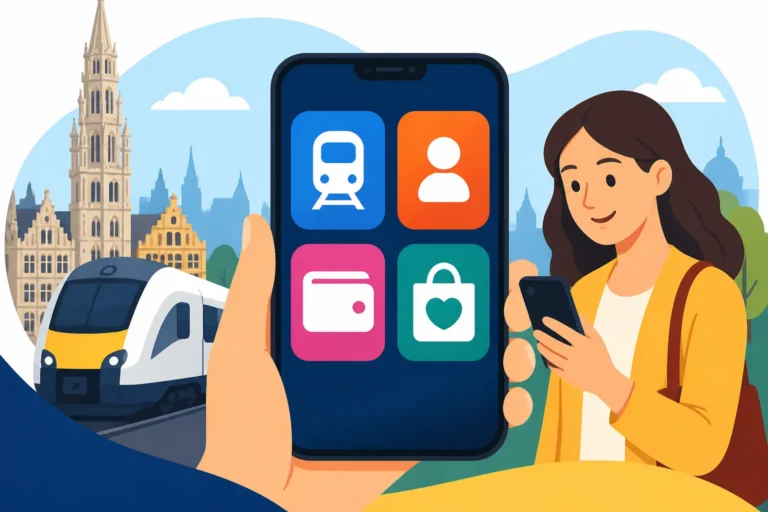
The De Lijn app is surprisingly robust. It allows you to plan routes that combine buses, trams, and even the Biking in Belgium: Villo!, Swapfiets, and Dedicated Bike Lanes systems. My favorite feature is the "Check-in" function, which allows you to buy a ticket with one tap.
However, a word of warning: "Real-time" is a relative term. If the app says the bus is "delayed," it could mean it’s stuck in Antwerp traffic, or it could mean it has vanished into a localized wormhole. Always give yourself a 10-minute buffer. If you're a regular traveler, you'll also want to keep a power bank handy. I usually pick one up from Amazon Belgium because the app’s GPS usage can drain your battery faster than a winter morning in Ostend.
Mastering the TEC Network in Wallonia
The TEC network is a different beast entirely. It feels a bit more traditional than De Lijn, but it’s undergoing a massive modernization push. Navigating Wallonia requires a bit more planning because the distances are greater and the frequencies are lower.
One thing to watch out for in Wallonia is the "Zone" system. While Flanders has moved toward a more time-based ticketing system (60 minutes of travel regardless of distance), the TEC still uses geographic zones for some of its legacy fares. This can be tricky if you are crossing through multiple "communes" on your way to work.
Understanding TEC Regions and Zones
The TEC is divided into administrative regions, but as a passenger, you mostly need to care about the type of journey you're taking. They categorize rides into "Short Distance" (usually within a single urban zone) and "Horizon" (which covers the entire network, including long-distance express buses).
The express buses (prefixed with an 'E', like the E5 from Nivelles to Namur) are excellent. They use comfortable coaches rather than standard city buses and are much faster. If you are living in a smaller town, these E-lines are your best bet for a professional commute. They are specifically designed for people who might otherwise take a car, so they are generally cleaner and more punctual.
Ticket Options and Mobib Integration
Like De Lijn, the TEC uses the Mobib card. You can load "Multi 8" or "Multi 12" tickets, which are the Walloon equivalent of the 10-ride card. A major benefit of the TEC is their "Eco" initiatives. During certain periods or for specific groups (like those under 24 or over 65), the TEC offers incredibly cheap yearly passes—sometimes as low as €12 for the entire year.
If you are just visiting or haven't received your eID yet, you can use the "TEC App" to buy QR-code tickets. Just remember that you must validate these by scanning them on the machine near the driver every time you board. Failure to validate, even if you have a valid pass, can lead to a hefty fine if the "controleurs" (inspectors) board the bus.
Common Pitfalls for New Arrivals in the Ardennes
Wallonia is beautiful, but its rural transport has quirks. Many stops are "on demand" only. This means if you are standing at the stop and don't clearly wave to the driver, they will simply drive past. Similarly, if you are on the bus and don't press the "Stop" button well in advance, the driver will assume no one wants to get off in the middle of a forest at 9:00 PM.
Another pitfall is the "School Term" schedule. During school holidays (which happen frequently in Belgium), many rural TEC lines simply stop running or switch to a "vacation" schedule with half the frequency. Always check the calendar in the app before you head out, or you might find yourself waiting for a bus that won't arrive for another three days.
Essential Tools for Every Expat Commuter
Navigating these systems requires a toolkit. You cannot just "wing it" in Belgium, especially when you are dealing with regional transfers. Here are the essentials I have found indispensable over the years.
Connectivity and Real-Time Data
I cannot stress this enough: your phone is your lifeline. Between the De Lijn app, the TEC "Next" app, and the general SNCB app for trains, you will be checking data constantly. This is why having a reliable local SIM or an Airalo plan is crucial. If your data cuts out in the middle of a "Scan and Pay" transaction, the driver will not be happy, and the people behind you in the queue will be even less so.
Managing Your Mobib Card across Regions
The "holy grail" of Belgian transport is The Mobib Card: How to Load Tickets for All Belgian Transport guide. While the card is technically universal, the contents are not. You can have a De Lijn subscription and a TEC 10-ride pass on the same physical card.
The trick is knowing how to scan it. On a De Lijn bus, the scanner will look for a De Lijn product. On a TEC bus, it will look for a TEC product. If you have both, the machine is usually smart enough to pick the right one, but it pays to check your balance regularly at the physical machines located at major stations.
Alternative Mobility and Sharing
Sometimes the bus just isn't the right choice. Maybe the strike (a common occurrence) has cancelled your line, or the "last mile" to your house is too far to walk. In Flanders, particularly Antwerp, you should look into Using Poppy, Cambio, and Miles Car Sharing in Belgium. These services often have "drop zones" near major bus and tram hubs.
In Wallonia, car-sharing is less common in the countryside but growing in cities like Namur. Combining a TEC bus with a folding bike or a local e-scooter is a pro-move that will save you hours of walking over the course of a month.
Practical Tips for a Stress-Free Journey
After a few years of commuting, you pick up on the unwritten rules that the official manuals never mention. These are the "pro-tips" that separate the tourists from the residents.
| Feature | De Lijn (Flanders) | TEC (Wallonia) |
|---|---|---|
| Primary Colors | Yellow & White | Red & Yellow |
| App Name | De Lijn | TEC (formerly Next) |
| Boarding | Front door only | Front door only |
| Cash Payments | Almost never (Digital only) | Limited (Moving to digital) |
| Language | Dutch | French |
| Best Value | 10-ride Lijnkaart | Multi 8 / Yearly Pass |
Etiquette and Unwritten Rules
In Belgium, there is a very specific social contract on public transport. First, the "Bise" or greeting. While you don't kiss the driver (obviously!), it is considered very rude not to say "Goeiedag" (in Flanders) or "Bonjour" (in Wallonia) when you board. Even if you're in a rush, that small acknowledgement goes a long way.
Second, the seat hierarchy. It goes without saying that you give up your seat for the elderly or pregnant, but Belgians are particularly observant of this. If you are sitting in the designated "priority" seats near the front, be prepared to move the moment someone with a cane boards. Also, keep your bag on your lap, not on the seat next to you—Belgian buses get crowded, and people will ask you to move it, often with a very pointed look.
Dealing with Delays and Strikes
Strikes (or "stakingen/grèves") are a part of life here. Usually, they are announced a few days in advance. The Everyday Rules in Belgium: Garbage Sorting, Noise, and Etiquette guide touches on the "polder model" of negotiation, but for you, it means checking the "Disruptions" tab in your transport app every single morning.
If there is a strike, the operators usually provide a "guaranteed service" on certain main lines, but the smaller routes will be cancelled. If you absolutely must get to work, this is the day to book a car-share or ask a colleague for a lift. Belgians are generally very understanding about "strike delays," but your boss will still appreciate a heads-up.
Night Buses and Weekend Services
One of the biggest shocks for expats moving from cities like London or New York is the lack of 24-hour transport. In Flanders, "Nachtbussen" (night buses) exist in cities like Ghent and Antwerp, but they often only run on Friday and Saturday nights and usually stop around 2:00 or 3:00 AM.
In Wallonia, night service is almost non-existent outside of the major Liège routes. If you are planning a night out, always check the time of the last bus. If you miss it, a taxi or Uber will be your only (and very expensive) option. This is a key factor to consider when choosing where to live; being on a night bus line can save you hundreds of euros in transport costs over a year.
Settling In: Logistics and Living
Once you’ve mastered the bus, you’ll start to see the country differently. You’ll realize that Belgium is a collection of small villages tied together by these yellow and red lifelines.
Choosing a Home Based on Transport Links
When you are browsing HousingAnywhere, don't just look at the photos of the kitchen. Use Google Maps to check the frequency of the nearest De Lijn or TEC stop during rush hour. A "10-minute walk to the bus" sounds fine in July, but in the dark, rainy depths of a Belgian November, you will want that stop to be as close as possible.
Check if the line is a "Direct" or "Snelbus" (Fast bus). Some lines stop at every single farmhouse, turning a 10km journey into a 45-minute odyssey. Others skip the smaller stops and can get you into the city in no time.
Setting Up Your Apartment
When you finally move in, you’ll likely need a lot of stuff—fast. Since you might not have a car yet (or are still waiting for your foreign license to be exchanged), carrying a flat-pack desk on a De Lijn bus is not recommended. I speak from experience; it is a recipe for broken toes and angry commuters.
This is where Amazon Belgium is a life-saver. They deliver almost everything, often the next day, which means you can save your bus trips for exploring the city rather than hauling heavy boxes. Once you have your apartment set up, your Mobib card in your wallet, and your apps configured, you’ll finally feel like you’ve conquered the Belgian "bureaucracy of movement."
Disclaimer
The information provided in this guide is for general informational purposes only and reflects the transport systems in Belgium as of early 2026. While we strive to keep our content accurate, regional transport rules, pricing, and app functionalities can change frequently. Always consult the official De Lijn and TEC websites or apps for the most current schedules and fare regulations before traveling. We are not responsible for any delays, fines, or missed connections resulting from changes in service.