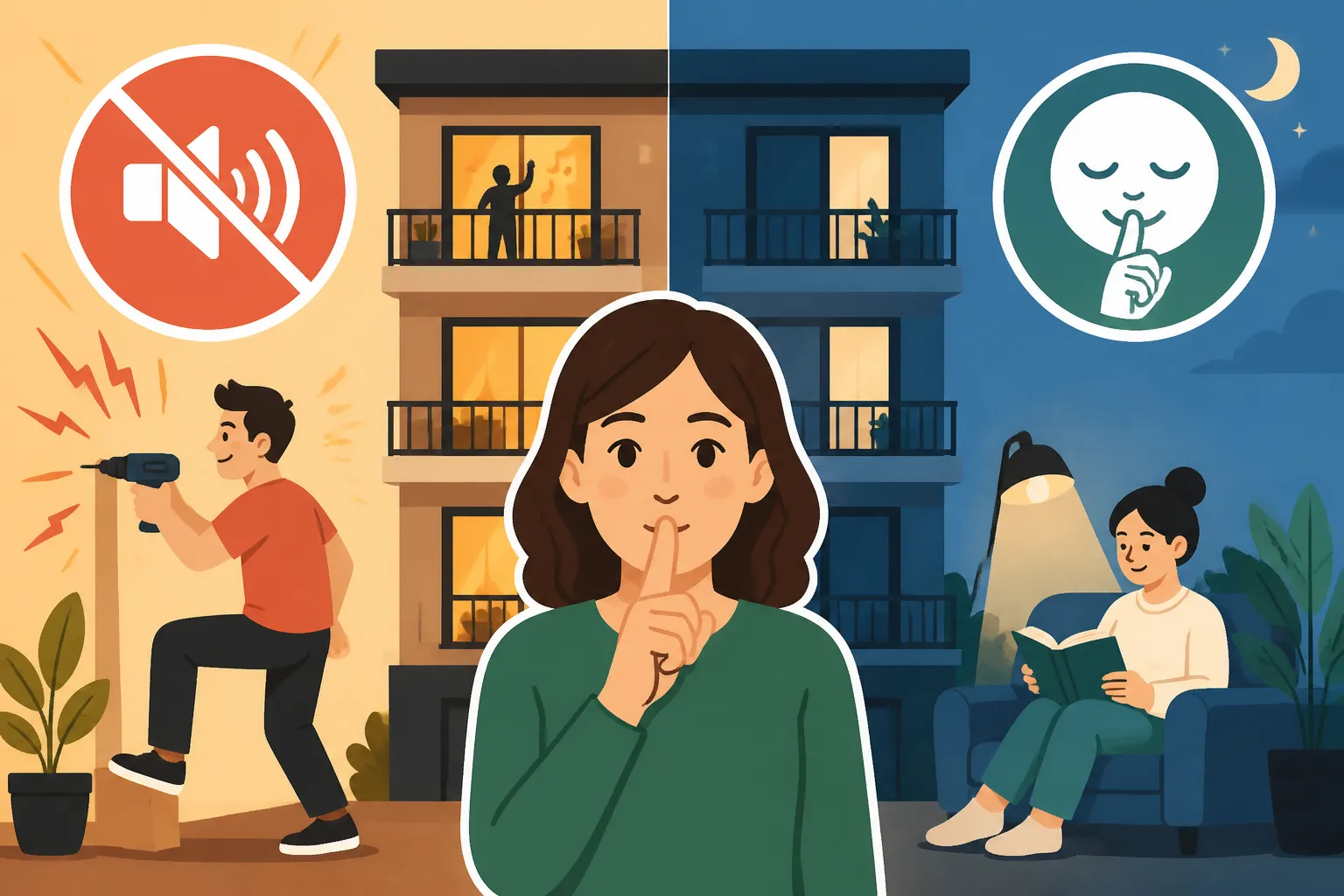
Noise and Apartment Etiquette: Quiet Hours and Sunday Rules
You have just settled into your beautiful new Brussels apartment, and it is a sunny Sunday morning. You decide to catch up on your housework and switch on the vacuum, only to hear a rhythmic, frantic banging on your ceiling five minutes later. I once made the mistake of drilling a single hole for a shelf at 8 PM on a Tuesday and felt the immediate, icy wrath of an entire apartment block. This guide solves the mystery of Belgian silence, outlining the strict quiet hours and Sunday rules you must follow to avoid fines and neighborhood feuds.
The Legal Foundation of Belgian Silence
Living in Belgium means navigating a complex web of rules that often feel like they belong to a different century. Unlike many countries where noise is a matter of "common sense," Belgium codifies silence. It is not just about being polite; it is about complying with local ordinances that are strictly enforced by both the police and your neighbors. Understanding these rules is the first step toward a peaceful life in your new home.
The General Police Regulations RGP APV
The backbone of noise control in Belgium is the General Police Regulation, known as the RGP in French (Règlement Général de Police) or APV in Dutch (Algemeen Politiereglement). Every one of Belgium’s 581 communes has its own version of this document. While they are broadly similar, the specific hours and fines can vary significantly. These regulations cover everything from loud music and shouting to the use of power tools and lawn mowers.
In most communes, any noise that is "excessive, without necessity, and due to a lack of foresight or precaution" is prohibited at all times. This means that even during the day, you cannot simply blast music or let your dog bark for hours. However, the enforcement becomes much stricter during the designated quiet hours. If you are using HousingAnywhere to find your next home, it is always a good idea to ask the landlord for a copy of the building’s internal rules, which often go even further than the police regulations.
Regional Differences Brussels vs Flanders vs Wallonia
While the RGP is a communal matter, there are broader regional cultural differences in how noise is handled. In Flanders, there is often a very high premium placed on "rust" (tranquility). Neighborhoods are meticulously kept, and the expectation of silence on Sundays is nearly absolute. If you are living in a Flemish suburb, using a leaf blower on a Sunday could result in a neighbor calling the police before they even think about knocking on your door to complain.
In Brussels, the rules are just as strict on paper, but the density of apartment living adds another layer of complexity. Here, the Everyday Rules in Belgium: Garbage Sorting, Noise, and Etiquette become part of a daily negotiation with neighbors from dozens of different cultures. Wallonia tends to be slightly more relaxed in a social sense, but the legal framework remains firm. Regardless of where you are, the "quiet hours" are generally considered to be from 10:00 PM to 7:00 AM, though some communes extend this until 8:00 AM on weekends.
Navigating Sunday Restrictions and Public Holidays
The Belgian Sunday is a sacred institution of silence. It is the day when the country collectively exhales, and any disruption to that peace is viewed with extreme suspicion. For expats used to a 24/7 lifestyle where Sunday is the day to finish all the DIY projects you couldn't do during the workweek, this is often the biggest culture shock of all.
The Lawn Mower and Power Tool Ban
The most common mistake new arrivals make is attempting garden work or heavy DIY on a Sunday. In almost every Belgian commune, the use of motorized tools—lawn mowers, hedge trimmers, chainsaws, and even power drills—is strictly forbidden on Sundays and public holidays. This is not a suggestion; it is a law. If you are heard using a drill on a Sunday afternoon, you are not just being a "busy neighbor," you are a lawbreaker in the eyes of the local authorities.
I remember my first spring in a house with a small garden. I waited for a dry Sunday to finally mow the lawn, only to have my neighbor lean over the fence within two minutes to inform me, quite sternly, that "we don't do that today." If you need to order supplies for your home projects, using Amazon Belgium to have them delivered mid-week is a smart move, but make sure you schedule the actual labor for Saturday. Saturday is the unofficial "loud day" in Belgium, where everyone gets their noisy chores out of the way.
Public Holidays and Collective Silence
Public holidays in Belgium are treated exactly like Sundays. Whether it is Ascension Day, Whit Monday, or the Belgian National Day, the same noise restrictions apply. This can be frustrating when you have a long weekend and want to spend it renovating your apartment, but you must resist the urge to be productive in a noisy way. These days are meant for family, rest, and quiet contemplation.
If you are planning a move or a large delivery, check the Belgian calendar carefully. If a public holiday falls on a Thursday, many Belgians will take the Friday as a "bridge day" (faire le pont/de brug maken), and while Friday technically allows noise, the general atmosphere of the neighborhood may still be geared toward quiet. Before you start any major work, it is worth checking Renting in Belgium: Apartments, Contracts, and Tenant Rights (2027) to ensure you aren't violating your lease by performing renovations on days meant for rest.
Apartment Living The Art of Being a Good Neighbor
When you live in a Belgian apartment building, you are entering into a silent contract with everyone else in the block. The walls in older Belgian buildings, particularly those charming "maison de maître" conversions, can be paper-thin. Your neighbors will hear your phone vibrating on a nightstand, and they will certainly hear you walking in high heels across a wooden floor.
Understanding the 10:00 PM Rule
The magic number in Belgium is 10:00 PM. This is the cutoff point for "tapage nocturne" (nightly disturbance). After 10:00 PM, the expectation is that your apartment becomes essentially silent. This means turning down the TV, stopping any laundry cycles, and avoiding loud conversations on the balcony. In fact, many apartment buildings have internal regulations that forbid the use of washing machines or dishwashers after 10:00 PM because the vibration of the pipes can be heard throughout the building.
If you are a night owl, this can be a difficult transition. I highly recommend investing in thick rugs and perhaps some sound-dampening curtains from Amazon Belgium to help muffle your internal movements. If you are having a late-night chat with friends back home, using an eSIM from Airalo to stay connected on your device while sitting in a carpeted room is much better than pacing around on a squeaky parquet floor in the hallway.
Parties and Socializing the Note in the Hallway
Belgians are not anti-social, but they are very pro-preparation. If you plan to have a small gathering that might go past 10:00 PM, the standard etiquette is to place a polite note in the common hallway at least three to four days in advance. The note should be in the local language (French or Dutch, or both in Brussels) and should state the date, the reason for the gathering, and a phone number where you can be reached if the noise becomes too much.
Crucially, this note does not give you a legal right to be loud; it is a gesture of goodwill. If a neighbor calls the police at 11:30 PM, the police will still show up and tell you to be quiet, regardless of the note. However, a note significantly reduces the chances of a neighbor calling the police in the first place. They are much more likely to send you a quick text message asking you to turn the music down if you’ve provided your number. This falls under the general umbrella of Everyday Rules in Belgium: Garbage Sorting, Noise, and Etiquette which emphasize social harmony over individual rights.
Handling Renovation Noise and Necessary Maintenance
Maintenance is a fact of life, but in Belgium, it is a timed event. Whether you are doing the work yourself or hiring professionals, you must adhere to the windows of "acceptable" noise. If you are unsure of the rules in your specific building, your best resource is the "Syndic" or building manager.
The Schedule for Heavy Work
Generally, heavy construction and renovation noise are permitted from 7:00 AM or 8:00 AM until 6:00 PM or 7:00 PM on weekdays, and usually on Saturdays during similar hours. However, many apartment buildings have stricter house rules (Règlement de Copropriété) that may limit noisy work to between 9:00 AM and 5:00 PM to protect those who work from home or have young children.
If you are Hiring a Domestic Cleaner via Titres-Services (Dienstencheques), make sure they know not to use loud industrial vacuums or move heavy furniture during restricted hours. Similarly, if you are Finding English-Speaking Plumbers and Electricians via RingTwice, ensure they are aware of the building's access hours. Professionals in Belgium generally know these rules well, but it is always your responsibility as the tenant or owner to ensure they are followed.
Emergency Repairs and the Exception Rule
There is, of course, an exception for emergencies. If a pipe bursts at 11:00 PM on a Sunday, you are allowed to have a plumber come and fix it. Noise generated by emergency maintenance to prevent damage to the property or ensure safety is generally exempted from quiet hour restrictions. However, "emergency" does not include finishing a painting job or putting up a curtain rod because you have guests coming the next day.
When an emergency happens, it is helpful to have your documents and landlord's contact info ready. I always keep my lease and building contact numbers saved in a cloud folder so I can access them even if I'm standing in a flooded kitchen. Understanding The Brussels Housing Code (BHC): Rights and Duties of Tenants can help you distinguish between what is a tenant-responsible minor noise and what is a landlord-led emergency repair.
Dispute Resolution From Polite Notes to Police Intervention
So, what happens when you are the one suffering from a neighbor’s noise? Or when a neighbor is being unreasonable about your own quiet activities? In Belgium, there is a very specific hierarchy of how to handle these situations. Jumping straight to calling the police is often seen as an "aggressive" move that can permanently sour neighborhood relations.
The First Step A Friendly Conversation
The first step is always a face-to-face conversation. Belgians value directness, but it must be delivered with a high degree of politeness. Knock on the door, introduce yourself, and explain the issue calmly. "I’m sorry to bother you, but the sound of your TV carries quite a bit into my bedroom. Would you mind turning it down a little after 10 PM?" usually works wonders.
If you are worried about the language barrier, having a translation app ready on your phone via Airalo data can be a lifesaver. Most Belgians speak excellent English, but starting with a few words in French or Dutch shows respect for the local culture. If the verbal approach doesn't work, a polite, written letter in their mailbox is the next step. Keep a copy of this letter for your records, as it may be needed later.
Involving the Syndic or the Juge de Paix
If the noise continues, the next level of escalation is the Syndic (for apartment buildings) or the owner of the property. You can find more about this in Navigating Syndicate Meetings (Syndic) for Apartment Owners. The Syndic has the power to issue formal warnings and even fines if the building's internal regulations are being repeatedly violated.
For long-standing disputes that cannot be resolved through the Syndic, the "Juge de Paix" (Justice of the Peace) is the ultimate arbiter. This is a low-level court designed specifically for neighbor disputes and tenant-landlord issues. It is a mediation-heavy process that is relatively inexpensive and does not always require a lawyer. It is the "Belgian way" of solving problems—slow, bureaucratic, but ultimately focused on restoring the peace.
| Noise Type | Monday – Saturday (Day) | Sunday / Public Holidays | Night (10 PM – 7 AM) |
|---|---|---|---|
| Power Drills / DIY | Allowed (7 AM – 7 PM) | Strictly Forbidden | Strictly Forbidden |
| Lawn Mowers | Allowed (7 AM – 8 PM) | Strictly Forbidden | Strictly Forbidden |
| Loud Music / TV | Moderate Levels Only | Low Levels Only | Very Low / Silent |
| Washing Machines | Allowed | Allowed (Moderate) | Often Forbidden in Flats |
| Vacuuming | Allowed | Discouraged / Forbidden | Forbidden |
Essential Belgian Etiquette for Harmonious Living
Beyond the legal rules, there are unwritten cultural norms that will make your life in Belgium much easier. These small habits signal to your neighbors that you are a "bon voisin" (good neighbor) who respects the collective harmony of the street.
Garbage Sorting and Communal Cleanliness
Noise is not the only thing that can cause friction; how you handle your trash is equally important. Each commune has a specific schedule for when different colored bags are collected. If you put your Garbage Sorting Rules: Blue, Yellow, White, and Green Bags Explained out on the wrong night, or if they are noisy bags (like glass bottles) being dumped into a bin at 6:00 AM, you will hear about it.
In many buildings, there is a rotation for cleaning the common hallway or the sidewalk in front of the house. Even if you have a busy job, failing to do your "tour" is a major social faux pas. It is often during these small communal tasks that you build the social capital needed so that when you do accidentally drop a heavy pot at 11:00 PM, your neighbors are inclined to forgive you rather than report you.
The Philosophy of Non-Interference
The ultimate rule of Belgian apartment life is "non-interference." Belgians generally don't want to know everything about your life, and they expect the same in return. This is why silence is so highly valued—it is the physical manifestation of privacy in a crowded space. By keeping your noise levels down, you are giving your neighbors the gift of privacy, and they will generally return the favor.
If you are struggling with the transition, remember that you are not alone. Many expats find the first six months in a Belgian apartment to be a learning curve of "walking on eggshells." But once you understand the rhythm—the loud Saturdays, the silent Sundays, and the 10:00 PM shutdown—you will find that the system actually works quite well. For more on the specifics of apartment life, check out Dealing with Noise Complaints: When to Call the Belgian Police to know exactly where the line is drawn.
Disclaimer
The information provided in this guide is for general informational purposes only and does not constitute legal advice. Belgian local regulations (RGP/APV) and regional laws are subject to change and can vary significantly between communes. Always consult your local commune’s official website or a qualified legal professional for the most up-to-date information regarding noise ordinances and tenant rights in your specific area.