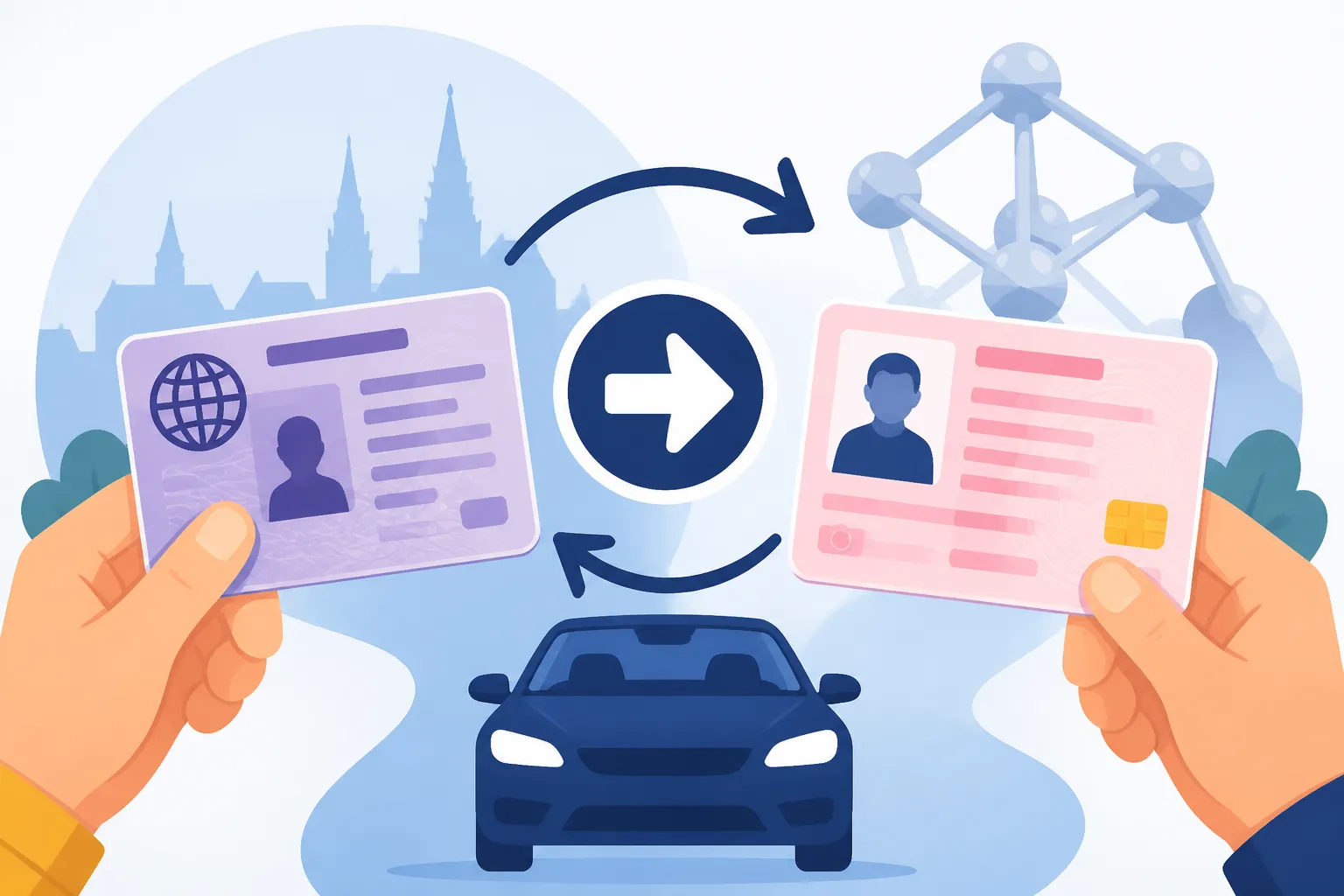
Exchanging a Foreign Driver’s License for a Belgian One
Navigating the Belgian bureaucracy for something as simple as a driver's license can feel like an Olympic sport where the rules are written in a language you haven't mastered yet. I remember standing in the rain outside my local commune in Ixelles, clutching a folder of documents and wondering if I’d ever be legally allowed to drive to the Ardennes. This guide simplifies the entire exchange process, ensuring you stay legal and avoid the dreaded Belgian fines.
Understanding the Eligibility Criteria for License Exchange
The first hurdle is determining whether you actually need to exchange your license or if you can continue using your home country's permit indefinitely. Belgium divides the world into two main categories: the European Union (EU/EEA) and the rest of the world (non-EU). If you are an EU citizen, your life is significantly easier, but there are still nuances regarding the expiration dates and the type of permit you hold.
The Residency Rule and the Six Month Window
For non-EU citizens, the clock starts ticking the moment you are registered in the National Register. Once you have completed your Registering at the Commune: The 8-Day Rule After Arrival and received your residency card, you are generally allowed to drive on your valid foreign license for up to 185 days. However, this is not a suggestion; it is a hard deadline. Once you pass that six-month mark of residency, your foreign license is no longer recognized by Belgian authorities, even if it is still valid in your home country.
I’ve seen many expats wait until the 180th day to start the process, only to realize that the appointment wait times at some communes, like those in central Brussels or Antwerp, can be weeks or even months. If you are caught driving after 185 days of residency without having initiated the exchange, you are effectively driving without a license. This can lead to your car being impounded on the spot and your insurance being invalidated, which is a financial nightmare no one wants to face. While you wait for your new home, perhaps found via a service like HousingAnywhere, it is wise to start gathering your paperwork immediately.
Recognized vs Non-Recognized Countries
Belgium has reciprocal agreements with a specific list of non-EU countries. If your country is on this list—which includes nations like Canada, Japan, and certain U.S. states (though this varies)—the process is a straightforward administrative exchange. You hand over your old license, pay a fee, and wait for the Belgian version to arrive. However, if your country is not on the list of recognized nations, the process is much more grueling.
In cases where no agreement exists, you cannot simply exchange the document. You will be required to go through the entire Belgian licensing process from scratch. This involves passing the theoretical exam and the practical driving test. It feels like a punch in the gut for veteran drivers with twenty years of experience, but there is no way around it. Before you even book your Booking an Appointment at the Commune (Stadhuis/Maison Communale), check the official list on the Federal Public Service Mobility website to see where your country stands.
The Step-by-Step Exchange Process at Your Local Commune
Once you’ve confirmed you are eligible for an exchange, the real "fun" begins at the Maison Communale or Stadhuis. This is where the paper trail becomes vital. Belgian officials are famously meticulous; if a single stamp is missing or a translation isn't from an approved source, they will send you home without a second thought.
Gathering the Essential Document Dossier
Your dossier needs to be bulletproof. At a minimum, you will need your Belgian residency card (the eID), your original foreign driver's license, and a recent passport-sized photograph that meets the strict Belgian biometric standards. If your license is not in French, Dutch, German, or English, you will almost certainly need a sworn translation. It is highly recommended to look into Translating Birth and Marriage Certificates via Sworn Translators as the same professionals often handle driver's license translations.
Furthermore, some communes require a "certificate of authenticity" from your home country’s licensing authority or embassy. This document proves that your license is genuine and hasn't been suspended. I remember having to coordinate with my home embassy for three weeks just to get a one-page letter with a gold seal. It felt like overkill, but without it, the clerk wouldn't even look at my application. You should also ensure you have your Apostille vs Legalization: Authenticating Documents for Belgium requirements handled if your country is not part of the Hague Convention.
The Appointment and the Waiting Game
Most communes now operate strictly by appointment. When you arrive, you’ll submit your documents, pay the administrative fee (usually between €25 and €35), and hand over your original foreign license. Yes, they take it from you. This is the part that scares most people—you are essentially "license-less" for a few weeks. You will receive a temporary document (an Annex or a receipt) that allows you to drive within Belgium, but be warned: this paper is usually not valid for driving abroad.
While waiting for the plastic card to be printed, I found it helpful to keep a digital copy of my old license on my phone and the receipt in my glove box. If you're using a local SIM or an e-SIM from Airalo, you can easily access your scanned documents from the cloud if you ever get pulled over. The processing time usually takes about two to four weeks. Once it's ready, you’ll return to the commune to pick up your new Belgian license, which is a standard EU-format plastic card.
Navigating the Challenges of Non-EU License Holders
If you are from a country that doesn't have a treaty with Belgium, the path is significantly steeper. You aren't just exchanging a card; you are proving to the Belgian state that you can navigate their specific—and often narrow—road systems.
Tackling the Theory Exam in English
The theory exam is the first hurdle. It consists of 50 questions, and you need 41 correct to pass. However, there’s a catch: "grave" infractions (like ignoring a red light or a stop sign) result in a 5-point deduction, meaning two big mistakes and you fail instantly. The exam is traditionally in the local language, but many centers in Brussels and larger cities allow you to take it in English with the help of a translator.
Studying for this is not optional. Belgian road rules have quirks, like the "Priority from the Right" (Priorité à droite), which can be terrifying for those from the UK or US. Basically, if there is no sign at an intersection, the car coming from the right has the right of way, even if you are on a "main" road. I spent many nights ordering study guides on Amazon Belgium to memorize these signs. If you fail the theory twice, you are legally required to attend 12 hours of theory classes at a driving school before you can try again.
The Practical Exam and the Risk of Failure
After the theory comes the practical. If you are an experienced driver, you might think this is a breeze. It isn't. Belgian examiners look for very specific "eco-driving" habits and precise maneuvers. Many expats fail because they drive "too comfortably" or miss a small sign in a residential area. You can take the exam in your own car (if it meets requirements) or use a driving school car.
If you fail the practical exam twice, you must take 6 hours of professional driving lessons. This is an expensive and time-consuming requirement. It’s often better to take two or three "refresher" hours with an instructor before your first attempt just to learn the specific traps of the local exam route. This is particularly true if you are still getting used to Driving in Belgium: Licenses, Car Registration, and Traffic Rules and the local infrastructure.
| Feature | EU/EEA License | Recognized Non-EU License | Non-Recognized License |
|---|---|---|---|
| Mandatory Exchange | Only if expired or lost | Yes, after 185 days residency | No exchange possible |
| Testing Required | None | None | Theory and Practical Exams |
| Average Cost | €25 – €35 | €25 – €35 + Translations | €500 – €1,500 (incl. lessons) |
| Processing Time | 1 – 2 weeks | 3 – 6 weeks | Months (due to exam slots) |
| Document Translation | Rarely | Often required | Not applicable |
Practical Life with a Belgian License and Road Safety
Once you have that Belgian card in your wallet, you are part of the system. This brings both benefits and responsibilities. The Belgian license is valid across the entire EU, making those weekend trips to Paris or Amsterdam much easier.
Understanding the Lack of a Points System
One of the biggest surprises for expats is that Belgium does not currently use a "points" system like France or the UK. Instead, they rely heavily on immediate, heavy fines and temporary license withdrawals. If you are caught speeding significantly, the police can take your license for 15 days on the spot. You then have to go to the police station or the court to get it back after the suspension period.
For minor infractions, you will receive a "Perception Immédiate" in the mail. If you ignore these, the fines double or triple quickly. It is vital that your address is correctly registered because these fines go to the address linked to your National Register number. If you moved and didn't update your Address Changes (Changement d'Adresse): Updating the Commune When Moving, you might miss a fine and end up with a bailiff at your door.
Car Insurance and the Importance of History
When you get your Belgian license, you’ll also need to look into insurance. If you are bringing a car from abroad, you need to follow the steps for Registering a Foreign Car in Belgium: Customs, Taxes, and Plates. Insurance companies in Belgium can be picky about foreign driving history. If you can provide a "claims-free" statement from your previous insurer in your home country, you might save hundreds of euros on your premium.
I recommend keeping all your old driving records. When I first moved, I used a phone mount I bought from Amazon Belgium to ensure I was always using GPS, which helped me avoid accidental entries into Low Emission Zones (LEZ) in Brussels, Antwerp, and Ghent. These zones are strictly enforced by cameras, and having a Belgian-registered vehicle or an updated registration is mandatory to avoid a €150 fine.
Common Pitfalls and Veteran Tips for Success
The process is rarely a straight line. Bureaucracy in Belgium is decentralized, meaning the experience at a commune in a small village in Flanders might be totally different from a busy office in central Liège.
The "Police Check" Delay
One thing that catches many people off guard is the police check. You cannot get your driver's license exchanged until the local police officer has physically verified that you live at your address. This is part of The Police Address Check: What Happens if You Are Not Home? process. If the "wijkagent" or "agent de quartier" hasn't visited yet, the commune's computer system will literally block the clerk from processing your license application.
I spent two weeks working from my living room, jumping at every knock on the door, just waiting for that officer to show up. Once they verify your residency and you get your official ID, only then can you proceed with the license exchange. Don't even bother going to the commune for your license until your ID card is fully activated with its PIN codes.
Driving with an Annex 15
If your current residency card is being renewed or you are in a transitional phase, you might be issued an Annex 15. This is a temporary residency document. While it technically proves you are legal in the country, many commune clerks are hesitant to process a driver's license exchange using only an Annex 15. You might be told to wait until your physical eID card arrives.
This can be a problem if your 185-day window is closing. If you find yourself in this situation, be persistent. Explain the legal deadline for the license exchange. Sometimes, showing them you have a stable living situation through HousingAnywhere or a work contract can help "grease the wheels" of the administrative process, though it's never guaranteed. Always carry a printed copy of the federal regulations if you feel a clerk is being unfairly restrictive.
Managing the Transition and Staying Connected
The period between arriving in Belgium and getting your permanent license is often the most stressful. You are learning new roads, new languages, and a new set of social norms.
Staying Online for Appointments
You will find that everything in Belgium requires a digital appointment or a login via Itsme. To set this up, you need a working phone with data. I highly recommend getting an e-SIM from Airalo as soon as you land. It allows you to keep your home number for two-factor authentication (which you’ll need for your old bank accounts) while having local data to navigate the commune’s website or use the SNCB/NMBS (National Trains) Fares and Passes app when you can't drive.
Once you have your license, make sure to keep it safe. Replacing a lost Belgian license is the same process as getting a new one—minus the translation. You’ll have to go back to the commune, pay the fee again, and wait. I keep mine in a dedicated travel wallet alongside my residency card, as the police will always ask for both if you are stopped.
Final Thoughts on Belgian Road Etiquette
Driving here is more than just following the law; it’s about understanding the "flow." Drivers in Brussels are assertive, while in Flanders, they tend to be more observant of the strict speed limits. Always watch out for cyclists—Belgium is a cycling nation, and the law almost always favors the "vulnerable road user." If you have an accident with a cyclist, even if they were in the wrong, you will likely face a complicated legal battle.
Take your time, gather your papers, and don't let the bureaucracy discourage you. Once you have that license, the whole of Europe opens up. You can drive from the coast at Ostend to the forests of the High Fens in a single afternoon. Just remember to always have your Emergency Numbers: Calling 112 in Belgium and What to Expect saved in your phone, just in case.
Disclaimer
This guide is intended for informational purposes only and does not constitute legal advice. Belgian immigration and transport laws are subject to frequent changes and regional variations. Always consult with your local commune or a qualified legal professional for the most up-to-date information regarding your specific situation.