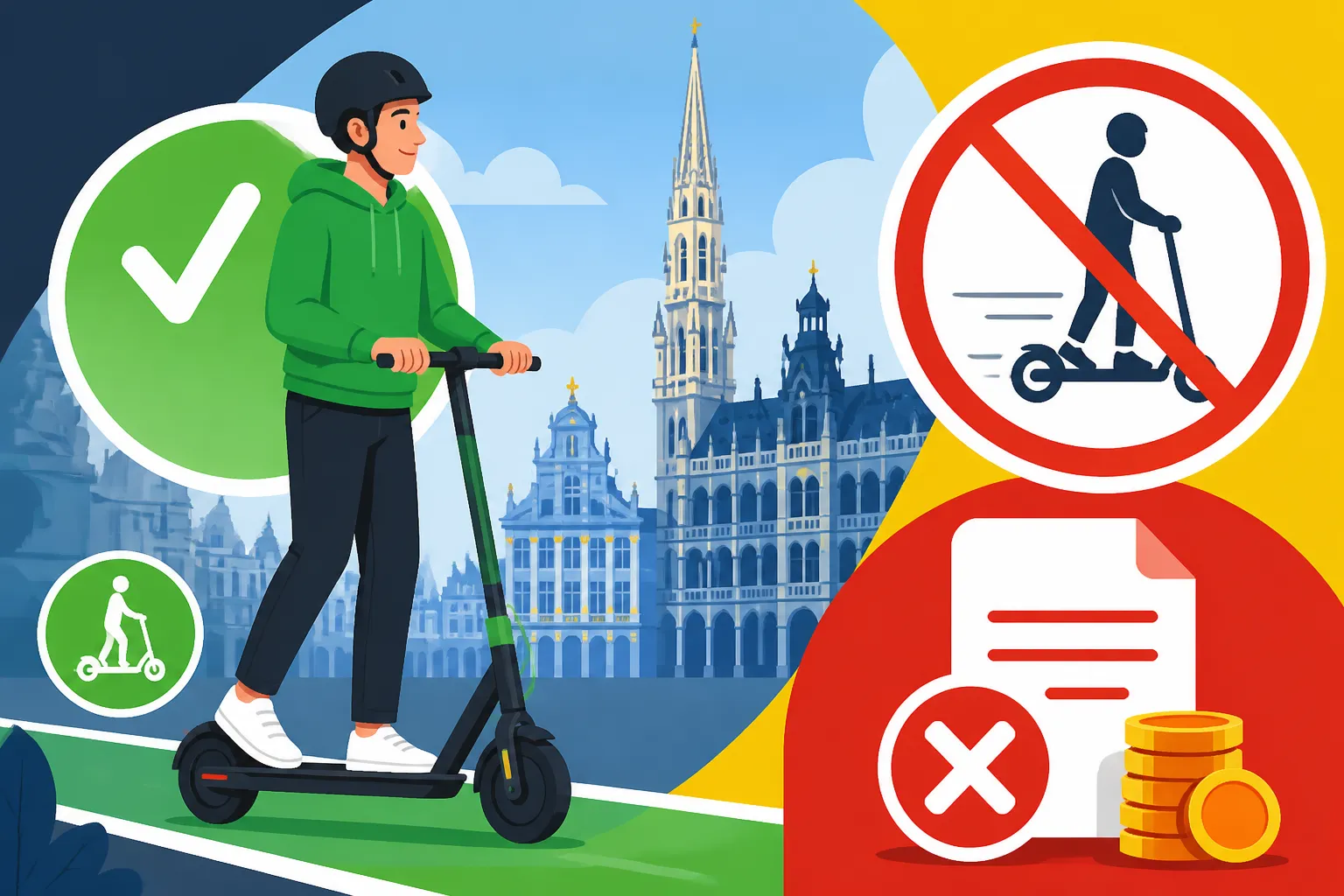
E-Scooter (Trottinette) Rules and Fines in Brussels
Navigating the frantic streets of Brussels is a rite of passage for any newcomer, but nothing quite tests your patience like the silent swarm of e-scooters weaving through traffic. I still remember my first month in Ixelles, nearly losing a grocery bag to a teenager zooming past on a sidewalk trottinette at what felt like terminal velocity. This guide breaks down the complex, often frustrating web of local regulations to ensure you stay mobile without draining your bank account on fines.
The Legal Landscape: Who Can Ride and Where
The Belgian government, and specifically the Brussels-Capital Region, has undergone a massive legislative shift regarding motorized displacement devices. Gone are the "Wild West" days when you could ride anywhere and leave your scooter as a makeshift hurdle for pedestrians. Today, the rules are much stricter, and the police in zones like PolBru (Brussels-City/Ixelles) are increasingly vigilant.
Age Restrictions and Licensing
In the eyes of Belgian law, an e-scooter is categorized similarly to a bicycle, provided its speed is capped. You do not need a specialized driver's license to operate a standard e-scooter in Brussels. However, you cannot simply hand one to a child. As of 2022, the minimum age for riding an e-scooter on public roads in Belgium is 16 years old.
There are minor exceptions for "play" devices or those used in strictly residential zones or pedestrian areas, but for the standard commute, the 16-plus rule is absolute. If you are caught letting a younger teenager ride, you are not just looking at a fine; you are looking at potential liability issues. For those still finding their feet in the city, checking Everyday Rules in Belgium: Garbage Sorting, Noise, and Etiquette can help you understand the broader social expectations that accompany these local laws.
Where You Can and Can't Ride
This is where most expats get tripped up. The most important rule to memorize is this: sidewalks are strictly for pedestrians. Unless you are moving at a walking pace (maximum 6 km/h) because of a specific medical necessity, you must stay off the pavement. You are required to use the cycle paths. If there is no cycle path, you must ride on the road, staying as far to the right as safely possible.
Brussels is a city of "Zones 30," where the speed limit for cars is 30 km/h. In these areas, riding an e-scooter feels relatively safe, but you must still obey all traffic signals, one-way street signs (unless a "white bike" sign indicates two-way cycle traffic), and priority-to-the-right rules. If you are caught on the sidewalk in a busy area like Rue Neuve or near the Grand Place, expect an immediate on-the-spot fine.
Shared E-Scooters vs. Private Ownership
Whether you choose to use a service or buy your own device depends heavily on your daily route and storage capabilities. Brussels has one of the highest densities of shared scooters in Europe, but the costs add up quickly.
Using Apps like Dott and Lime
The shared economy is dominant here. Companies like Dott, Lime, and Voi provide thousands of units across the 19 communes. To use these effectively, you will need a reliable mobile data plan. I often suggest Airalo to incoming expats who haven't yet secured a local SIM but need to unlock a scooter the moment they step off the train at Gare du Midi.
Shared scooters are speed-limited by GPS. When you enter a "Slow Zone," such as the pedestrianized center or certain parks like Parc de Bruxelles, the scooter will automatically decelerate to 8 km/h. This isn't a malfunction; it is a regulatory requirement enforced by the city's digital mapping. If you are moving between neighborhoods, perhaps looking for a new apartment through HousingAnywhere, these apps are invaluable for those "last-mile" trips where Brussels Transport (STIB/MIVB): Metros, Trams, and Bus Networks doesn't quite reach your front door.
Buying Your Own Scooter in Belgium
If you commute daily from Etterbeek to the European Quarter, buying your own trottinette is often more economical. You can find a wide range of models on Amazon Belgium that meet local technical requirements. When buying privately, you must ensure the device does not exceed a maximum speed of 25 km/h. Anything faster is classified as a moped (Class B), requiring a license plate, insurance, and a helmet.
A private scooter also means you are responsible for its maintenance. Unlike cars, there is no mandatory Car Inspection (Contrôle Technique / Autokeuring) in Belgium for e-scooters, but you should regularly check your brakes and tire pressure. The cobblestones in Saint-Gilles are unforgiving and will rattle a poorly maintained scooter to pieces within months.
Parking Rules: The Battle of the Sidewalks
Parking has become the most contentious issue in Brussels e-scooter history. In early 2024, the region implemented mandatory "Drop-off Zones" (known locally as "drop-zones"). These are designated areas, often marked with white painted boxes on the ground or indicated in the app, where shared scooters must be parked.
Mandatory Drop-off Zones
If you are using a shared app, you can no longer end your ride just anywhere. If you try to park outside a designated zone in communes like Brussels-City, Ixelles, or Saint-Josse, the app will refuse to end the session. You will continue to be charged by the minute until you move the device to a legal spot.
This change was brought about by the sheer number of complaints regarding blocked sidewalks, which often led to Dealing with Noise Complaints: When to Call the Belgian Police or general administrative reports. For private owners, the rules are slightly more relaxed—you can park on the sidewalk as long as you leave at least 1.5 meters of free space for pedestrians and wheelchairs. However, I highly recommend finding a bike rack to lock your personal device, as theft is unfortunately common.
Fines for Illegal Parking
If you do manage to bypass the app's restrictions or if you leave a private scooter in a way that obstructs traffic, the fines are steep. The commune can impound the scooter, charging a removal fee (often around €60 to €100) plus a daily storage fee. If it’s a shared scooter, the operator will pass this cost directly to you, often with an added administrative fee. Always take a photo of your parked scooter through the app as proof of correct placement.
Safety and Equipment Requirements
While the Belgian approach to e-scooters is meant to be flexible, safety equipment is no longer a suggestion; for some items, it is a legal mandate.
Helmet Laws and Reflective Gear
For scooters limited to 25 km/h, helmets are technically not mandatory for adults under Belgian law. However, as someone who has seen the state of Brussels' asphalt after a rainy day, I cannot stress enough how vital a helmet is. The combination of wet tram tracks and slippery cobblestones is a recipe for disaster.
At night or in low visibility (which is roughly six months of the year in Belgium), you are legally required to have lights. Your scooter must have a white or yellow light at the front and a red light at the rear. If your lights are obscured or broken, you must wear a reflective vest. You can find high-quality safety gear and helmets on Amazon Belgium that are specifically designed for urban commuters.
Technical Standards for Private Scooters
If you are bringing a scooter from another country, be careful. If the motor is more powerful than 250 watts or if it can exceed 25 km/h without a software lock, the police may seize it. Furthermore, every e-scooter in Belgium must be equipped with a bell or a warning device audible at 20 meters. It sounds trivial, but in a city where pedestrians are used to the hum of Public Transport: SNCB/NMBS (National Trains) Fares and Passes, a silent scooter is a dangerous one.
Fines and Penalties: What Will the Police Actually Charge You?
The Belgian "Code de la Route" (Highway Code) is very specific about the costs of breaking these rules. Fines are categorized by "degrees," and e-scooter infractions often fall into the first or second degree.
| Infraction | Type of Fine | Estimated Cost |
|---|---|---|
| Riding on the Sidewalk | 1st Degree | €58 |
| Parking in a Non-Designated Zone | Administrative | €60 – €150 |
| Riding with Two People (Doubling) | 1st Degree | €58 |
| Ignoring a Red Light | 3rd Degree | €174 |
| Using a Mobile Phone While Riding | 2nd Degree | €116 |
| Riding Under the Influence (Alcohol) | Criminal | €179 to €11,000+ |
Riding "two-up" or "doubling" is a favorite pastime for students near ULB, but it is highly illegal and unstable. If you are caught with a passenger on a single-rider device, you will both likely be fined. Using a phone while riding is also a major focus for Brussels police. If you need navigation, buy a sturdy phone mount—holding your phone in your hand while steering with the other is a fast track to a €116 penalty.
Alcohol and Drug Limits for Riders
Because e-scooters are motorized vehicles, the same blood-alcohol limits apply as they do for car drivers. The limit is 0.5 grams per liter of blood. If you are caught riding a trottinette while drunk after a night out at Place Lux, the consequences are severe. You can lose your right to drive a car for a period, and for expats on certain visas, a criminal record for DUI can complicate your residency status. If you've been drinking, it is much safer to use Transportation in Belgium: SNCB Trains, Trams, and Mobib Cards or a dedicated ride-share service like Using Poppy, Cambio, and Miles Car Sharing in Belgium.
Practical Tips for Navigating Brussels on Two Wheels
Beyond the laws, there is the "unwritten" code of surviving Brussels traffic. The city is currently a massive construction zone as it transitions to more bike-friendly infrastructure, which means your usual route might be blocked by a "chantier" (work site) without notice.
Dealing with Cobblestones and Rails
The tram tracks are the natural enemy of the e-scooter. Never, ever attempt to cross a tram track at a shallow angle. Your small wheels will get caught in the groove, and you will go down instantly. Always cross tracks as close to a 90-degree angle as possible. Similarly, when it rains, the cobblestones in areas like the Marolles become as slick as ice. Reduce your speed significantly and avoid sudden braking.
Integrating with Public Transport
One of the best ways to get around is combining your scooter with the train or metro. You are allowed to take your folding e-scooter on STIB/MIVB trains and buses for free, provided it is folded and doesn't obstruct other passengers. During peak hours, however, the metros are packed, and trying to squeeze a muddy scooter into a crowded carriage will not win you any friends. If you live in Living in Brussels: Top Expat Neighborhoods (Ixelles, Etterbeek), you might find it faster to just ride the whole way rather than dealing with the transfer at Schuman or Arts-Loi.
Always check the local commune website for the most up-to-date "Arrêtés du Bourgmestre" (Mayoral Decrees). Communes like Schaerbeek or Molenbeek sometimes introduce temporary parking bans during festivals or markets. Being a "veteran" expat means knowing that in Belgium, the rules can change as quickly as the weather, and staying informed is the only way to keep your commute stress-free.
Disclaimer
This guide is for informational purposes only and does not constitute legal advice. While every effort has been made to ensure the accuracy of the information provided regarding Brussels e-scooter regulations as of 2026, laws and fines are subject to frequent changes by the Belgian federal and regional authorities. Always consult official government sources such as the SPF Mobilité or your local commune's police department for the most current regulations. Riding an e-scooter involves inherent risks; always prioritize safety and local traffic laws.