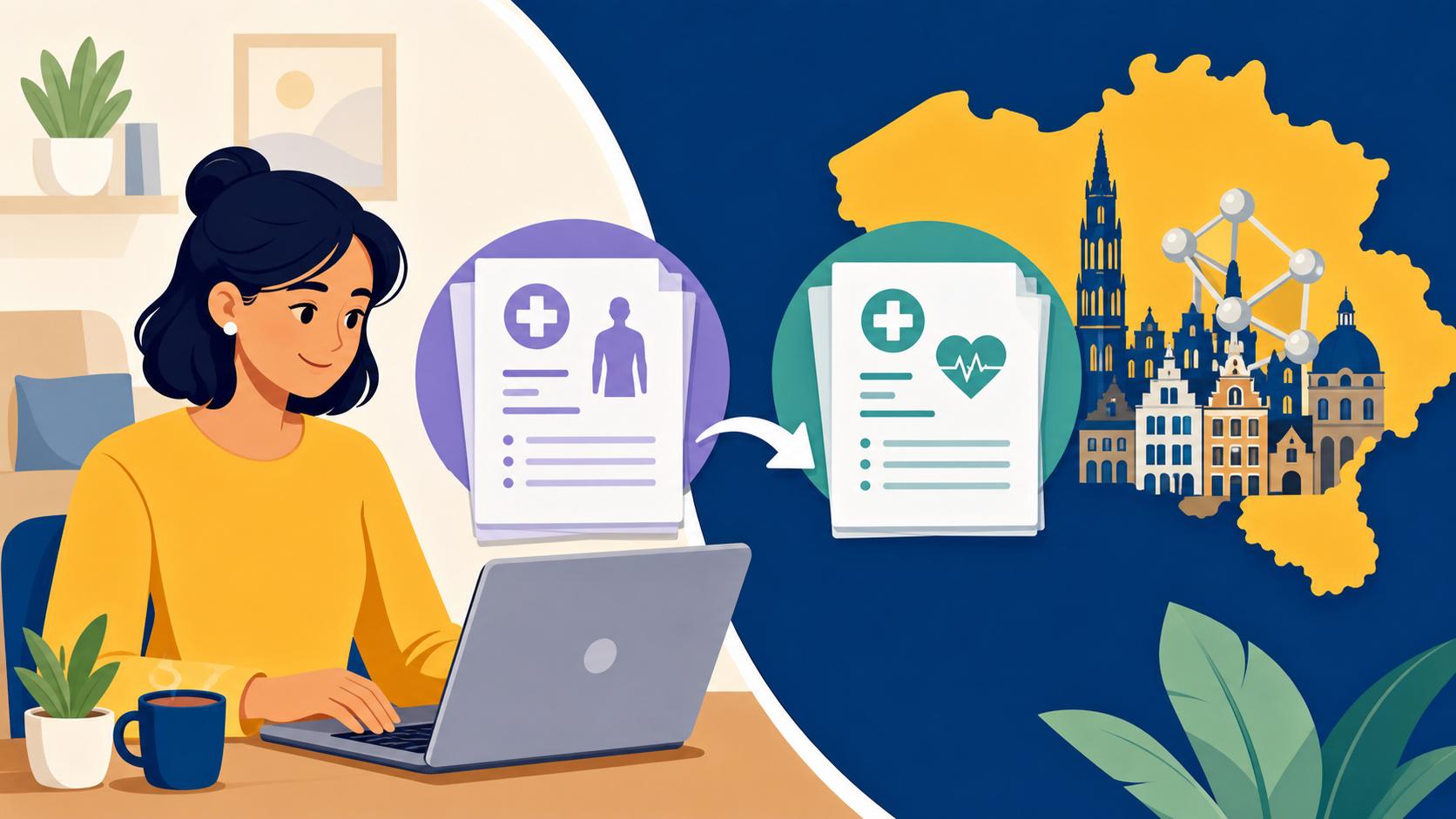
Translating Medical Records from Your Home Country to French/Dutch
Staring at a confused Belgian doctor while trying to explain a complex past surgery in broken French is a unique kind of stress. I remember sitting in a cold waiting room in Ixelles, clutching a folder of English records that might as well have been hieroglyphics to the specialist. This guide solves the logistical nightmare of making your medical history legible to the Belgian healthcare system.
Why You Need Your Medical Records Translated Before an Emergency
When you first arrive in Belgium, your priority is often finding a place to live or getting your eID card. However, the administrative side of your health is just as critical. Belgian doctors are highly skilled, but they operate within a system that thrives on precise documentation. If you have a chronic condition, a history of surgeries, or specific allergies, having those records translated into French or Dutch is not just a courtesy—it is a safety requirement.
Imagine being admitted to a hospital in Ghent or Liege. In an emergency, the medical staff needs to know your blood type, past reactions to anesthesia, and current prescriptions. While many Belgian doctors speak excellent English, the official medical record system—and the nurses or technicians processing your intake—will likely require data in a local language. Furthermore, having these documents ready is essential for Choosing Your First GP (General Practitioner) in Belgium. Your GP will act as the gatekeeper of your health, and providing them with a translated history allows them to build a comprehensive The Global Medical Record (DMG/GMD): Why You Need It for Better Refunds from day one.
Beyond immediate care, there is the financial aspect. If you are applying for Private Health Insurance in Belgium: When Do Expats Really Need It?, companies like Cigna Global may require a clear understanding of your pre-existing conditions to determine your premium or coverage limits. Without a professional translation, you might face delays in your application or, worse, a denial of coverage because the insurer couldn't verify your medical status.
Choosing the Right Language: French vs. Dutch
Belgium’s linguistic divide is legendary and, occasionally, a bit frustrating for newcomers. Before you spend money on a translator, you need to know where you will be spending most of your time. If you are living in Brussels, you can generally choose between French and Dutch, though French is the most common language in the capital's hospitals. However, if you are settling in Antwerp, Leuven, or Ghent, you must prioritize Dutch. Conversely, if you are in Namur, Liege, or Charleroi, French is your only viable option.
Most expats find that French translations are the "safer" bet if they are undecided, as Brussels is a major medical hub for the whole country. However, the Flemish healthcare system is incredibly efficient, and if you are Finding Medical Care in Belgium: GPs, Specialists, and Hospitals in Flanders, having Dutch records will significantly speed up your referrals to specialists at major institutions like UZ Leuven.
It is also worth noting that some documents, such as vaccination records, are often accepted in English, but complex surgical reports or psychiatric evaluations almost always require a formal translation. If you are managing a condition like ADHD, you will find that Bringing ADHD Medication (Stimulants) Into Belgium Legally requires very specific paperwork that must be understood by the Belgian Federal Agency for Medicines and Health Products. In these cases, a precise translation is non-negotiable.
The Role of Sworn Translators and Legal Requirements
You cannot simply use an online AI tool to translate your medical records and expect a Belgian hospital or insurance provider to accept them. For official use, you often need a "Sworn Translator" (Traducteur Assermenté in French or Beëdigd Vertaler in Dutch). These are professionals who have taken an oath before a Belgian court and whose stamp carries legal weight.
A sworn translation is usually required for:
- Legal disputes regarding medical negligence.
- Applications for disability benefits through your Mutuelle and Ziekenfonds: Public Health Insurance Registration Guide.
- Official dossiers for long-term care or specialized school placements for children.
- Serious insurance claims involving Private Health Insurance in Belgium: When Do Expats Really Need It? providers.
When you hire a sworn translator, they will provide a hard copy (and often a digital version) with their official seal and a statement declaring the translation is a true and accurate reflection of the original. This is the gold standard. For routine visits to a GP, a "professional" translation (one done by a medical translation agency but not necessarily sworn) might suffice, but always check with your doctor first. I found that having a sworn translation of my most critical records saved me months of back-and-forth with the local commune when I was proving my health status for residency requirements.
| Document Type | Translation Requirement | Recommended Language |
|---|---|---|
| Vaccination Records | Professional / English often OK | French or Dutch |
| Surgical Reports | Sworn Translation | Region-specific |
| Current Prescriptions | Professional / Pharmacy-level | French or Dutch |
| Chronic Condition History | Sworn Translation | French or Dutch |
| Allergy Lists | Professional / Clear Printout | French and Dutch |
Navigating Costs and Insurance Reimbursements
Let’s be honest: professional translation is expensive. In Belgium, you can expect to pay anywhere from €0.15 to €0.25 per word, or a flat fee per page for sworn services. This can add up quickly if you have a thick file of records. Unfortunately, the standard Healthcare Budgeting: Copays, DMG/GMD, and Reimbursements through the public mutuelle system does not typically cover translation costs. These are considered administrative expenses, not medical ones.
However, if you have a premium international policy with a provider like Cigna Global, check your fine print. Some international plans include "assistance services" that can help facilitate or even subsidize the translation of medical documents for the purpose of continuing treatment abroad. It is a lifesaver if you are moving with a complex history that requires hundreds of pages of documentation.
For those on a tighter budget, you should prioritize. You don't need to translate every routine blood test from five years ago. Focus on the summaries: discharge papers, specialist "end-of-treatment" notes, and your most recent diagnostic results. This keeps costs down while ensuring your new Belgian medical team has the "highlight reel" of your health. While you are waiting for your Belgian pharmacy setup to be finalized, you can often find familiar over-the-counter support via iHerb for vitamins or supplements you previously used, but for anything prescription-strength, your translated records are the only way to get a Belgian doctor to write a local equivalent.
Practical Steps to Get Your Records Translated
The process should start at least two months before you move, or immediately if you are already here. First, contact your current doctors in your home country and ask for a "Clinical Summary." This is much better than a raw file of every nurse's note. A summary is shorter, cheaper to translate, and more useful for Choosing Your First GP (General Practitioner) in Belgium.
Once you have your summary, find a translator via the official Belgian National Register of Sworn Translators and Interpreters. You can search this database by language pair and region. I highly recommend finding someone who specializes in "Medical" translation, not just a generalist. Medical terminology is a language of its own; you don't want a translator confusing "hypertension" with "hypotension."
After receiving your translations, make several copies. Keep the originals with the sworn stamps in a safe place, and give a set of copies to your GP to be scanned into your electronic file. This ensures that whenever you visit a specialist or an emergency room, the most important information is already in the Belgian system. If you ever find yourself Finding Medical Care in Belgium: GPs, Specialists, and Hospitals in a different city, having these digital records accessible via your eID makes the transition seamless.
Managing Medications and Pharmacy Transitions
One of the most immediate needs for translated records is at the pharmacy. If you arrive with a bottle of pills from the US, UK, or India, a Belgian pharmacist cannot legally refill it based on a foreign bottle. You need a Belgian prescription. By showing your translated medical history to a local doctor, they can quickly identify the Belgian equivalent (which often has a different brand name) and issue a prescription that your Mutuelle and Ziekenfonds: Public Health Insurance Registration Guide will actually recognize for reimbursement.
In the meantime, many expats rely on iHerb to maintain their routine of specific vitamins or health products that might not be readily available in the local apotheek. It provides a sense of continuity while you navigate the Belgian system. However, for chronic medications, your translated records are your ticket to Pharmacies and Medication in Belgium: Prescriptions and OTC Rules. Without them, you might be forced to undergo redundant testing in Belgium just to prove you need the medication you’ve been taking for years.
The Belgian system is incredibly rewarding once you are "in," but the barrier to entry is almost always paperwork. Investing in high-quality translations of your medical history isn't just about following rules; it’s about giving yourself the peace of mind that if you get sick, the system is ready to help you, not just file you away.
Disclaimer
This guide is for informational purposes only and does not constitute legal or medical advice. Translation requirements can vary by region and specific medical institution in Belgium. Always verify the current regulations with your local commune, your Mutuelle, or a legal professional before proceeding with official documentation. Always consult with a qualified healthcare provider in Belgium regarding your specific medical needs.