After-Hours Medical Care: On-Call Doctors (Garde/Wacht)
Your child starts crying with a sharp ear infection at 9:00 PM on a Saturday, and your usual GP’s office is long closed. I still remember the sheer panic I felt the first time my own fever spiked on a rainy Sunday morning in Brussels, and I stood staring at my phone, not knowing if I should go to the emergency room or just suffer through. This guide solves the mystery of the Belgian on-call system, ensuring you get medical help without the ER wait times.
Understanding the Belgian On-Call System
Belgium has a highly structured approach to healthcare that differentiates between life-threatening emergencies and urgent medical needs that arise when regular clinics are closed. This is where the "Garde" (in French) or "Wacht" (in Dutch) system comes in. It is designed to provide continuity of care, ensuring that no resident is left without medical supervision just because it is a weekend or a public holiday. For most expats, the realization that you cannot simply walk into a GP’s office at 8:00 PM on a Tuesday is a bit of a culture shock, but the alternative system is actually very efficient once you know the "secret" phone numbers.
The system is primarily staffed by local General Practitioners (GPs) who take turns being on call. This means the doctor you see at a weekend post is a fully qualified local physician, often the same one you might see during a regular appointment. This network is a pillar of Finding Medical Care in Belgium: GPs, Specialists, and Hospitals, providing a bridge between your local doctor and the major hospital emergency departments. By using the on-call system for non-life-threatening issues like high fevers, minor injuries, or sudden infections, you help keep the emergency rooms clear for trauma cases.
While the public system is robust, many expats choose to supplement their coverage with Cigna Global to ensure they have access to private consultations and additional medical support that might not be fully covered under the standard state reimbursement rates. Having that extra layer of private insurance can be a massive relief when you are navigating a medical system in a language that isn't your own.
The Difference Between Emergency and On-Call Care
The biggest mistake many newcomers make is heading straight to the "Urgences" or "Spoedgevallen" (ER) for something like a bad cough or a twisted ankle. In Belgium, hospital emergency rooms are strictly for life-threatening situations or severe trauma. If you show up at a major hospital with a minor ailment on a Sunday, you might find yourself waiting six or seven hours because more critical cases will always be prioritized. The on-call doctor (Médecin de Garde / Huisarts van Wacht) is specifically there to handle these mid-level "urgent but not life-threatening" issues.
If you are unsure whether your situation is an emergency, you can always refer to the guide on Emergency Numbers: Calling 112 in Belgium and What to Expect. Generally, if you can wait an hour or two for a consultation, you should use the on-call system. If someone is unconscious, having a heart attack, or has suffered a major accident, 112 is the only number you should call. For everything else, the "Garde" is your best friend.
It is also worth noting that the on-call doctor will have access to the same prescription systems as your regular doctor. They can provide sick notes for work, which is vital because Belgian employers are often very strict about receiving a medical certificate even for a one-day absence. If you are struggling with a chronic issue, however, the on-call doctor will usually recommend you follow up with your primary physician as part of Choosing Your First GP (General Practitioner) in Belgium.
Regional Variations and the 1733 Number
Belgium’s linguistic divide extends to its medical services, but the government has been working hard to centralize the on-call system. The magic number you need to memorize is 1733. This is a centralized federal number for non-emergency medical assistance. When you call 1733, you will usually be asked to enter your postal code or select your language, and the system will then route you to the appropriate on-call service for your specific area.
In Flanders, the 1733 system is very well-integrated with the "Huisartsenwachtposten" (GP on-call stations). In Brussels and Wallonia, the system is also becoming the standard, though some local areas still maintain their own specific dispatch numbers. Always check your local commune’s website or the noticeboard at your regular GP’s office to see if they list a preferred local number alongside the national 1733. Regardless of where you live, the goal is the same: to get you in front of a doctor as quickly as possible without involving a hospital.
In some more rural parts of Wallonia, the 1733 number might still be in a testing phase or require you to call a different local "centrale de garde." If you find yourself in a situation where the phone system feels overwhelming, remember that most pharmacists also have access to the current on-call schedules. You can learn more about how they operate in the guide to Pharmacies (Apotheek/Pharmacie) in Belgium: Operating Hours and Services.
How to Access a Doctor After Hours
When you realize you need a doctor and it’s outside the typical 8:00 AM to 6:00 PM window, your first step should always be the phone. Unlike some countries where you might just "show up" at a clinic, the Belgian system prefers a triaged approach. This ensures that the doctors aren't overwhelmed and that patients are seen in an order that reflects their medical need. Calling ahead also allows the operator to tell you exactly which "Poste de Garde" you should go to, as there are often several scattered across a city like Brussels or Antwerp.
When you call, have your identity card (eID) or your Belgian National Register Number ready. The operator will ask for your symptoms, your location, and your age. They are trained to determine if your case can wait until Monday, if you need to go to an on-call station immediately, or if they need to dispatch a doctor to your home. For most ambulatory patients—meaning you can walk and have a car or can take a taxi—you will be directed to a physical location.
For those who prefer digital tools, apps like Rosa and Doctena are increasingly popular in Belgium. While they are fantastic for Using the Rosa App: Booking Medical Consultations Online during regular hours, they don't always show every on-call doctor. The 1733 phone line remains the gold standard for after-hours care because it connects you to the official regional roster that these apps might not fully cover.
Using the 1733 Centralized Number
The 1733 system is designed to be user-friendly, but the linguistic prompts can be a hurdle for new arrivals. Usually, the system will speak to you in the language of the region you are calling from. In Brussels, you will typically hear prompts in both French and Dutch. If your language skills are still a work in progress, try to have a friend or neighbor help with the initial call, though many operators do speak a fair amount of English given the international nature of Belgium’s major cities.
Once you enter your postal code, the system will either give you the address of the nearest on-call post or connect you to a dispatcher. If you are in a region where 1733 isn't fully operational yet, the automated message will usually provide an alternative local number to call. It is a good idea to "test" the number by looking at the official 1733.be website to see how your specific commune is handled before an emergency actually strikes.
If you are calling for a child, the 1733 operator might ask more detailed questions. Belgium has excellent pediatric support, but on-call doctors are usually generalists. If the situation is specifically pediatric and you feel it is urgent, the operator may direct you to a specialized pediatric emergency department, such as the Queen Fabiola Children's University Hospital in Brussels.
Online Portals and Mobile Apps
While 1733 is the primary entry point, there are several regional websites that provide real-time information on which doctors are currently on duty. In Brussels, "Garde Bruxelloise" (Brussels Wacht) maintains a website where you can see the locations of the various "Postes de Garde" and their current opening hours. These posts are often strategically located near major transport hubs or hospitals but operate independently from the hospital’s ER.
| Region | Service Name | Contact/Website |
|---|---|---|
| Brussels | Garde Bruxelloise / Brusselse Wacht | 1733 / gbbw.be |
| Flanders | Huisartsenwachtposten | 1733 / naar de wachtpost.be |
| Wallonia | Postes de Garde | 1733 / mpostesdegarde.be |
| National | Emergency (Life-threatening) | 112 |
Using these websites can save you a lot of stress. For instance, the Flemish site "Huisartsenwachtposten.be" allows you to enter your zip code and see a map of the nearest station. This is particularly helpful if you are traveling within Belgium—perhaps spending a weekend in the Ardennes or at the coast—and don't know the local medical landscape.
What to Expect at the On-Call Station
When you arrive at a "Poste de Garde" or "Huisartsenwachtpost," the atmosphere is usually much calmer than a hospital ER. These facilities are designed for efficiency. You will check in at the reception desk, where your eID will be scanned. This is a crucial step because it links the visit to your Global Medical Record (DMG/GMD): Why You Need It for Better Refunds. If you don't have an eID yet, you must bring your passport and any temporary residency documents you have.
The consultation itself is usually brief and focused on the immediate problem. The doctor will examine you, provide a diagnosis, and either give you a prescription or tell you to see your regular GP on Monday. They will also provide you with a "document de soins" (healthcare voucher) or a digital "eAttest." This is your proof of payment and the key to getting your money back from your mutuelle.
I often tell expats to keep a basic first-aid kit and common wellness items at home to avoid unnecessary trips. I personally use iHerb to stock up on high-quality vitamins and supplements that aren't always easy to find in local Belgian pharmacies. Sometimes, having the right supplements or over-the-counter support on hand can help you manage minor symptoms until the morning, but never hesitate to use the on-call system if you feel something is wrong.
The Triage Process
Wait times at these stations are generally much shorter than at a hospital, often ranging from 20 minutes to an hour. However, they do use a triage system. If someone arrives with a high fever and breathing difficulties, they will be seen before someone with a minor skin rash. When you check in, the receptionist might ask you a few basic questions to gauge the urgency.
It is important to be honest and clear about your symptoms. If you are in significant pain, mention it. If you have a history of allergies or chronic conditions, bring that up immediately. The doctors at these posts are used to dealing with a high volume of patients and appreciate direct, clear communication. If your French or Dutch is limited, having a list of your symptoms written down in one of the local languages can be a huge help.
Consultation Costs and Payment
One of the most confusing parts of the Belgian system for expats is the pricing. On-call consultations are more expensive than regular appointments because of the "after-hours" surcharge. A standard GP visit during the day might cost around €30, but a weekend on-call visit can easily exceed €50 or €60. However, the Belgian social security system is very generous.
If you have a Mutuelle and ZiekenfondsPublic Health Insurance Registration Guide setup, you will be reimbursed for a large portion of this cost. Most people end up paying only a small "ticket modérateur" (co-payment) of about €10 to €15 after the reimbursement. You will usually have to pay the full amount upfront at the station—most accept Bancontact or credit cards—and then the reimbursement is handled automatically via your eID or by you sending the paper receipt to your insurance provider.
| Type of Visit | Estimated Cost (Upfront) | Estimated Out-of-Pocket (After Refund) |
|---|---|---|
| Standard Day GP | €30 | €4 – €6 |
| Evening On-Call (Wacht) | €50 – €70 | €12 – €18 |
| Home Visit (Late Night) | €100+ | €25 – €40 |
Note: These costs vary based on whether the doctor is "Conventioned" (follows official state rates). You can read more about this in the guide on Understanding the 75% Reimbursement System for Medical Consultations.
Home Visits and Serious Situations
There are times when you simply cannot leave the house—perhaps you have a very high fever, a severe migraine that makes driving dangerous, or you are caring for multiple sick children alone. In these cases, you can request a home visit from the on-call doctor. When you call 1733, you should explain why you cannot travel to the "Poste de Garde."
The dispatcher will determine if a home visit is justified. Be aware that home visits are significantly more expensive and the wait times can be longer, as the doctor on duty has to drive between various locations. In Brussels, services like SOS Médecins are famous for providing home-based urgent care, though they operate slightly differently than the standard regional "Garde."
If you find that the cost of these visits or the co-payments are adding up, this is where Private Health Insurance in Belgium: When Do Expats Really Need It? becomes a vital conversation. Some private plans will cover the "ticket modérateur" that the public mutuelle does not, which can be a lifesaver for families with young children who seem to catch every bug going around.
When a Doctor Will Come to You
The criteria for a home visit are usually stricter than for an office visit. The dispatcher will prioritize the elderly, people with mobility issues, and parents with very young infants. If you are a healthy adult with a minor injury, they will almost always ask you to take a taxi to the nearest on-call post. This is to ensure the doctor's time is used as efficiently as possible.
When the doctor arrives at your home, they will need a clean, well-lit space to examine you. Have your eID and any current medications ready. They will provide the same "document de soins" that you would receive at the clinic. Ensure you ask for a "quittance" (receipt) if you intend to claim the expense through a private provider like Cigna Global.
Follow-up and Medical Records
The on-call doctor is a temporary solution. One of the most important things they do is send a report of the consultation to your regular GP. This is why having a "Global Medical Record" (DMG) is so important. It ensures that your medical history is centralized. If the on-call doctor prescribes medication or suggests further tests, your regular doctor will see this in your file.
On Monday morning, it is a good habit to call your regular GP's office to let them know you saw the on-call doctor. They may want to see you for a follow-up or simply update your records. This coordination is what makes Healthcare in Belgium for Expats: Complete System Overview (2027) so effective—the communication between the various levels of care is remarkably tight.
After-Hours Pharmacies (Pharmacie de Garde)
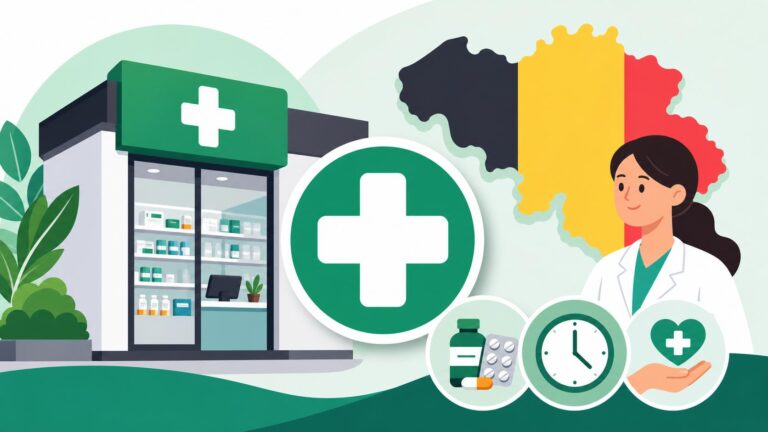
Finding a doctor is only half the battle; you often need to get a prescription filled immediately. In Belgium, pharmacies also take turns being on call. These are known as the "Pharmacie de Garde" or "Apotheek van Wacht." Unlike a doctor's office, you cannot just walk up to any pharmacy at night and expect it to be open.
There is a dedicated website, pharmacie.be (or apotheek.be), where you can enter your location to find the nearest open pharmacy. Most pharmacies also display a list of the current on-call shops in their window. It is important to note that after 10:00 PM, many on-call pharmacies require you to call them first or ring a bell, as they operate through a small security window for safety.
To understand the specifics of what you can and cannot buy during these hours, check out Buying Paracetamol and Ibuprofen in Belgium: Pharmacy Only Rules. Generally, the on-call pharmacist is there for urgent prescriptions, not for buying toothpaste or beauty products.
Finding the Nearest Open Pharmacy
The list of on-call pharmacies changes daily. Some are on call for a full 24 hours, while others only cover the evening shift until 10:00 PM. If you are in a major city like Brussels, there is usually at least one 24-hour pharmacy in most major districts. In smaller towns, you might have to drive 10 or 15 minutes to reach the one designated shop for that night.
The website for How to Find an On-Duty Pharmacy (Pharmacie de Garde) at Night is the most reliable resource. If you don't have internet access, calling the police or the 1733 number can sometimes provide this information, though the website is much faster. Always bring your prescription and your eID, as the pharmacist will need to register the medication to your national number.
Surcharges for Late-Night Prescriptions
Be prepared for the "fee de garde." If you visit a pharmacy after regular hours (usually after 7:00 PM or 8:00 PM) or on a Sunday, the pharmacist is legally allowed to charge a small surcharge. However, if you have a valid urgent prescription from a doctor, this fee is often covered by your mutuelle, meaning you won't see it on your final bill.
If you are just stopping by to buy over-the-counter medicine because you forgot to buy it earlier, you will have to pay the surcharge out of pocket. This is another reason to keep your home medicine cabinet stocked with basics from iHerb, so you don't find yourself paying an extra €5 or €10 just to get a box of throat lozenges at midnight.
Practical Tips for Your First "Garde" Visit
Navigating medical care in a foreign country is stressful, but a little preparation goes a long way. I always suggest that expats keep a "medical folder" in an accessible place. This should include your eID, your mutuelle stickers (vignettes), a list of any allergies, and the contact details for your regular GP.
If you have children, make sure you have their ISI+ card or eID ready. The system for children is slightly different, and having their documents on hand will speed up the process. You can learn more about this in the guide on Family Health in Belgium: Pregnancy, Birth, and Pediatric Care. Knowing where the nearest "Poste de Garde" is before you actually need it can save you 20 minutes of panicked searching when someone is ill.
Finally, don't be afraid to ask for a translation. While the official languages are French, Dutch, and German, the Belgian medical community is very international. If you don't understand the instructions for a medication or the doctor's diagnosis, ask them to write it down or explain it in English. Most Belgian doctors are incredibly proficient in English and are happy to help a patient who is clearly trying their best to navigate the system.
Documentation Checklist
When you leave the house for an on-call appointment, do a quick double-check for the following items:
- Identity Card (eID): This is your passport to the Belgian healthcare system.
- Payment Method: Most posts prefer Bancontact, but keep a bit of cash or a credit card as a backup.
- Current Medications: If you are already taking something, bring the boxes so the doctor can check for interactions.
- Mutuelle Stickers: While the eID handles most things, having your "vignettes" is helpful if the digital system is down.
- A Mask: Many medical facilities in Belgium still prefer or require masks in waiting rooms, especially during flu season.
Once the visit is over, make sure you receive your How to Submit Medical Receipts for Reimbursement in Belgium instructions. Most doctors now use "eAttest," which means the receipt is sent digitally to your mutuelle, and you’ll see the refund in your bank account within a few days without doing any paperwork at all.
Overcoming the Language Barrier
The fear of not being understood is the number one reason expats delay seeking care. In my experience, Belgian on-call doctors are some of the most patient professionals you will meet. They understand that you are in a stressful situation. If you are struggling with terminology, use a translation app or even simple gestures.
It is also helpful to know a few key phrases:
- "J’ai une urgence médicale" (I have a medical emergency – French)
- "Ik heb een medisch noodgeval" (I have a medical emergency – Dutch)
- "Où est le poste de garde?" (Where is the on-call post? – French)
- "Waar is de wachtpost?" (Where is the on-call post? – Dutch)
By staying calm and following the 1733 procedure, you ensure that you receive high-quality care at any hour of the day or night. Belgium’s medical system is one of the best in the world; you just need to know which door to knock on when the sun goes down.
Disclaimer
The information provided in this guide is for informational purposes only and does not constitute professional medical advice, diagnosis, or treatment. Always seek the advice of your physician or other qualified health provider with any questions you may have regarding a medical condition. Never disregard professional medical advice or delay in seeking it because of something you have read in this article. While we strive to keep information up to date, Belgian medical regulations and phone numbers can change; always verify with official government sources or your local commune.