Going to the Emergency Room (Urgences/Spoedgevallen) in Belgium
Finding yourself in a medical crisis at 2 AM in a foreign country is one of the most isolating experiences an expat can face. I remember the sheer panic of my first Belgian emergency when I realized I didn't even know the word for "stitches" in French or Dutch. This guide breaks down the Belgian emergency room process so you can navigate the system with confidence.
Navigating the Belgian Emergency System
The first thing you realize when living here is that Belgium has a world-class healthcare system, but it is deeply structured. You cannot simply walk into any clinic for a midnight emergency. You need to know the difference between the Urgences (French) or Spoedgevallen (Dutch) and the local on-call services. If you are in a life-threatening situation, your first move is always to call 112. This is the universal emergency number in Europe and will get you an ambulance or the MUG/SMUR (the specialized mobile intensive care unit).
When to Call 112 vs Driving Yourself
It is a common expat mistake to think calling an ambulance is the "fastest" way to be seen. In Belgium, the triage system is king. If you arrive by ambulance with a non-life-threatening issue, you will still wait behind someone who walked in with a more severe condition. However, for chest pain, severe shortness of breath, or suspected stroke, calling 112 is non-negotiable. You can learn more about the specifics of Emergency Numbers: Calling 112 in Belgium and What to Expect to understand the dispatcher's questions.
If the situation is stable enough to travel, driving to the nearest ER is often more efficient. Keep in mind that Ambulance Fees in Belgium: What the Mutuelle Covers can be surprising; you are often billed a flat fee regardless of the distance, and your public health insurance only covers a portion of this. Having a plan for transport before a crisis hits is a hallmark of a seasoned expat.
Recognizing Urgent vs Non-Urgent Cases
Belgian hospitals are increasingly under pressure, and they have become quite strict about what constitutes an "emergency." If you show up at the ER for a prescription refill or a common cold, you will likely face a very long wait and a higher "administrative" fee. For things like high fevers in adults, minor sprains, or sudden rashes, the better route is often the Poste de Garde or Huisartsenwachtpost.
These are on-call GP centers that operate when your regular doctor is closed. They are fully equipped to handle "urgent but not emergency" cases. If you aren't sure where to go, you can always consult our guide on Finding Medical Care in Belgium: GPs, Specialists, and Hospitals to see which facility fits your current symptoms. This saves the ER for the true trauma cases and saves you hours of sitting in a plastic chair in a crowded waiting room.
Finding the Nearest ER in Major Cities
In Brussels, you are spoiled for choice, but choice can lead to indecision. Hospitals like Saint-Luc in Woluwe-Saint-Lambert or Delta in Auderghem are popular with the expat community because they often have a higher density of English-speaking staff. In Antwerp, UZ Antwerpen is a massive hub with specialized departments. In Ghent, the UZ Gent is one of the most advanced facilities in the country.
I always recommend scouting the route to your nearest ER during the daylight hours. Check the parking situation, as Belgian hospital parking can be a labyrinth. If you are a newcomer, our Brussels Healthcare Guide for Expats: Clinics, Hospitals, and Care provides a breakdown of the best facilities by neighborhood, which is invaluable when you're too stressed to use GPS effectively.
The Triage Process and What to Expect
When you walk through those sliding doors, the first thing you see is the registration desk. This isn't just about your name; it’s about your legal status in the country. In Belgium, your medical life is tied to your Belgian eID card. This card contains all your insurance data and your National Register Number.
The Importance of Your eID or ISI+ Card
If you have your residence permit, that little plastic card is your golden ticket. The receptionist will scan it, and your insurance status will pop up immediately. If you don't have your eID yet because you’re still waiting for the commune to process your paperwork, you should have an ISI+ card (for children or those not yet eligible for an eID) or an Annex 15.
If you are a tourist, you must provide your European Health Insurance Card (EHIC) or proof of private travel insurance. This is where Private Health Insurance in Belgium: When Do Expats Really Need It? becomes a critical read. Without these, the hospital may ask for a significant upfront deposit. For long-term expats, companies like Cigna Global offer a layer of security that covers the gaps public insurance leaves behind, especially regarding private room preferences if you end up being admitted.
Understanding the Color-Coded Triage System
Belgium uses a standardized triage system, often the Manchester Triage System (MTS). After you register, a nurse will call you into a small room to assess your vitals. They will assign you a color code:
- Red: Immediate (Life-threatening)
- Orange: Very Urgent (Target time 10 minutes)
- Yellow: Urgent (Target time 60 minutes)
- Green: Standard (Target time 120 minutes)
- Blue: Non-Urgent (Target time 240 minutes)
Be prepared: if you are yellow or green, and a "red" patient arrives, your clock resets. It’s frustrating, but it’s the reality of a system that prioritizes survival. During these long waits, I’ve often wished I had brought a power bank for my phone and a bottle of water. While you wait, it’s worth checking MyHealth.belgium.be Guide: Accessing Your Medical Records Online to see if your previous history is correctly logged in the federal system.
Wait Times and Communication Barriers
Language can be a hurdle in the heat of an emergency. While most doctors in Belgian ERs speak excellent English, the support staff, nurses, and receptionists might prefer French or Dutch. If you are in Flanders, expect Dutch; in Wallonia or Brussels, expect French.
If you feel your symptoms aren't being understood, don't be afraid to use a translation app or ask for a "traducteur" or "tolk." However, the medical terminology is often similar to English. For those living in the north, our Antwerp Healthcare Guide: Where to Go and How to Book Appointments has specific tips on navigating the Dutch-centric system. Usually, a calm "I am an expat, I speak English" will shift the conversation to a language everyone is comfortable with.
Costs and Reimbursements: The Financial Side
One of the best things about Belgium is that you won't go bankrupt from an ER visit, but it isn't "free." There is a complex dance between your Mutuelle (public insurance) and your out-of-pocket expenses.
| Fee Type | Description | Estimated Cost (Out of Pocket) |
|---|---|---|
| Consultation Fee | The basic charge for seeing the ER doctor. | €25 – €50 (after mutuelle) |
| Administrative Fee | Surcharge for using the ER instead of a GP. | €15 – €30 |
| Lab/Imaging | X-rays, blood tests, or CT scans. | €10 – €100+ (variable) |
| Supplements | Charges for non-conventioned doctors or night visits. | Variable |
Standard ER Fees and the Tiers-Payant System
Belgium often uses the "Tiers-Payant" (third-party payer) system in hospitals. This means the hospital bills the Mutuelle directly for the bulk of the cost, and you only pay the "ticket modérateur" (your co-payment). However, sometimes you might receive a bill by mail weeks later for the doctor’s specialized fees.
It is essential to understand The Global Medical Record (DMG/GMD): Why You Need It for Better Refunds. If you have a registered GP and a DMG, your co-payments for many services are reduced. If you are still in the process of setting this up, check Registering for Public Health Insurance: Step-by-Step at Your Commune to ensure you aren't overpaying for your emergency care.
Hospitalization Insurance and Room Supplements
If the ER doctor decides to admit you, the financial conversation changes. You will be asked if you want a single room or a shared room. Warning: Choosing a single room allows the doctors to charge "honorarium supplements" that can be 200% to 300% of the standard rate.
Most Belgian employment contracts include "Hospitalization Insurance" (like DKV, AG, or Alan) that covers these supplements. If you are self-employed or your employer doesn't provide this, you should seriously consider Private Health Insurance in Belgium: When Do Expats Really Need It? to avoid a €2,000 bill for a two-night stay. Cigna Global is a frequent choice for expats who move between countries and want consistent, high-level coverage that includes these private room costs.
Why Cigna Global is a Lifesaver for Private Top-ups
While the Belgian public system is great, it’s a "safety net" system. It ensures you get the care you need, but it doesn't always ensure the most comfortable or convenient experience. Private insurers like Cigna Global allow you to bypass the stress of co-payments and supplements. They handle the bureaucracy that often confuses newcomers. When you are already dealing with the trauma of an injury, the last thing you want is to be debating the cost of a CT scan with a billing department.
Specialized Emergency Care
Not all emergencies are created equal. If you take a child to a general adult ER, you might find the environment quite jarring. Belgium has several dedicated facilities designed for specific needs.
Pediatric Emergencies (Urgences Pédiatriques)
If your little one has a high fever or a nasty fall, look for an Urgences Pédiatriques. In Brussels, the Queen Fabiola Children's University Hospital (HUDERF) is a dedicated oasis for kids. The doctors there are specialists in pediatric trauma, and the environment is much less intimidating.
When dealing with children, make sure you have their ISI+ card or eID. If you’re a new parent, our guide on Pediatricians in Belgium: Routine Vaccines and Child Checkups can help you find a doctor who can handle the follow-up care after an ER visit. Knowing where the nearest pediatric ER is can save you precious minutes when your child is in distress.
Psychiatric Emergencies and Mental Health Support
Mental health crises are treated with the same urgency as physical ones in Belgium. Most major hospitals have a psychiatrist on call in the ER. However, there are also specialized "Crisis Centers" that provide a more supportive environment than a standard emergency room.
If you or someone you know is struggling, Mental Health in Belgium: Therapy, Psychiatry, and Expat Support is a vital resource. Isolation is a real issue for expats, and the Belgian system has specific pathways for those experiencing burnout or severe anxiety. You don't have to wait for a "physical" emergency to seek help.
Dental and Eye Emergencies
Standard ERs are notoriously bad at handling dental issues. If you have a knocked-out tooth or a severe abscess on a weekend, you need the Service de Garde Dentaire (Dental On-call Service). This is a centralized number or a specific rotating clinic.
For eye injuries, some hospitals like Saint-Pierre in Brussels have a more robust ophthalmology department. If you find yourself needing urgent eye care, Eye Care: Visiting Ophthalmologists and Getting Glasses Reimbursed explains how to navigate these specialist referrals. Don't waste four hours in a general ER for a scratched cornea if there is a specialist eye clinic on call.
Post-ER Care and Follow-ups
The ER’s job is to stabilize you. Once you are discharged, the responsibility for your recovery shifts to you and your GP. You will often leave with a "lettre de sortie" (discharge letter) and a handful of prescriptions.
Pharmacy Rules and Post-Recovery Wellness
In Belgium, pharmacies have strict operating hours. If it's after 10 PM, you will need to find a Pharmacie de Garde (on-call pharmacy). You can find the nearest one by checking the list posted in any pharmacy window or using a dedicated website. Be aware that there is a small "duty fee" for using an on-call pharmacy late at night.
For your long-term recovery, you might need vitamins or supplements that are expensive in local pharmacies. I often use iHerb to restock on high-quality wellness products once the initial crisis has passed. They ship quickly to Belgium, and it's a great way to manage your Healthcare Budgeting: Copays, DMG/GMD, and Reimbursements by saving on over-the-counter items that the Mutuelle won't cover. Our guide on Pharmacies and Medication in Belgium: Prescriptions and OTC Rules explains exactly what you can and cannot buy without a doctor's note.
The Role of Your GP (GMD/DMG)
Your GP is the "manager" of your health in Belgium. After an ER visit, you should schedule an appointment with your GP to discuss the findings. They will add the ER report to your Global Medical Record (DMG/GMD): Why You Need It for Better Refunds, ensuring that all your future doctors have the full picture.
If you don't have a GP yet, now is the time to find one. Use our guide on Choosing Your First GP (General Practitioner) in Belgium to find someone who speaks your language and is located conveniently. In the Belgian system, having a consistent GP is the single best way to ensure you get the best reimbursements and the most personalized care.
Alternative After-Hours Options
Sometimes, you’re too sick to wait in an ER but not sick enough to justify the trip. This is where Belgium’s supplementary services shine.
On-call GPs (Garde/Wacht)
The Garde Médicale or Wachtpost is a network of GPs who cover nights and weekends. In Brussels, you can call 1733 to find the doctor on duty. These centers are fantastic because they can perform basic tests, write prescriptions, and even give you a sick note for work.
Using these services is often cheaper than the ER and much faster. They are the perfect solution for an ear infection or a sudden bout of the flu. For more details on how these work, see After-Hours Medical Care: On-Call Doctors (Garde/Wacht). It’s the "middle ground" of Belgian medicine that every expat should have on speed dial.
Home-visit Doctors (SOS Médecins)
If you are too ill to leave your bed—perhaps due to severe vertigo or a debilitating migraine—you can call for a home visit. Services like SOS Médecins in Brussels will send a doctor to your apartment.
While more expensive than visiting a clinic, it is a godsend when you live alone and can't drive. Keep in mind that SOS Médecins Brussels: How to Call a Doctor to Your Home is a private-ish service, so the co-payment might be higher than a standard visit. However, the convenience during a crisis is worth every cent.
Medical Emergency Checklist
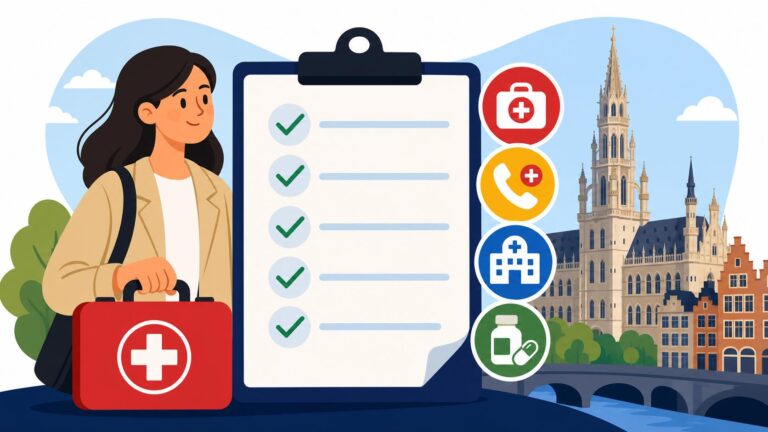
To make your life easier, here is a quick checklist of what to grab before heading to the ER:
- Belgian eID card or ISI+ card.
- Private insurance card (e.g., Cigna Global, DKV).
- A list of current medications you are taking.
- Your phone and a long charging cable.
- A bottle of water and a light snack (if you aren't nauseous).
- A sweater (ERs are notoriously chilly).
- Cash or a Bancontact card for the initial co-payment.
Navigating a Belgian ER is a rite of passage for many of us. It’s a bit bureaucratic, and the wait times can be long, but the quality of care is exceptional. Once you understand the triage system and have your paperwork in order, the stress levels drop significantly. Stay safe, and remember that Finding Medical Care in Belgium: GPs, Specialists, and Hospitals is always here to help you find your way.
Medical Disclaimer
The information provided in this guide is for informational purposes only and does not constitute professional medical advice, diagnosis, or treatment. Always seek the advice of your physician or other qualified health provider with any questions you may have regarding a medical condition. If you are experiencing a medical emergency in Belgium, call 112 immediately.