Opening a Free Student Bank Account: Best Options for 2027
Getting your head around the Belgian administrative machine is enough to make any student want to hop on the next train back home. I remember clearly my first week in Brussels, sitting in a cold hallway at the commune, only to be told I couldn't open a bank account because my temporary residence paper wasn't "the right kind of Annex." This guide solves that exact frustration by highlighting the best free student bank accounts in Belgium for 2026 and explaining how to bypass the most common bureaucratic roadblocks.
Why a Local Belgian Bank Account is Non-Negotiable
When you first arrive in Ghent, Leuven, or Louvain-la-Neuve, you might think your home-country card is sufficient. After all, it's 2026, and the world is digital. However, you will quickly discover that Belgium is the land of Bancontact. While major retailers accept Visa and Mastercard, many local "frietkoten," smaller grocery stores, and government offices still rely heavily on the local Bancontact system. Without a Belgian IBAN, you will find it nearly impossible to set up essential services for your Student Accommodation (Kot) in Belgium: Contracts and Culture.
Most Belgian landlords and utility companies require a SEPA direct debit, known here as a "domiciliation." Trying to set this up with a non-Belgian IBAN often results in "technical errors" that are really just code for "our system hasn't updated to 21st-century international standards yet." Having a local account allows you to participate in the local economy seamlessly, using the Payconiq app to split dinner bills with your new friends or pay for your laundry at the student residence.
Furthermore, a local account is the gateway to Itsme Authentication: How to Set Up Belgium's Vital Digital ID. Itsme is the golden key to Belgian life; it is used to sign into your university portal, access your medical records, and even sign your lease. Most major Belgian banks allow you to activate Itsme directly through their mobile app, which is a massive time-saver compared to the alternative of buying a card reader and wrestling with your laptop.
The Top Free Student Account Options
The Belgian banking landscape has changed significantly over the last few years, with several traditional players merging and digital-only banks gaining ground. For students, the "free" aspect is usually guaranteed until age 24 or 25, provided you can prove your enrollment status.
KBC and KBC Brussels: The Gold Standard for Apps
KBC is widely considered to have the best banking app in Europe, and for an expat student, this is a lifesaver. Their "KBC Plus Account" is free for anyone under 25. The interface is available in English, which is a rare and beautiful thing in a country split between French and Dutch. I personally found their "Kate" AI assistant surprisingly helpful when I needed to find a nearby ATM or understand why a transaction was pending.
KBC also offers a "placeholder" account for those who have just arrived. If you are still waiting for your Registering at the Commune: The 8-Day Rule After Arrival, KBC often allows you to start the application process with just your passport and proof of university registration. This is crucial because you need a place to deposit your "block account" funds if you are a non-EU student.
BNP Paribas Fortis: The Reliable Giant
As the largest bank in Belgium, BNP Paribas Fortis is everywhere. Their student offering, the "Hello" package, is robust and free. The biggest advantage here is the physical presence. If you prefer walking into a branch in the city center of Antwerp or Liège to talk to a human being, BNP has the most extensive network. In my experience, the staff in branches near major universities like KU Leuven or ULB are very used to dealing with international students and usually speak excellent English.
They have also been pioneers in integrating with Bancontact and Payconiq: The Backbone of Belgian Payments, ensuring that your digital wallet is ready to go the moment your account is active. While their app isn't quite as flashy as KBC’s, it is incredibly stable and reliable for those monthly rent transfers.
Hello bank!: The Digital Pure-Player
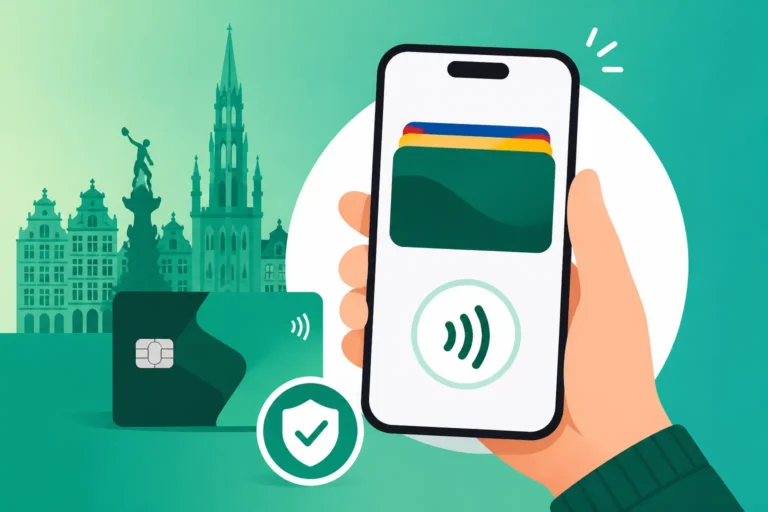
Owned by BNP Paribas but operated entirely online, Hello bank! is the go-to for the "digital nomad" student. Everything is managed via the app. It is completely free, and they often offer sign-up bonuses (sometimes up to €50) for new students. If you are comfortable never visiting a physical office and doing everything via chat or video call, this is a fantastic option. They provide a physical debit card that works everywhere Bancontact is accepted, and their integration with Apple Pay and Google Pay is seamless.
Required Documents and the Infamous Annex 15
Opening an account is where most students hit a wall. In Belgium, you are legally required to register at your local "Maison Communale" or "Stadhuis" within eight days of arrival. After this, you will likely receive an "Annex 15," which is a temporary document proving you have applied for residency while you wait for The Police Check (Contrôle de Quartier) for Address Verification.
Most banks will ask for:
- A valid Passport or National ID card (for EU citizens).
- Proof of enrollment at a Belgian Higher Education institution (Attestation d'inscription).
- Proof of address in Belgium (your lease or the Annex 15).
- Your Belgian National Register Number (if you have it yet).
A common "pro-tip" I give to every newcomer: if one branch of a bank tells you they cannot open an account with an Annex 15, try a different branch of the same bank, preferably one in a different neighborhood. Belgian banking is surprisingly decentralized at the branch level, and some managers are more "expat-friendly" than others.
| Bank Name | Age Limit for Free Account | Key Student Benefit | English App? | Physical Branches? |
|---|---|---|---|---|
| KBC / KBC Brussels | Under 25 | Award-winning app & Kate AI | Yes | Yes |
| BNP Paribas Fortis | Under 24 | Massive branch network | Yes | Yes |
| Hello bank! | Under 28 | Fully digital, easy sign-up | Yes | No |
| Belfius | Under 25 | Great integration with public transport | Yes | Yes |
| ING Belgium | Under 26 | Good for international students | Yes | Yes |
Managing International Transfers and Currency
While your Belgian bank account is perfect for local life, it is often a terrible choice for receiving money from home if you live outside the Eurozone. Traditional banks in Belgium often hide high fees in the exchange rate. This is where you should look at International Money Transfers: SWIFT vs Wise in Belgium.
Using Wise in conjunction with your Belgian account is the smartest financial move a student can make. You can receive your allowance in your home currency into your Wise multi-currency account and then transfer it to your KBC or BNP account in Euros at the mid-market rate. This can save you enough money over a semester to pay for a few weekend trips to Bruges or the Ardennes. Many students also use Wise as a secondary account for travel within the Schengen area to avoid the small "out-of-network" ATM fees that Belgian banks sometimes charge.
Modern Finance: Investing and Crypto for Students
For students who have a part-time job or are looking to grow their savings while abroad, the landscape offers some interesting tools. If you manage to save a bit from your Student Budgets: How Much Do You Need to Live in Leuven?, you might want to look beyond the 0.11% interest rates offered by traditional savings accounts.
Trade Republic has become incredibly popular among the student population in Brussels and Ghent. It offers a much higher interest rate on uninvested cash compared to traditional Belgian banks, and it allows for commission-free fractional investing in ETFs. It is a great way to start building a "nest egg" while you study.
Additionally, for those interested in the digital asset space, Binance remains a major player for managing crypto portfolios in Belgium. Just keep in mind that while owning crypto is legal, the tax implications can be tricky if you start trading frequently. If you are just a "casual" holder, you are usually safe under the "Good Father of the Family" rule, but if you become a pro, you might eventually need to look into Filing a Non-Resident Tax Return (Impôt des Non-Résidents).
Common Pitfalls to Avoid
One of the strangest things about Belgian banking is the What is a Maestro Card and Why is Mastercard/Visa Sometimes Rejected? phenomenon. Even in 2026, you will find "Bancontact-only" shops. When you open your student account, ensure your card is "Co-badged." This means it has the Bancontact logo for local use and a Visa or Mastercard logo for international and online use. Most student accounts now provide these "Debit Mastercard" or "Visa Debit" cards as standard, but it is always worth double-checking during your appointment.
Another trap is the "hidden" cost of paper statements. Many traditional banks will charge you €2-€5 a month if they have to mail you a physical letter. When you sign up, explicitly opt-out of all paper communications and choose the "100% digital" path. Not only is it better for the environment, but it keeps your account truly free.
Finally, be wary of the "Insurance" upsells. Banks often try to package student accounts with "Family Liability Insurance" or "Cyber-security Insurance." While some of these are useful, check if your university or your "Mutuelle" already covers these things. You don't want to pay twice for the same protection.
Closing Your Account When You Leave
If your time in Belgium comes to an end, don't just abandon your account. Belgian banks are notorious for charging "inactive account fees" once you pass the student age limit. Most banks allow you to close your account via the app or by sending a signed letter. Make sure you have downloaded all your past statements first, as you might need them for future tax or visa purposes in other countries. If you have any remaining funds, use Wise to send them back to your home country to ensure you get the best possible final exchange rate before you fly out of Zaventem.
Disclaimer
The information provided in this guide is for informational purposes only and does not constitute financial, legal, or professional advice. Banking regulations, fees, and account features in Belgium are subject to change. Always verify current terms and conditions directly with the financial institution before opening an account. The author is an expat blogger sharing personal experiences and research, not a licensed financial advisor.