Mortgage Down Payment Requirements for Expats (10% to 20%)
The dream of owning a slice of Belgian history—perhaps a high-ceilinged apartment in Ixelles or a charming gabled house in Antwerp—often hits a brick wall when you realize the banking rules here aren't quite the same as back home. I remember the sinking feeling in my stomach during my first meeting with a mortgage officer in Brussels; I had a solid salary, but because I hadn't been in the country for a decade, the "standard" rules suddenly didn't apply to me. This guide solves the mystery of the Belgian mortgage down payment, helping you navigate the 10% to 20% requirements and the hidden costs that can catch even the most prepared expat off guard.
Understanding the Belgian Mortgage Landscape for Foreigners
Belgium’s property market is often described as a "brick in the stomach" (baksteen in de maag) because locals are obsessed with homeownership. However, for us expats, the path to getting that brick is paved with specific financial mandates from the National Bank of Belgium (NBB). Since 2020, the NBB has tightened the screws on "Loan-to-Value" (LTV) ratios, which is just a fancy way of saying how much of the property's value the bank is willing to lend you. For most buyers, the expectation is that you will bring a significant amount of your own capital to the table.
In the past, you might have heard stories of expats getting 100% or even 105% mortgages that covered the purchase price plus the taxes. Those days are largely over. Today, the standard expectation is an 80% LTV, meaning you need a 20% down payment. While there is a 10% exception for certain buyers, the criteria are strict. As an expat, you are often viewed through a higher risk lens. If you are on a temporary contract or have only recently arrived, banks are far more likely to insist on that 20% cushion to protect themselves against the possibility of you leaving the country suddenly.
Navigating this requires a deep dive into Banking and Finance in Belgium: Complete Expat Guide (2027) to understand how your local accounts interact with these loan requests. Banks like KBC, BNP Paribas Fortis, and ING will scrutinize every centimeter of your financial history. They want to see stability, and more importantly, they want to see that you have a "skin in the game." If you’ve been using Trade Republic to grow your savings over the last few years, having those clear statements of capital can be a massive help in proving you have the funds ready for a deposit.
The 10 Percent Exception vs The 20 Percent Reality
The NBB allows banks to lend more than 80% of a property's value to a limited percentage of their total loan portfolio. Specifically, they can offer 90% LTV (a 10% down payment) to about 35% of first-time buyers. However, "first-time buyer" in this context usually means you don't own any other property anywhere in the world. If you own a small flat back in your home country, you might find yourself disqualified from this lower down payment bracket and pushed immediately into the 20% category.
For expats, the 10% down payment is the "holy grail," but it is often reserved for those with a "contrat à durée indéterminée" (CDI), which is a permanent employment contract. If you are a freelancer or on a "contrat à durée déterminée" (CDD), the bank will almost certainly demand 20% or even 25%. I’ve seen many friends get their hopes up after seeing a 10% advertisement, only to be told during the "expertise" (the bank’s valuation of the home) that their specific profile requires more cash upfront.
Furthermore, the bank’s valuation (the expertise) is what determines the LTV, not the price you agreed to pay. If you agree to buy a house for €400,000 but the bank’s expert says it’s only worth €380,000, the bank will base their 80% or 90% loan on the €380,000. You would then have to cover the €20,000 difference out of your own pocket, on top of your 10% or 20% down payment. This is a common trap that requires careful Healthcare Budgeting: Copays, DMG/GMD, and Reimbursements level of attention to your overall liquid assets.
Why Expats Often Pay More Upfront
Beyond the NBB rules, there’s the "Expat Tax" of sorts—not a literal tax, but a set of stricter internal bank policies. Banks worry about "flight risk." If a local Belgian defaults on a loan, the bank knows exactly how to chase them. If an expat defaults and moves back to Canada or Australia, the legal headache for the bank is immense. To mitigate this, they often ask for a higher down payment from non-residents or those with non-EU nationalities.
If you are a non-EU citizen, the hurdles are even higher. You might want to consult Mortgages (Crédit Hypothécaire) for Non-EU Citizens in Belgium to see how residency status impacts your interest rates and deposit requirements. Often, a bank will only consider a 10% down payment if you can show you’ve been a resident for at least two or three years and have a stable history of tax payments. If you’ve been active in the crypto space, be aware that banks are still very wary; while you might use Binance to manage your portfolio, many Belgian banks will not count crypto assets toward your "solvency" or down payment unless they have been liquidated into Euros and sat in a European bank account for several months.
Calculating the Total Cash Required: The 15 Percent Rule of Thumb
One of the biggest shocks for foreigners moving to Belgium is that the "down payment" is only part of the cash you need. In many countries, you can roll closing costs into the loan. In Belgium, this is strictly forbidden. You must pay all taxes, notary fees, and administrative costs with your own savings. This means that if you are aiming for a 10% down payment, you actually need about 17% to 25% of the property value in cash.
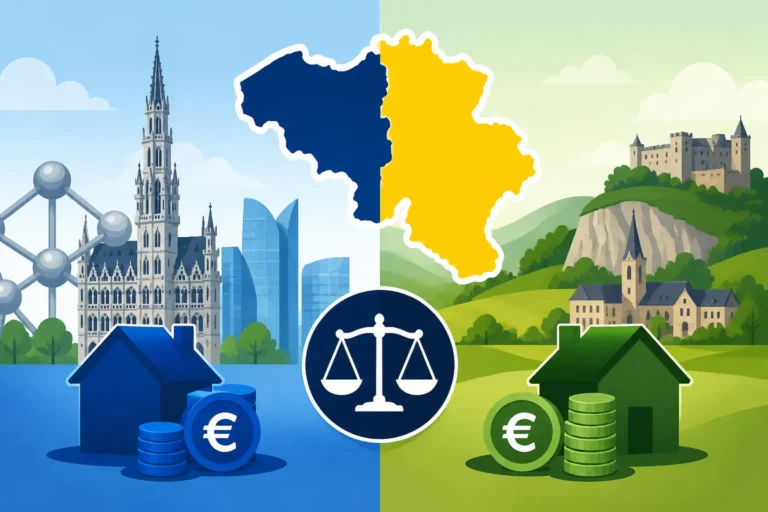
The biggest chunk of this extra cash goes to "droits d'enregistrement" (registration duties). These vary wildly depending on which region you are buying in. In Flanders, for your first home, this was recently lowered to 3%, but in Brussels and Wallonia, it remains a staggering 12.5% for most properties. This creates a massive disparity in how much cash an expat needs. A €300,000 apartment in Brussels requires significantly more upfront liquidity than the same priced home in the suburbs of Antwerp.
To help visualize this, let’s look at a typical scenario for an expat buying a €350,000 home.
| Expense Category | Flanders (3% Duty) | Brussels (12.5% Duty) |
|---|---|---|
| Down Payment (10%) | €35,000 | €35,000 |
| Registration Duties | €10,500 | €43,750 |
| Notary Fees (Approx) | €4,500 | €4,500 |
| Administrative Costs | €1,500 | €1,500 |
| Total Cash Needed | €51,500 | €84,750 |
As you can see from the table, the "down payment" is just the beginning. The regional difference is huge. If you are looking in the capital, you definitely need to read up on The Brussels Abattement: Tax Discount on Your First Home, which can save you a significant amount on those registration duties if the property is under a certain price threshold.
Notary Fees and Administrative Hurdles
The notary in Belgium isn't just someone who signs a paper; they are a central figure in the transaction. You will pay for two different deeds: the "acte d'achat" (the purchase deed) and the "acte de crédit" (the mortgage deed). Each comes with its own set of fees and taxes. You can find a detailed breakdown in Notary Fees and Registration Duties When Buying a Belgian House.
Additionally, there are smaller fees that add up. The bank will charge an "ouverture de dossier" (file opening fee), usually around €500 to €700. There is also the "expertise" fee I mentioned earlier, which usually costs between €250 and €400. You’ll also need to prove your identity and address history, often using Itsme Authentication: How to Set Up Belgium's Vital Digital ID to access your digital records on MyHealth.belgium.be Guide: Accessing Your Medical Records Online or the finance portal.
The Impact of Energy Ratings (EPC/PEB)
In 2026, the energy efficiency of a house is no longer just a "nice to have"—it’s a financial requirement. Properties with poor EPC (Flanders) or PEB (Brussels/Wallonia) ratings of E, F, or G are increasingly difficult to finance. Banks are now required to factor in the cost of mandatory renovations to bring the property up to a better energy standard.
If you buy a "fixer-upper" with a bad energy rating, the bank might approve your 10% or 20% down payment on the purchase price, but they may refuse to lend you the money for renovations unless you have even more cash as a buffer. This is a critical part of Buying Property vs Renting in Belgium: Financial 2026 Comparison that many expats ignore until they are already in the negotiation phase. Always ask for the energy certificate before you sign anything.
Proving Your Financial Solvency to a Belgian Bank
When you sit down with a bank like Belfius or KBC, they are going to want to see a clear "audit trail" of where your down payment came from. This is where many expats run into trouble with anti-money laundering (AML) laws. If your down payment is coming from an inheritance in your home country or the sale of a property abroad, you need to have the paperwork ready and translated.
I found that the easiest way to manage this was by consolidating my funds into a single European account a few months before I started house hunting. If you are moving large sums of money from the UK, US, or India, using Wise can save you thousands in exchange rate markups compared to traditional bank transfers. You will need to provide Wise statements to the bank to show the origin of the funds. They are very sensitive about large, unexplained deposits that suddenly appear in your account right before a mortgage application.
Handling Foreign Income and Assets
If part of your income comes from abroad—perhaps you have a rental property in your home country or receive dividends—Belgian banks will usually only "count" about 70% to 80% of that income toward your debt-to-income ratio. They want to see that your Belgian salary alone can cover the mortgage payments.
Furthermore, you are legally required to declare all foreign bank accounts to the National Bank of Belgium (NBB) and in your annual tax return. If you haven't been doing this, and the bank sees transfers from an undeclared account, your mortgage application will likely be rejected immediately. Make sure you understand How to File Your Income Tax via Tax-on-web (MyMinfin) and have properly declared your international holdings before you start the mortgage process.
The Importance of the Compromis de Vente
In Belgium, once you sign the What is the 'Compromis de Vente' When Buying Belgian Property?, you are legally committed to the purchase. There is usually a "suspensive condition" (clause suspensive) that allows you to back out if you can't get a mortgage, but you only have a limited window—typically 3 to 4 weeks—to get bank approval.
Because the down payment is so high, you must have your "accord de principe" (agreement in principle) from the bank before you even think about signing a compromis. If you sign and then realize you can only get an 80% loan but you only have cash for a 90% loan, you could lose your 10% deposit (the "acompte") as a penalty. This is a heart-wrenching mistake I've seen expats make far too often.
Practical Tips for Saving and Negotiating
If you are currently in the "saving phase" of your expat journey, focus on liquidity. While it’s tempting to keep all your money in a high-growth Trade Republic account or even a Binance wallet, Belgian banks prefer to see "boring" stability. About six months before you apply for a mortgage, start moving your down payment funds into a Belgian savings account. This shows the bank that the money is "local" and ready for use.
When it comes time to negotiate, don't just look at the interest rate. Look at the "total cost of credit." Banks will often offer you a lower interest rate if you take their "assurance solde restant dû" (outstanding balance insurance) and their home insurance. However, these "bundled" products can sometimes be more expensive than if you bought them separately. Always do the math.
Shopping Around Beyond the "Big Four"
Don't just stick to the bank where your salary is paid. Often, smaller players like Argenta or VDK offer much better conditions for expats because they are looking to grow their market share. There are also mortgage brokers (courtiers en crédit) who specialize in expat profiles. They know which banks are currently "friendly" to non-EU citizens or those on specific visa types.
For those sending money from abroad to hit that 20% mark, remember to check Sending Money In and Out of Belgium: Remittance and Currency for the most efficient ways to move capital without losing 3% to 5% in hidden banking fees. Every Euro you save on the transfer is a Euro that goes toward your registration duties.
The Psychological Aspect of the Belgian Deposit
Finally, it’s worth validating that the Belgian system feels "unfair" to many of us. In the UK or the US, a 5% or 10% deposit is standard. Here, being asked for €80,000 in cash to buy a modest apartment can feel like a personal insult to your financial success. It’s not you—it’s the system. Belgium is a conservative financial environment that prioritizes long-term stability over easy access to credit. Once you accept that you need to be a "saver" before you can be a "buyer," the process becomes much less stressful.
Disclaimer on Financial Information
The information provided in this guide is for educational and informational purposes only and does not constitute professional financial, legal, or investment advice. Mortgage regulations, tax laws, and bank policies in Belgium are subject to frequent changes and may vary based on your individual residency status, nationality, and financial profile. Always consult with a qualified financial advisor, a certified mortgage broker, or a legal professional (notary) before making significant financial commitments or signing property contracts in Belgium.
By following these steps and preparing your capital well in advance, you can move from being a frustrated renter to a confident homeowner in one of Europe's most stable property markets. Good luck—the first "apéro" on your new terrace will make all the paperwork worth it!