Mobile Phone Plans: Prepaid vs Subscriptions (Orange, Base, Proximus)
Getting off the plane at Zaventem or arriving at Brussels-Midi with a heavy suitcase is stressful enough without realizing your phone has no data and you cannot call a taxi. I remember standing in a brightly lit mobile shop in the city center, clutching my passport, only to be told I couldn't get a monthly plan without a Belgian bank account and an eID. This guide solves the "connectivity catch-22" by breaking down the best prepaid and subscription options to get you online immediately.
The Belgian Telecom Landscape: Why It Feels So Complicated
Belgium’s telecommunications market is often a shock to expats coming from the US, UK, or even neighboring France. If you are used to incredibly cheap "all-you-can-eat" data plans for ten euros, prepare for a bit of a reality check. The market is dominated by a few major players, and while competition is increasing, prices remain relatively high. Understanding the hierarchy of these companies is the first step to ensuring you don't overpay for a service that doesn't reach your fourth-floor apartment.
Understanding the Big Three: Proximus, Orange, and Telenet/Base
Proximus is the state-owned incumbent, much like BT in the UK or AT&T in the States. They generally have the most robust infrastructure and the widest 5G coverage, but they also tend to be the most expensive. Orange Belgium, formerly Mobistar, is the primary challenger, often offering better "fun" perks and roaming deals. Then there is Base, which is owned by Telenet (the big cable provider in Flanders). Base has traditionally marketed itself toward the younger crowd and those who want flexibility, often providing some of the best value for data-hungry users.
When you are looking for a place to stay through a platform like HousingAnywhere, you might notice that some neighborhoods have better reception for certain providers than others. In Brussels, for instance, the thick stone walls of old Ixelles townhouses can be a nightmare for signal. It is always worth asking your future landlord which provider they use for their own mobile or if there is a known "dead zone" in the building before you commit to a long-term contract.
Why the eID is Your Biggest Hurdle
In Belgium, your identity is tied to your Electronic Identity Card (eID). For a veteran expat, the eID is both a blessing and a curse. To get a standard monthly subscription, almost every provider will ask for this card to run a credit check and verify your address. If you are still waiting for your Registering at the Commune: The 8-Day Rule After Arrival, you might find yourself stuck in a loop where shops refuse to give you a contract.
This is where many newcomers fail. They walk into a store with just a passport and are turned away. If you don't have your eID yet, you should look into Setting Up Itsme While Waiting for Your Physical eID Card because some digital-first providers might accept the temporary paper "Annex" you receive from the commune, provided you have a Belgian IBAN. If you have neither, prepaid is your only legal route for the first few weeks.
Regional Nuances: Flanders vs Wallonia vs Brussels
While the major mobile providers operate nationwide, the marketing and "bundles" can feel very regional. Telenet is the king of Flanders, while VOO is the dominant force in Wallonia and parts of Brussels. If you plan on eventually getting a "Pack" (mobile, internet, and TV), your choice of mobile provider might be dictated by which cable company serves your specific street.
The Utilities and Home Setup: Electricity, Water, Gas, and Internet in your new home will often be cheaper if you bundle your mobile phone with your home Wi-Fi. However, as a new arrival, I highly recommend keeping these separate for the first six months. It gives you the freedom to move apartments or switch providers without the headache of unbundling a complex multi-service contract while you are still figuring out the Cost of Living in Belgium 2026: Budgeting for Cities and Families.
Prepaid SIM Cards: The Freedom of Pay-As-You-Go
For the first-month survivor, the prepaid SIM card is your best friend. It requires no long-term commitment, no Belgian bank account (usually), and can be topped up at supermarkets, newsstands, or online. However, there is a catch that catches many tourists off guard: the mandatory registration law.
Who is Prepaid Actually For
Prepaid is ideal for the "in-betweeners." If you are a student here for a single semester, a freelancer testing the waters, or an expat waiting for their permanent residence card, prepaid offers the most peace of mind. You won't have to worry about a surprise 80-euro bill because you accidentally watched too much YouTube on the train to Bruges.
I personally used a prepaid card for my first three months because I wasn't sure if I would stay in Brussels or move to Antwerp. It allowed me to control my budget tightly while I was still dealing with the high initial costs of Renting in Belgium: Apartments, Contracts, and Tenant Rights (2027). Once you have your feet on the ground, you can easily port that same number over to a subscription.
The Identification Law: No More Anonymous SIMs
Since late 2016, Belgium has banned anonymous prepaid SIM cards for security reasons. This means you cannot just buy a card at a Night Shop and start texting. You must "identify" yourself. This can be done in-store by scanning your passport or eID, or online using a Belgian bank app or a card reader.
If you are arriving from outside the EU, make sure your phone is unlocked before you get here. You can find affordable unlocked phones or even card readers on Amazon Belgium if you need to set up your digital ID at home. If you try to bypass the registration, the SIM simply won't activate, and you'll be out of ten or fifteen euros.
Topping Up and Expiry Traps
The biggest frustration with Belgian prepaid cards is the "validity period." Usually, when you top up fifteen euros, your "bonus" data or minutes are only valid for 30 days. After that, you still keep your money (the credit), but you lose the free data. If you forget to top up on day 31, your phone will start eating your actual cash credit at an incredibly high rate per megabyte.
Many expats find themselves with zero balance within hours because their background apps updated while they weren't on Wi-Fi. To avoid this, always set an alarm for 28 days after your last top-up. Most providers like Orange and Proximus have decent apps where you can see exactly how many megabytes you have left. If you are struggling with the local languages, most of these apps now have an English toggle, which is a lifesaver in those first few weeks.
Monthly Subscriptions: Data, Perks, and Contracts
Once you have your eID and a Belgian bank account, the world of subscriptions (post-paid) opens up. This is where you get the most data for your money and, crucially, the ability to use "Itsme," the digital identity app that is essential for everything from checking your taxes to seeing your MyHealth.belgium.be Guide: Accessing Your Medical Records Online.
Post-paid Advantages for Residents
The primary advantage of a subscription is "set it and forget it." Your bill is paid via a "domiciliation" (direct debit), meaning you never run out of credit mid-call. Furthermore, the "Fair Use Policy" for data on subscriptions is generally much more generous than on prepaid. In 2026, many "unlimited" plans in Belgium actually give you about 50GB to 300GB of full-speed data before throttling you, which is plenty for most users.
Another perk is the "Joint Offer." You might see deals where you get a brand-new iPhone or Samsung for a fraction of the price if you sign a 24-month "Data Phone" contract. Be very careful here. These are essentially loans. If you decide to leave Belgium before the 24 months are up, you will have to pay back the remaining value of the phone in one lump sum. For many expats, it is better to buy a phone outright from Amazon Belgium and stick to a SIM-only plan.
Common Contract Lengths and Exit Rules
The good news is that Belgian law is quite protective of consumers regarding contract duration. For SIM-only plans, you are usually not "locked in" for years. You can generally cancel your plan with one month's notice without a penalty. This was a huge win for the expat community, as it meant we were no longer terrified of signing a document in a language we didn't fully understand.
However, "canceling" and "porting" are two different things. If you want to keep your number and move to a different provider, do NOT cancel your current contract. Instead, go to the new provider and tell them you want to port your number. They will handle the cancellation of the old one for you. If you cancel it yourself first, your number goes back into the "pool," and it is nearly impossible to get back.
Bundling with Home Internet and TV
If you are staying in a long-term rental found through HousingAnywhere, you will eventually need home Wi-Fi. This is where bundling becomes powerful. Proximus offers "Flex" plans, and Orange has "Love" packages. These can save you between 10 and 20 euros a month compared to buying services separately.
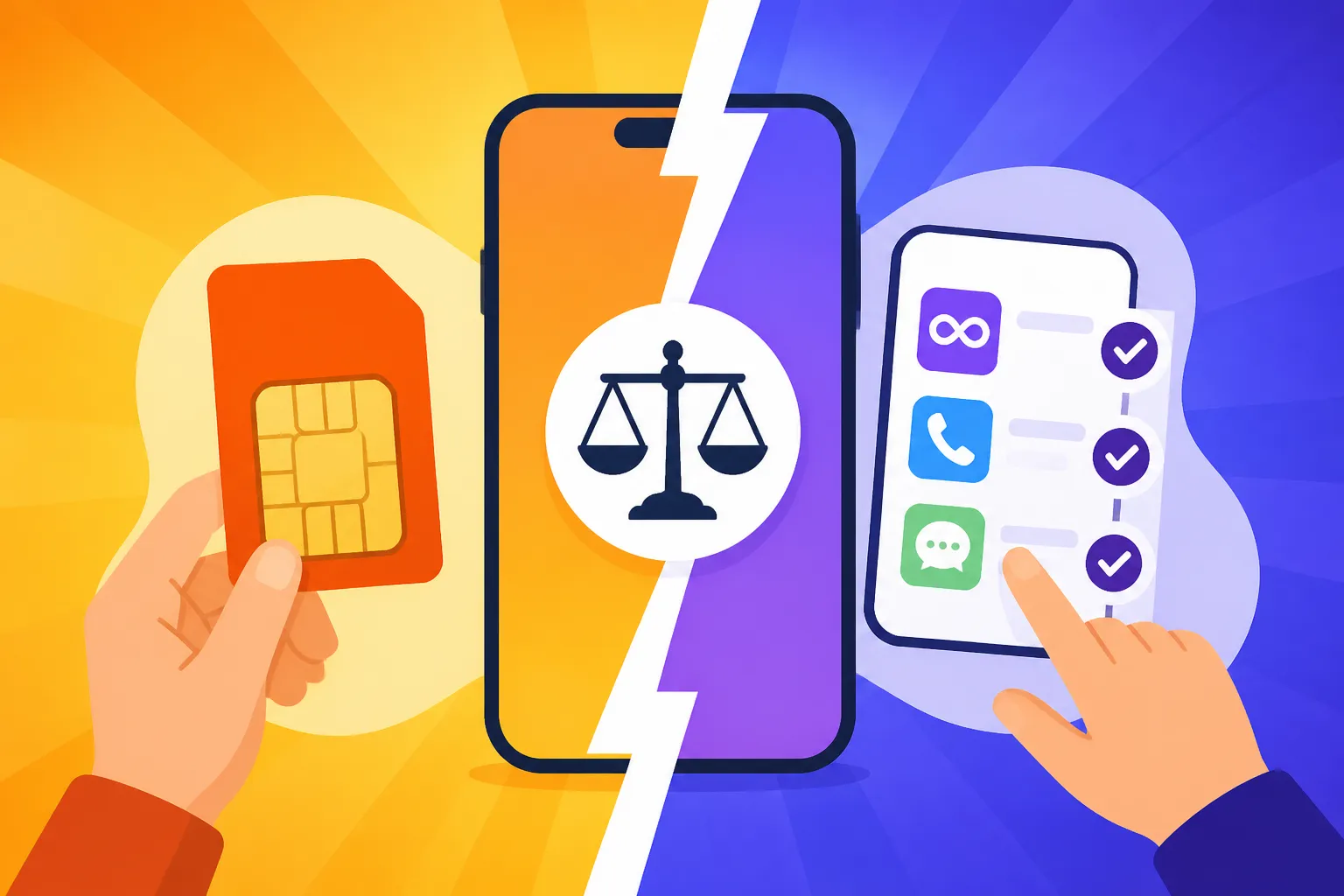
| Feature | Prepaid | Monthly Subscription |
|---|---|---|
| Commitment | None | 1 month (usually) |
| Payment | In advance (Top-up) | Monthly invoice (Direct Debit) |
| ID Required | Passport or eID | eID + Belgian Bank Account |
| Data Cost | Higher per GB | Lower per GB |
| Roaming | EU included | EU + sometimes extra perks |
| Best For | New arrivals, students | Long-term residents, professionals |
Comparing the Major Providers: Proximus vs Orange vs Base
Choosing between the big three often comes down to where you live and how much data you consume. Each has its own personality and "hidden" benefits that might not be obvious from a simple price comparison.
Proximus: The Premium Incumbent
If you want the most reliable coverage in the Ardennes or on a high-speed train to London, Proximus is usually the winner. They have invested heavily in 5G and fiber. Their customer service is available in English, which is a major plus for expats. However, you pay for that privilege. Their plans are consistently a few euros more expensive than the competition.
One hidden benefit of Proximus is their "Public Wi-Fi" network. As a subscriber, your phone will automatically connect to "Proximus Public Wi-Fi" hotspots found in cafes and public buildings across the country. This can save your mobile data allowance significantly if you spend a lot of time working from cafes while waiting for your Finding English-Speaking Therapy and Counseling in Belgium session or a business meeting.
Orange: The Middle Ground
Orange Belgium is often the favorite for expats because they offer a great balance of price and performance. Their "Go" plans are straightforward. One of their unique selling points is the "Orange Thank You" program, which gives you free movie tickets or extra data "just because."
Orange also has a very strong roaming footprint. If you travel frequently back to your home country or across the EU, their network handovers are generally very smooth. I have found their store staff in major cities like Brussels and Antwerp to be very accustomed to dealing with foreigners, making the sign-up process slightly less intimidating than at the more "traditional" Proximus outlets.
Base: The Value King for Data
Base (Telenet) is excellent if you just want raw data and don't care about "fancy" extras. One of their best features is "Data Free," where certain apps (like Spotify or social media) don't count against your data limit on specific plans. They also have a unique feature where your unused data "rolls over" to the next month, which is surprisingly rare in the Belgian market.
The downside to Base can be their indoor coverage in some parts of Wallonia. While it has improved massively, if you are living in a rural farmhouse in the south, you might find the signal a bit patchy compared to Proximus. But for city dwellers in Ghent, Leuven, or Antwerp, Base is often the smartest financial choice for a mobile plan.
Modern Alternatives: MVNOs and eSIMs for Expats
In the last few years, the "Mobile Virtual Network Operators" (MVNOs) have shaken up the market. These are companies that don't own their own towers but "rent" space from the big three. They are almost always cheaper and more digital-friendly.
Mobile Vikings and Hey Telecom
Mobile Vikings is a cult favorite in Belgium. They started as a data-only provider for geeks and have grown into a massive brand. They run on the Proximus network but offer much more flexible plans. You can "pay" for your phone credit by shopping online through their partner links—it sounds gimmicky, but the "Viking Points" really do add up and can make your phone bill essentially zero.
Hey Telecom is Orange’s "budget" digital brand. It is 100% online, meaning you won't find a Hey store. This makes it a bit tricky if you have a problem and want to talk to a human, but the prices are unbeatable. They often have promotions where your data allowance doubles after you’ve been a customer for six months. It is a great option once you have your Standard vs Bi-Hourly Electricity Meters: Day and Night Tariffs and other home basics sorted and are looking to trim your monthly budget.
Airalo and the Travel SIM Strategy
If you are just landing and need data for 48 hours to find your way to your HousingAnywhere apartment, an eSIM from Airalo is a game-changer. You can buy a small 1GB or 3GB pack before you even leave your home country. As soon as your plane touches down, your phone connects to a local Belgian network.
This buys you time. You won't feel pressured to run into the first shop you see at the airport (where prices are often higher). You can use that Airalo data to navigate the STIB/MIVB Airport Line: Cheapest Way from Zaventem to City Center and get to your accommodation. Once you're settled and have a coffee in hand, you can then decide which local provider fits your long-term needs.
Ordering Gear via Amazon Belgium
If you decide to go with a digital-only provider like Mobile Vikings or Hey, you will need to handle your own hardware. Many expats arrive with "locked" phones from their home country carriers (especially those from the US). If you realize your phone won't accept a Belgian SIM, don't panic. You can order a budget-friendly, unlocked Android or an older iPhone model from Amazon Belgium and have it delivered to a "Point Relais" or your new home within 24 hours. This is often much cheaper than buying a phone at a physical retail store in the city center.
Practical Steps to Getting Connected
Knowing which plan you want is only half the battle. The actual "act" of getting the SIM card and making sure it works can be a bureaucratic dance. Here is the "veteran" way to do it without losing your mind.
What Documents You Really Need
Don't just walk in with a smile. If you are going for a subscription, have a folder (physical or digital) ready. You will need your passport, your Belgian eID (or the Annex 15/Annex 8 paper), and proof of a Belgian bank account. Some shops also ask for a "proof of residence," which could be your signed lease agreement.
If you are a student, bring your university enrollment letter. Many providers have "Under 26" deals that are significantly cheaper but require proof of age and student status. If you are still waiting for your bank account to be opened, check out Opening a Belgian Bank Account: Documents Needed and Roadblocks to understand why that might be the bottleneck in your phone setup.
Keeping Your Number (Portability)
As mentioned, keeping your number is a legal right in Belgium. When you sign up for a new plan, the clerk will ask for your "SIM card number" (the long string of digits on the back of the card) and your current account number. The transfer usually takes between 2 hours and one business day.
During the switch, your old SIM will suddenly stop working. That is your cue to pop the new one in. If you are switching from a foreign number (e.g., a French or German number) to a Belgian one, "porting" doesn't work across borders. You will get a brand new Belgian number (+32). Be prepared to spend an hour updating your 2FA settings for your bank, email, and Everyday Rules in Belgium: Garbage Sorting, Noise, and Etiquette reminders.
Avoiding Roaming and International Call Shocks
Since 2017, "Roam Like at Home" has been the law in the EU. This means you can use your Belgian data in Spain, Italy, or Germany at no extra cost. However, there is a massive trap: calling from Belgium to another country is not roaming; it’s an international call.
If you use your Belgian SIM to call your mom in London or New York, you could be charged 1 euro per minute or more. Always use WhatsApp, FaceTime, or Telegram for international calls. Even calling a neighboring country like France from your Belgian mobile can be expensive unless you have a specific "International" add-on. I learned this the hard way after a "quick" 20-minute call to a friend in Paris resulted in a 15-euro surprise on my bill.
Disclaimer
The information provided in this guide is based on the author's personal experience as an expat in Belgium and was accurate at the time of writing. Telecommunication laws, pricing, and provider offerings in Belgium are subject to change by the BIPT (Belgian Institute for Postal Services and Telecommunications). Always verify the current terms and conditions with your chosen provider before signing any binding contract. This guide is for informational purposes only and does not constitute financial or legal advice.