Sick Leave in Belgium: Medical Certificates and Informing Employers
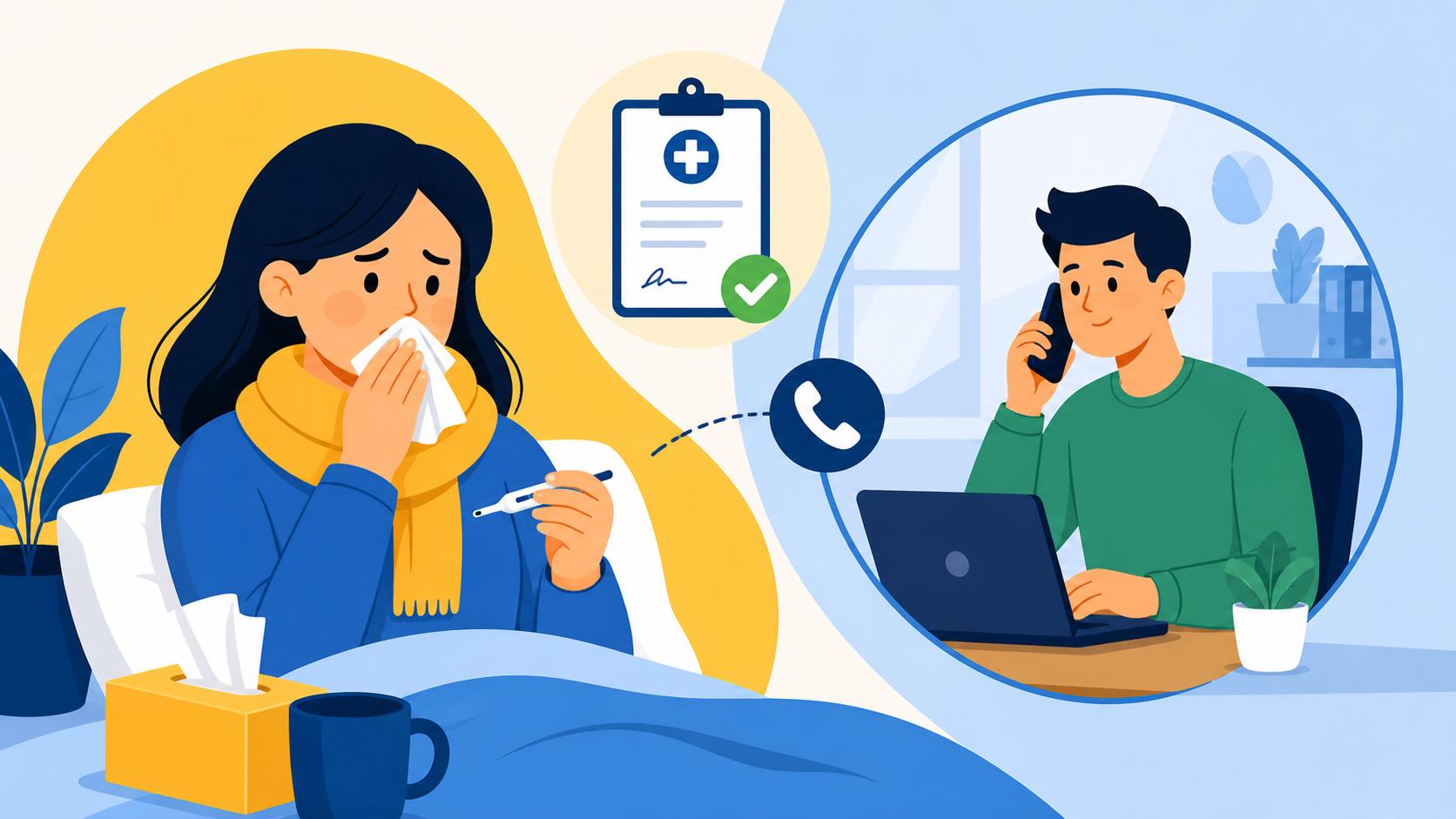
Waking up with a pounding headache or a fever in a foreign country is stressful enough without worrying about your employment contract. I remember lying in my bed in Ixelles during my first winter, terrified that missing one day without the right paperwork would jeopardize my residency. This guide explains the Belgian sick leave system, how to obtain medical certificates, and how to communicate with your employer to stay legally protected.
Immediate Steps: What to Do When You Can't Work
The first few hours of your illness are the most critical from a legal perspective. In Belgium, the law is quite strict regarding the "duty of notification." As an employee, you are obligated to inform your employer of your incapacity to work as soon as possible. This isn't just about professional courtesy; it is a legal requirement that triggers your right to a guaranteed salary. If you fail to notify them promptly, your employer might technically be within their rights to consider your absence as "unjustified," which can lead to a loss of pay for those days.
I always suggest checking your specific employment contract or the "work regulations" (règlement de travail/arbeidsreglement) provided when you were hired. Some companies are very relaxed and only require a quick message, while others have a rigid protocol, such as calling a specific HR hotline before 9:00 AM. Even if your boss is your friend, send a formal email or a text message as well. This creates a paper trail that proves you fulfilled your duty of immediate notification. If you are dealing with a severe medical emergency, this rule can be slightly relaxed under the principle of "force majeure," but you should still aim to have a family member or friend reach out on your behalf.
When you send that initial notification, you don't need to provide a diagnosis. In fact, under Belgian privacy laws, you are not required to tell your boss why you are sick (e.g., "I have the flu" or "I have a migraine"). You only need to state that you are unable to work and, if possible, give an estimate of how long you think you will be out. This protects your medical privacy while allowing the company to manage their workflow. If you are looking for supplements to support your immune system during these early stages, checking out iHerb can be a great way to have wellness products delivered directly to your door in Belgium.
The Medical Certificate (Certificat Médical / Medisch Attest)
The "certificat médical" (French) or "medisch attest" (Dutch) is the holy grail of Belgian sick leave. This is the document issued by a doctor that officially confirms your inability to work. While the notification is your first duty, the certificate is your proof. It generally includes the date the illness started, the expected end date, and whether or not you are allowed to leave your house (which is relevant for the "control doctor" visit, discussed later).
For most Belgian companies, a medical certificate is mandatory for any absence of two days or more. However, many employers exercise their right to demand a certificate even for a one-day absence. This is often where expats get caught out. I’ve seen many newcomers stay home for a single day thinking they’ll "just sleep it off," only to find out later that their HR department requires a note for every single hour missed. You should refer to Getting a Sick Note (Certificat Médical) for a 1-Day Absence to understand the nuances of these short-term requirements.
To get this note, you must see a doctor. If you haven't yet settled into a routine, Choosing Your First GP (General Practitioner) in Belgium is your first step. During the consultation, the doctor will ask about your symptoms and determine if you are fit for work. If they decide you need rest, they will print the certificate or, more commonly now, use the digital "eAttest" system. You must then send this certificate to your employer within the timeframe specified in your contract—usually 48 hours. If you are a non-EU expat or have complex health needs, having a supplemental policy from a provider like Cigna Global can offer peace of mind that goes beyond the standard local coverage.
| Feature | Blue-Collar Workers (Ouvriers) | White-Collar Workers (Employés) |
|---|---|---|
| Notification Requirement | Immediate (Phone/Email) | Immediate (Phone/Email) |
| Certificate Deadline | Usually within 48 hours | Usually within 48 hours |
| Guaranteed Salary (Month 1) | Covered by employer (scales) | 100% covered by employer |
| Payment After Day 31 | Paid by the Mutuelle | Paid by the Mutuelle |
| Control Doctor Visits | Possible from Day 1 | Possible from Day 1 |
Guaranteed Salary and Financial Protection
One of the best things about working in Belgium is the "guaranteed salary" (salaire garanti/gewaarborgd loon). For the first 30 days of your illness, your employer is generally responsible for paying your salary. This ensures that a bout of pneumonia doesn't lead to an immediate financial crisis. However, the exact percentage of your salary you receive during this month depends on whether you are classified as a white-collar worker (employé) or a blue-collar worker (ouvrier).
White-collar workers typically receive 100% of their salary from their employer for the first 30 days. Blue-collar workers have a slightly more complex system where the employer pays a portion, and the social security system covers the rest, though it usually totals close to the full amount. This financial safety net is only activated if you have followed all the rules: notifying the employer on time and providing a medical certificate if requested. If you are still in the process of setting up your local life, make sure you understand Registering for Public Health Insurance: Step-by-Step at Your Commune so that your administrative records are up to date.
It is also important to remember that while your salary might be guaranteed, your medical costs are a separate matter. In Belgium, you pay for your doctor's visit upfront and then claim a portion back from your insurance. Understanding how this works is vital for your monthly budgeting. You should read about Understanding the 75% Reimbursement System for Medical Consultations to avoid any surprises when you see the bill from your GP. Some expats find that the basic reimbursement isn't enough, which is why Private Health Insurance in Belgium: When Do Expats Really Need It? is a common topic of discussion in the community.
The Control Doctor (Médecin Contrôle / Controlearts)
This is the part of the Belgian system that often shocks foreigners. In Belgium, your employer has the legal right to send a "control doctor" to your home to verify that you are actually sick. This isn't necessarily because they don't trust you; it is a standard procedural right used to prevent abuse of the system. The control doctor is not there to treat you or prescribe medication; their only job is to confirm that the duration of sick leave prescribed by your own GP is justified.
If your medical certificate says "stay at home," you must be at your registered residence during specific hours (often mentioned in your work regulations, such as between 10:00 AM and 12:00 PM or 2:00 PM and 4:00 PM). If the certificate says you are "allowed to leave the house," you can go to the pharmacy or the grocery store, but you must still be available for a visit or leave a note explaining where you are. If a control doctor knocks and you aren't there, your employer might refuse to pay your guaranteed salary for the period. For more details on this often-stressful experience, look at Control Doctors (Médecin Contrôle) in Belgium: Employer Checks on Sick Leave.
If the control doctor disagrees with your GP—for example, if your GP gave you 10 days but the control doctor thinks you are fit to return after 5—there is a dispute resolution process. Usually, a third "arbitration doctor" is called in to make a final decision. It is quite a formal process, and it emphasizes why you should always be honest about your condition. If you need to stock up on basic over-the-counter remedies while you're confined to the house, iHerb is an excellent resource for ordering vitamins and health essentials that might not be available at your local "apotheek."
Long-Term Illness and Mutuelle Involvement
If your illness lasts longer than 30 days, the responsibility for your income shifts from your employer to your "Mutuelle" (Mutualité/Ziekenfonds). This is the public health insurance fund you must join when you start working in Belgium. After the initial "guaranteed salary" month ends, you enter a period of "primary incapacity." During this time, the Mutuelle will pay you a "replacement income," which is typically around 60% of your gross salary (capped at a certain threshold).
To transition to Mutuelle payments, you and your doctor must fill out a specific form called the "Confidential" (Getuigschrift van arbeidsongeschiktheid). This form is sent directly to the medical advisor of your Mutuelle. It is absolutely vital that you have already completed your registration with a fund like Partena, CM, or Solidaris. If you haven't done this yet, you must read the Mutuelle and Ziekenfonds: Public Health Insurance Registration Guide immediately. Without this registration, you will not receive any payments after the first 30 days.
Long-term leave isn't just for physical injuries. The Belgian system increasingly recognizes mental health struggles as a valid reason for extended sick leave. If you are feeling the weight of the "grey" Belgian winters or the pressure of a high-stakes expat job, you are not alone. There is a specific legal framework for Burnout Leave in Belgium: Medical Diagnosis and Employment Protection that allows you the time to recover without losing your job. During these periods, international health plans from Cigna Global can be particularly helpful if you wish to seek specialized therapy in your native language.
Practical Tips for a Smooth Recovery
Once the administrative hurdles are cleared, your main job is to get better. This involves navigating the Belgian pharmaceutical system, which can be different from what you're used to back home. Most medications that require a prescription in Belgium are strictly controlled. You cannot simply walk into a pharmacy and ask for strong painkillers or antibiotics without a note from your GP. You can find more information on this in Pharmacies and Medication in Belgium: Prescriptions and OTC Rules.
I also highly recommend embracing the digital side of Belgian healthcare. Most doctors now use digital platforms to send your certificates directly to your Mutuelle, and many companies allow you to upload your notes via an HR portal like Workday or SD Worx. This reduces the risk of documents getting lost in the mail. If you're feeling particularly unwell and can't make it to a clinic, some doctors offer tele-consultations, though these are usually for follow-ups rather than initial sick notes.
Finally, remember that the goal of the Belgian system is social security. It is built on the idea that a worker should not be penalized for falling ill. As long as you are proactive—notifying your employer immediately, seeing a doctor the same day, and keeping your Mutuelle registration in order—you are protected. If you are still unsure about the basics of the system, I recommend checking Is Health Insurance Mandatory for Foreigners in Belgium? to ensure you are fully compliant with local laws. Recovery is much faster when you aren't worried about whether you'll still have a job or a paycheck at the end of the month.
Legal Disclaimer
The information provided in this article is for general informational purposes only and does not constitute legal, financial, or medical advice. Belgian labor laws and social security regulations are subject to frequent changes and may vary based on individual employment contracts or Joint Committee (Commission Paritaire) agreements. Always consult with a qualified legal professional, your HR department, or your labor union for advice specific to your situation. Use of the mentioned brands is at the user's discretion.